Why Does Weed Make Music Sound Better?
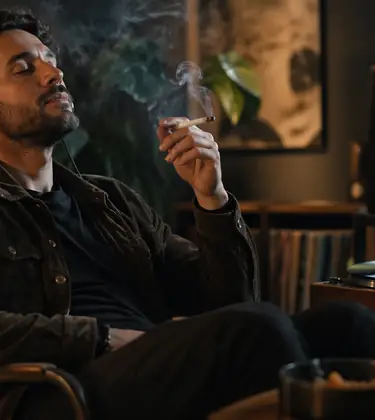
You've felt it. You light up, press play, and suddenly the bass is three-dimensional, that cymbal you never noticed is running the song, and lyrics you've heard a thousand times land like they were written for this exact moment.
You're not making it up. People have been saying music sounds better high since before the word stoner existed, and neurologists, music psychologists, and jazz historians all keep backing up the claim.
Here's what's actually going on in your brain when weed and music collide, plus why this pairing has been driving culture forward for over a century.
What Does the Science Actually Say?
In a 2025 study, 104 recreational cannabis users reported significantly greater hearing sensitivity and deeper musical absorption while high compared to sober. Listening to music was the single most common thing people did while high, reported by 45% of them. That's more than watching TV, more than eating, more than socializing.
The researchers pulled out four themes from the interviews: altered thinking patterns, new auditory sensations, emotional openness, and the feeling of being completely immersed inside the sound. That last one, absorption, is a measurable psychological trait that predicts how deeply someone gets lost in music. Weed amplifies it.
Brain imaging work lines up with that. In a controlled fMRI experiment, cannabis increased participants' desire to listen to music and enhanced their subjective sound perception compared to a placebo. The effect showed up whether the cannabis contained CBD or not.
Translation: every stoned conversation you've had about how wild an album sounds is backed by peer-reviewed data.
Weed Warps Time, and Music Is Made of Time
Music lives inside rhythm, tempo, and the spaces between notes. Change how you perceive time, and you change how you hear music.
Cannabis is well-documented as doing exactly that. Laboratory studies in both humans and animals have confirmed that cannabis slows the perception of time, with most users reporting that intervals feel longer than they really are. Your internal clock stretches out, giving your brain more room to register what's happening inside a song.
For a listener, that extra breathing room means more grace notes, more texture, more of the negative space that producers spend years obsessing over. It's why a guitar solo can feel like it's happening in slow motion even at normal tempo, and why a four-minute song can feel like a full short film.
This is the same effect jazz soloists swore by for decades. They weren't just chilled out. They were playing inside a slightly stretched version of reality where more notes fit between the beats.
Short-Term Memory Lapses, Long-Term Vibes
THC does a number on short-term memory. That sounds like a disadvantage. For a music listener, it turns into a feature.
When you can't easily hold onto the last few bars or predict what's coming next, you stop mentally racing through the song and start living inside each note. Your brain gives up on anticipation and settles into pure presence. Music psychologists have described this as a time-standing-still phenomenon, where life keeps moving but the track you're in feels suspended.
That's why a song you've played to death can hit like a brand-new release at 10:47 p.m. on a Tuesday with a joint burning in the ashtray. Your usual pattern-recognition brain takes a break, your expectation engine goes quiet, and the only thing left is the song happening to you right now.
Feeling lost on how to start? Try taking our quiz!
Start a QuizWhen You Start Feeling Music With Your Whole Body
Ever caught yourself thinking a guitar solo had a color? Or that a bassline felt physical, like it was happening on your skin and not in your ears?
That's mild synesthesia, a crossing over between senses that researchers have linked to THC. The effect isn't full-blown hallucination. It's more like the borders between your sensory systems getting a little fuzzy and letting information leak from one channel into another.
For a music listener, this turns a three-minute track into a full-body event. The snare has a shape. The vocals have a temperature. The drop has weight. Your brain is still processing sound, but it's decorating that sound with input from other senses it usually keeps separate.
If you've ever put on a record high and felt like you climbed inside the speakers, now you know why.
The unexamined day is a wasted opportunity. Reflect on what you did, what you learned, and how you can improve.
John Dewey
The Jazz Vipers Figured This Out First
Long before anyone put a cannabis user inside an fMRI machine, jazz musicians in 1920s New York had the formula nailed down. They called themselves vipers, named after the hissing sound of a deep pull on a joint, and they gathered in tea pads across Harlem to smoke and play.
Louis Armstrong was the most famous viper of them all. He first tried cannabis in the 1920s and used it before performances and recordings throughout his career. Cab Calloway recorded outright tributes like "Reefer Man," and blues singer Trixie Smith dropped "Jack, I'm Mellow."
Those musicians weren't smoking just to unwind. They were using the time-stretch, the focus, and the lowered inhibitions to push improvisation into places it had never gone. Bebop, hard bop, and every wild saxophone run you've ever loved owe something to that culture.
The government noticed. Harry Anslinger, the first commissioner of the Federal Bureau of Narcotics, ran an explicit campaign to tie cannabis to jazz and to Black musicians as an excuse for mass arrests. He sent letters to his agents instructing them to gather cases against musicians for a coordinated national round-up. Armstrong himself did nine days in a Los Angeles jail after getting caught smoking in a parking lot. The War on Drugs tried to erase the whole scene. The music outlived the war.
Why the Strain You Pick Actually Matters
Here's where most articles stop. It's also where Barney's Farm has something to add after 30+ years of breeding in Amsterdam.
Cannabis does not hit the same way across the board, and it does not pair with music the same way across the board. The difference comes down to the plant's terpene and cannabinoid profile, which is what we've spent decades refining.
Strains heavy in limonene lean bright and uplifting, which works for funk, disco, house, or anything you want to move to. Myrcene-dominant plants lean relaxed and couch-locked, which is why they match so well with ambient, dub, slow jazz, and late-night hip-hop. Caryophyllene adds a peppery kick and a body-focused calm that lets heavier genres like psychedelic rock, doom metal, and stoner rock hit exactly where they need to hit.
Our LSD strain, one of the oldest favorites in the catalog, leans trippy and cerebral and practically demands headphones and a full album with no skipping. Super Boof, with its fruity punch and higher THC, works better for festivals, speaker systems, and a room full of people.
If you want music to hit harder, be intentional about the flower. Terpenes are not just flavor. They steer the entire experience.
How to Get the Most Out of a Stoned Listening Session
A few things we've picked up across decades of coffee shop conversations, Cannabis Cup wins, and customers who live for this exact ritual:
Pick music that can take it. Songs with depth, layering, and space respond better to a stoned ear than songs that rely on volume alone. Put on something with production you can get lost in.
Respect the dose. Past a certain point, music stops being a pleasure and starts being overwhelming. A little less than you think is usually more. Sensory overload is a real thing and it ruins the session.
Use headphones at least once. If you've never listened to a full album high, on decent headphones, alone, in the dark, do it soon. That's the experiment every music fan owes themselves.
Match the strain to the mood. Sativa for daytime playlists and dance music, indica for nighttime sound baths and deep listening. Read the flower, not just the packaging.
Ditch the phone. Scrolling while you listen kills half the effect. The time-stretch, the focus, the immersion, none of it lands if you're also checking notifications. Let the music be the thing you're doing.
The Short Answer
Weed makes music sound better because it stretches your perception of time, narrows your attention, blurs the line between your senses, and clears out the mental chatter that usually keeps you from really listening.
Scientists are still working on the fine print. The vipers had the headline covered 100 years ago. Every generation since has added proof, one album at a time.
Barney's Farm has been developing premium cannabis genetics since the 1980s, with over 40 Cannabis Cup wins. Explore our full cannabis seed catalog and find strains bred for every climate and skill level.