What Are Moon Rocks and Are They Actually Worth the Price?

Somewhere in the last decade, a bud dipped in hash oil and rolled in kief acquired a name, a mythology and a price tag three times higher than the flower it was made from.
The mythology says 50% THC. Nobody has published a lab result on them. Not one.
This guide covers what moon rocks actually are, where the technique really came from, what the potency claim is worth, what the research says about whether extra strength gets you anywhere, and what you should be more worried about than THC percentage.
What a moon rock actually is
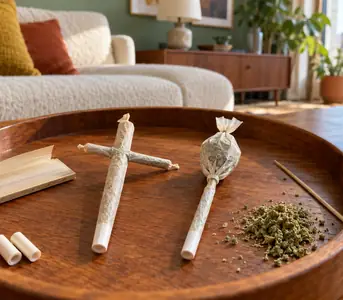
Three components, assembled by hand. You start with a cured bud. You coat it in cannabis concentrate, usually a hash oil warmed enough to spread. Then you roll the sticky result in kief, the loose trichome powder sifted off dried flower, until the surface is completely coated.
That is the whole product. Flower plus concentrate plus kief, layered instead of blended, so the potency depends entirely on the ratio of the three and the quality of each. There is no standardisation. A moon rock made by one producer has nothing chemically in common with a moon rock made by another beyond the general construction.
The origin story is off by a few years
Popular history credits the rapper Kurupt, who is genuinely associated with the product and has spoken about founding the Moonrocks brand. The claim usually attached to that is that he and a collaborator invented them in the early 1990s.
The paper trail says something more interesting. Denver dispensaries were selling exactly this construction under a different name years before the moon rock label took hold. In March 2012, Westword documented a Denver product built from twelve grams of hand-picked Kosher Kush dipped in fifteen grams of cured nectar and rolled in refined kief, sold as caviar at roughly $150 a gram in cost terms. A 2010 piece from the same paper covered oil-soaked buds selling at $60 a gram.
So the technique is documented, in print, in a legal market, under the name caviar. Whether anyone "invented" it is doubtful. Coating flower in resin is an obvious idea to anyone holding both.
About that 50% number
Every explainer repeats it. Moon rocks are around 50% THC, against 17% to 30% for ordinary flower. Police departments have repeated it. One officer described a moon rock as the equivalent of fifty joints at once.
Here is the problem. No published laboratory dataset measuring moon rocks exists. The figure is arithmetic that somebody did in their head, based on the assumption that mixing 20% flower with 70% concentrate and 50% kief lands somewhere around the middle. It is plausible. It has simply never been tested.
What has been tested is cannabis labelling generally, and the results are not reassuring for anyone buying on a stated percentage. An analysis of 23 samples from ten Colorado dispensaries found that around 70% measured more than 15% below their labelled THC content, with observed THC averaging 14.98% against labels claiming between 20.27% and 24.10%. Some samples held half of what their maximum label promised.
A moon rock is a flower product with concentrate stuck to it. Flower is the category where label inflation has been documented. Nothing about adding a hand-applied coating makes that better.
Feeling lost on how to start? Try taking our quiz!
Start a QuizThe finding that should change how you shop
This is the most useful piece of research on the whole question, and it has nothing to do with moon rocks specifically. Researchers at CU Boulder studied 121 regular cannabis users, comparing flower at 16% or 24% THC against concentrates at 70% or 90%. Blood THC in the concentrate group peaked at more than double the flower group.
And then the subjective intoxication and cognitive impairment were comparable. Everyone showed roughly 11% worse balance, resolving within about an hour. Twice the blood concentration produced the same high.
The lead researcher put it plainly: potency did not track with intoxication. The receptor system appears to saturate. Past a certain point you are paying for a number on a label that your endocannabinoid system has stopped responding to.
If that holds, then the entire premium on a moon rock is a premium on a measurement, not an experience.
The unexamined day is a wasted opportunity. Reflect on what you did, what you learned, and how you can improve.
John Dewey
The price maths
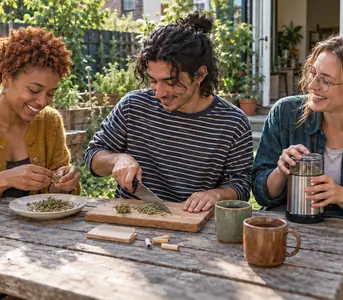
Work out what you are buying and the premium looks stranger. A moon rock is roughly one part flower, some fraction of a gram of concentrate, and a dusting of kief. Buy those three components separately at normal shelf prices and you can assemble the same thing yourself for a fraction of what the finished rock costs. The assembly takes about two minutes and requires a warm knife and a small dish.
There is no processing step you are paying for. No extraction, no curing, no ageing, nothing that requires equipment or expertise. You are paying for someone else having done two minutes of sticky work, plus the word.
The wider infused flower category has the same structure, and it has grown fast. Infused pre-rolls, hash holes, kief-coated joints and moon rocks are all versions of one idea: use concentrate to raise the number on flower that would otherwise sell for less. That is not a criticism of the products, some of which are excellent. It is an observation about why the category exists. Concentrate has been oversupplied and cheap in mature markets for years, and infusing it into flower is the most profitable way to move it.
What you should actually worry about
Potency is the wrong thing to focus on. Contamination is the right thing. A moon rock has an unusually large surface area, a sticky exterior that traps whatever it touches, and a dense interior that takes a long time to dry properly. That combination is a microbiological problem waiting to happen, and infused products have already demonstrated it. In September 2025, a Colorado producer recalled flower and hash-infused pre-rolls for exceeding mould and yeast limits, affecting 172 stores, part of a year in which 465 stores were named in recalls against 333 two years earlier.
Then there is the concentrate itself. A moon rock is only as clean as the oil coating it, and you cannot see residual solvent. When wholesale prices are falling, the incentive to use cheaper extract runs in exactly the wrong direction.
Practical notes if you do buy them. Do not grind one, because the oil and kief will coat the grinder and stay there. Break it by hand. Do not roll one into a joint, because hash oil migrates through rolling paper and the whole thing burns unevenly. Use glass, apply heat gently, and expect a slow uneven burn.
What a resin coating tells you
We look at moon rocks from a slightly different angle, because from a breeding perspective they are a workaround.
The point of dusting a bud in kief is to add trichome coverage the bud did not produce itself. That is worth saying out loud. Kief is not an ingredient, it is resin harvested from other flowers. When someone glues it onto a bud, they are compensating for a plant that did not make enough on its own.
Trichome density is a heritable trait. It is one of the things a breeder selects for over generations, alongside cannabinoid expression, and it is the reason the difference between a well-bred plant and an average one is visible to the naked eye at harvest. A flower carrying its own full resin load does not need a coating, and it will burn evenly, because the resin is distributed through the structure rather than stuck to the outside.
We also publish tested THC ranges on every release, which is the boring version of the moon rock claim and the only version anyone can check. Bruce Banner sits at 32%, from Strawberry Diesel crossed with OG Kush, finishing in 65 to 70 days. LSD runs at 30% across a 60 to 65 day flower, out of Skunk #1 crossed with a Mazar-I-Sharif Afghan indica.
Those are real numbers from a plant that made its own resin. Given what the Colorado impairment data suggests about saturation, they are also already past the point where a higher figure buys you anything.
The short version
Moon rocks are flower dipped in concentrate and rolled in kief. The construction was being sold in Denver as caviar by 2010, before the name existed. The 50% THC claim that justifies the price has never been measured by anyone.
Cannabis labels in general overstate flower potency more often than not, and controlled research shows that doubling blood THC does not double, or even meaningfully increase, how high you get. The real risks are mould and residual solvent, both of which a sticky handmade product is unusually exposed to.
Buy one because you want to try one. Do not buy one because of the number on the tag.
Barney's Farm has been developing premium cannabis genetics since the 1980s, with over 40 Cannabis Cup wins. Explore our full seed catalog and find strains bred for every climate and skill level.