Weed Scales: Why Yours Is Probably Lying to You
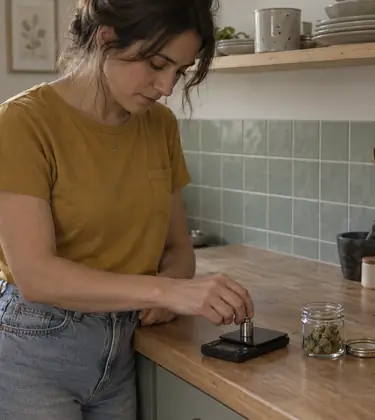
American legal metrology has a name for the last digit on a precision scale. It calls it auxiliary.
That is not a figure of speech. In the national standard, the verified scale division that the law tests against may be up to ten times coarser than the division the display shows you. The final digit exists to be read. It does not exist to be trusted.
Gram scale accuracy is not the same as resolution
A digital scale for weed is an ordinary precision instrument and it fails in ordinary ways. Two different numbers describe it, and the box prints only one.
Resolution is the smallest step the display can show. Accuracy is how close the reading is to the true mass. Handbook 44, the American standard for commercial weighing devices, keeps these separate on purpose: for the higher accuracy classes it states that the value of the verification division shall be greater than the display division and less than or equal to ten times it, and describes the extra digit as an auxiliary indication.
For the lower classes, the ones covering ordinary retail scales, there is no such allowance and the two must be equal. The gap exists precisely where the display looks most precise.
There is also a floor nobody escapes. Rounding to the nearest displayed step contributes an error of half a division at zero and half a division again under load, before a single mechanical fault is counted. A 0.01 gram display therefore starts life with plus or minus 0.005 grams of pure rounding at each end.
What the accuracy classes mean, and what a pocket scale is not
Handbook 44 sorts devices into classes by division size and number of divisions. The relevant boundaries:
- Class II covers devices with divisions of 1 to 50 milligrams and between 100 and 100,000 divisions. Laboratory territory.
- Class III covers divisions of 0.1 to 2 grams with 100 to 10,000 divisions, and this is where retail scales live.
- Class IIII is the coarse end, 100 to 1,200 divisions.
Now take a typical pocket scale sold as 200 grams by 0.01 grams. That is 20,000 divisions, which exceeds the Class III maximum. Its 0.01 gram division is finer than the Class III minimum. On paper the device is claiming Class II laboratory resolution while carrying no class certification at all.
That is not an accusation of fraud. It is the arithmetic of what the numbers on the box describe.
An NTEP Certificate of Conformance is the thing that would settle it, issued after evaluation against Handbook 44, and many states require one before a device can be used commercially. Cheap pocket scales are typically marked not legal for trade, which is a manufacturer telling you the truth in the smallest available type.
How much error is legal, on a scale that passes
The international standard the American one is harmonized with sets maximum permissible errors in verification divisions. For a Class II device weighing in the first band, the permitted error is half a division on initial verification. And there is a rule that surprises people: the maximum permissible errors in service shall be twice the maximum permissible errors on initial verification.
Work that through for a certified 0.1 gram retail scale weighing an eighth, 3.5 grams. It sits at 35 divisions, so the permitted error is 0.05 grams new and 0.1 grams in service. An eighth can be light by around a tenth of a gram on a scale that passes inspection.
That is the legal floor for a certified device. An uncertified pocket scale has no ceiling at all, because nothing tested it.
Feeling lost on how to start? Try taking our quiz!
Start a QuizScale calibration weights, and the one that is worse than your scale
Here is the part that undoes most home calibration. Calibration weights are classified, and the tolerances differ by orders of magnitude. At 200 grams, the maximum permissible error runs from 0.10 milligrams for the finest class down to 100 milligrams for the coarsest, through F1 at 1.0 milligram, F2 at 3.0 and M1 at 10.
There is a rule for choosing between them, and it is a requirement rather than folklore. Calibration standards shall not have an error greater than one third of the maximum permissible error of the instrument for the applied load.
Apply it. A 200 gram by 0.01 gram scale has a display step of 10 milligrams, so the weight should be good to roughly 3 milligrams at 200 grams. That means class F1 comfortably, or F2 at a push. An M1 weight, at 10 milligrams, is as coarse as the entire display step you are trying to verify.
Most weights bundled with cheap scales are M1 or carry no class marking whatsoever. People are calibrating with a reference looser than the instrument.
The unexamined day is a wasted opportunity. Reflect on what you did, what you learned, and how you can improve.
John Dewey
Is my scale accurate? The things that make it drift
Even a good scale misreads for reasons that have nothing to do with the sensor being cheap. Metrology institutes name them precisely.
- Hysteresis. For a given weight, a balance can display a different reading depending on whether the load is increasing or decreasing.
- Off-center loading. Put the item anywhere but the middle of the pan and the reading changes. It is tested formally, with a weight around half the capacity moved to each corner.
- Temperature. On a laboratory balance reading to 0.1 milligrams, a one degree change in room temperature produces a
- Static. Powders handled in plastic pick up charge, and a charged sample gives an inaccurate or unstable reading.
- Air buoyancy. Everything weighs slightly less in air than in vacuum, and the effect scales with volume, not mass. Low-density material suffers most, which puts dried cannabis flower close to a worst case.
The siting advice from national labs is unglamorous and works: a level surface, away from vibration, away from fans and air conditioning, out of direct sunlight, away from drafts.
What weights and measures officials actually find
Consumers assume commercial scales are reliably tested. They are tested, and a meaningful share fail. Pennsylvania's annual weights and measures report for 2014 recorded 30,420 small commercial scales tested and 2,149 rejected. That is a failure rate around seven percent, among registered, professionally serviced, legal-for-trade devices. Pocket scales are not in that population, and there is no reason to think they do better.
Several states now specify what a cannabis retailer must use. Washington requires an NTEP certificate and, for retail packaging of an ounce or less, a Class II scale with divisions of 0.1 grams or finer. Michigan requires a valid certificate plus calibration by the state or a registered service company, and forbids owners from calibrating their own commercial scales. California recommends Class II or better and notes that typical weighing should exceed 15 to 20 percent of the scale's capacity to reduce transaction error.
Which produces a quiet irony. The scale in your drawer is a device the dispensary you bought from is legally forbidden to use.
What a grower weighs, and why the number moves anyway
Four decades of running a seed company teaches you that the scale is often telling the truth and the plant is the variable.
Cannabis loses moisture continuously. Flower weighed at packaging is not the same mass as flower weighed a fortnight later on a shelf, and neither matches what you get at home after the jar has been opened a dozen times. A properly cured eighth sitting at the right humidity is stable. One that was dried too fast keeps losing weight for weeks, and every gram of that is water leaving.
Density matters, too, and it is genetic. A dense, resinous flower and an airy one weighing the same occupy very different volumes, which is why an eighth can look generous or mean without the number changing.
- Super Boof sits at the dense end, a Black Cherry Punch and Tropicanna Cookies cross whose tight, heavy flower reads small on the scale relative to how it looks in the bag.
- Cherry Poppers has the looser, more open structure that goes the other way, filling a jar for the same mass and looking like more product than it weighs.
What to do
Buy a class-rated calibration weight instead of trusting whatever came in the box, and match the class to the job: F1 or F2 for a 0.01 gram scale, not M1.
Weigh on a level, still surface away from sunlight, fans and open windows. Center the item on the pan. Let the scale sit in the room for a while before you use it if it has come in from somewhere colder.
Then treat the last digit as decoration. If your scale reads to 0.01 grams, the honest interpretation of 3.50 is somewhere near three and a half grams, not exactly three and a half grams. Flower weighs whatever it weighs on the day, and the humidity in the room has more effect on that number than the sensor does. The best scale for weed is a certified one used carefully. Everything else is a device with an opinion.
Barney's Farm has been developing premium cannabis genetics since the 1980s, with over 40 Cannabis Cup wins. Explore our full seed catalog and find strains bred for every climate and skill level.