Weed Grinders: 2-Piece vs. 4-Piece vs. Electric
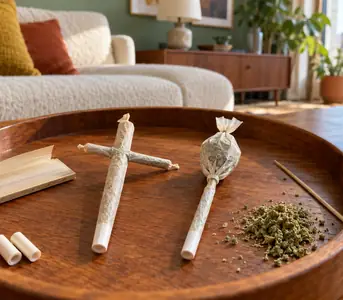
Two Australians from a town called Boort patented the modern herb grinder in 1905. It was for tobacco, and it already had everything: interlocking pins pointing in opposite directions, a chamber underneath, and holes in the floor so shredded material could fall through and be kept until wanted.
Patent 795,746, filed in April of that year, is the design in your pocket. It specifies a set of abrading pins studded on both halves, pointing in opposite directions so they interlock, which is precisely what your grinder does. A hundred and twenty years of iteration has changed the metal and very little else.
What each piece does
The taxonomy is simpler than the marketing suggests.
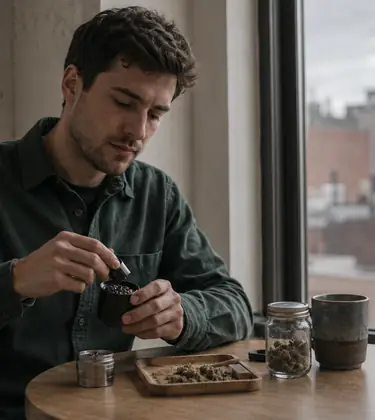
- 2-piece. The 1905 patent exactly. Two toothed halves, one chamber, everything stays where it lands. Fastest to use, easiest to clean, hardest to lose parts from.
- 3-piece. Adds holes in the grinding floor so material falls into a separate collection chamber. Also in the original patent.
- 4-piece. Adds a fine mesh screen under the collection chamber, so whatever passes the mesh accumulates on its own.
That bottom chamber is the grinder kief catcher, and it is the only part of the design that is actually about cannabis.
Material matters less than the internet suggests. Most metal grinders are aluminum alloy, usually 6061 or 6063, the same stock used for window frames and bicycle parts. There is no documented safety problem with anodized grinders: no product recalls, no peer-reviewed work on coating flaking, nothing beyond forum anecdote. Acrylic ones dull faster and crack, which is a durability complaint rather than a health one. What actually degrades a grinder is resin buildup between the teeth, and the fix is a soak in isopropyl rather than a new purchase.
Why the kief catcher works, in microns
Cannabinoids are made and stored in glandular trichomes on the flower, which is documented directly: researchers have dissected trichomes and measured the cannabinoids inside them.
The useful number is the size. A 2023 study of trichome development measured glandular heads ranging from 40 to 110 micrometers in diameter, with smaller bulbous types at 15 to 30. That is the physical basis of the whole fourth chamber. A screen with holes larger than a gland head lets it through while holding back plant matter, and the resin dust that collects underneath is trichome heads knocked loose by the teeth.
Worth being straight about two things here. There is no standard for grinder screen mesh. No ISO, no ASTM, nothing, and the modern grinder patents specify a screen by function without naming a size, so micron figures on packaging are marketing rather than specification. And there is no peer-reviewed measurement of collected kief potency at all. The closest published proxy is European agency data putting cannabis resin, which is pressed sifted trichome material, at 12 to 29 percent THC against 7 to 13 percent for herbal cannabis. Roughly double, from a related but not identical material.
What grind size does, according to actual research
Two findings are worth knowing and they pull in slightly different directions. Forensic work on sieved cannabis fractions found the highest THC concentration in particles between 0.063 and 0.125 millimeters, and the lowest above 0.8 millimeters. The explanation is unglamorous: coarse fractions are stem and leaf, which carry little resin. But the same study found that solvent extraction pulled out the THC regardless of particle size, so finer is not automatically more efficient.
For smoking, the evidence is thinner, and it comes from a conference presentation that has not been through peer review. A Canadian lab prepared joints at one, three and five millimeter particle sizes and reported that the one millimeter grind delivered the most cannabinoid per puff while the five millimeter version burned longer and hit softer. Treat that as an interesting result awaiting peer review, not a settled fact.
And here is the honest gap: nobody has tested whether grind uniformity improves dry herb vaporizer efficiency. The claim is everywhere, the mechanism is plausible, and the study does not exist.
Feeling lost on how to start? Try taking our quiz!
Start a QuizThe best weed grinder habit has nothing to do with the grinder
This is the one piece of common advice the research genuinely supports, and it is about timing, not hardware.
A 2020 study on postharvest storage compared whole and ground cannabis across a year. Terpenoid concentrations were lower in every ground sample than in the corresponding whole sample, the ground material oxidized faster because more surface area sat exposed to air, and grinding produced measurably higher concentrations of decomposition products, worst of all at room temperature.
The same paper puts terpene loss in perspective against cannabinoid loss. Terpenes fell by more than half within four months. Cannabinoids fell by 26 percent over twelve. Aroma leaves long before potency does.
Freezing does not rescue it either. Storage at minus 80 produced the greatest decline in terpenoids of any condition tested. So grind what you are about to smoke and store the rest whole. That is worth more than any upgrade.
The unexamined day is a wasted opportunity. Reflect on what you did, what you learned, and how you can improve.
John Dewey
What an electric weed grinder changes
The patent literature is more honest about this than the product pages. The stated rationale for a portable electric grinder is accessibility, not performance: conventional grinders need real grip strength, which is a genuine problem for anyone with arthritis or a hand injury.
The other common claim, that motors heat and damage the flower, has no cannabis evidence behind it. One published electric grinder design uses a 150 to 1 gear ratio for a no-load speed of about 90 rpm, which is roughly hand-twisting speed. Food science does show that high-speed industrial milling raises temperature and costs volatile oil, but that is a mill grinding turmeric, not a battery unit turning at ninety revolutions a minute.
The hardware question resolves quickly. A 2-piece for simplicity, a 4-piece grinder for the kief, an electric one where grip strength is the constraint. There is no measured performance gap between them worth paying a premium for.
What we notice about grinders from the breeding side
Every argument above is really an argument about resin, and resin is decided long before the grinder arrives.
A plant with dense, well-developed trichome coverage fills a kief chamber. A plant with sparse coverage does not, and no screen fixes that. The same goes for the terpene loss finding: you can only lose what was there, and a variety with a thin aromatic profile has very little margin before it smells like hay. Two of ours make the point from opposite ends:
- Papaya Frosting carries a trichome load dense enough that the fourth chamber fills noticeably faster than average, with a tropical, creamy nose that survives a proper cure.
- Shiskaberry is the patience case, a berry-forward indica whose sweetness develops through a slow cure and vanishes through a rushed one.
The drying and curing stage matters as much as the genetics either way. Trichome heads become brittle as flower dries, which is exactly why the teeth knock them loose, and material dried too fast or too warm arrives at the grinder with the aromatics already gone.
Four decades of selection has taught us that the difference between good flower and forgettable flower usually shows up in the small stuff. How much falls through a screen is one of the more honest tests available at home.
Buy the genetics, not the hardware
The design is 120 years old and the physics has not moved. Teeth break flower apart, holes sort by size, a screen sorts again at around the diameter of a trichome head.
What the research supports: fine particles carry more THC, ground cannabis loses terpenes faster than whole flower, and freezing makes it worse. What it does not support: any specific kief potency figure, any micron standard, any vaporizer efficiency claim, and the idea that electric grinders cook your weed.
Grind fresh, keep the rest whole, and spend the money you were going to spend on a grinder upgrade on better genetics instead.
Barney's Farm has been developing premium cannabis genetics since the 1980s, with over 40 Cannabis Cup wins. Explore our full seed catalog and find strains bred for every climate and skill level.