The Emerald Triangle: Inside America's Most Famous Weed Region
Three counties in Northern California shaped what Americans smoke more than any dispensary chain, any state legislature or any lab ever did. There was no branding budget behind it and no trade association. There were steep hillsides, fog, and a few thousand people who spent forty years growing cannabis with helicopters overhead.
That is the Emerald Triangle. Here is how it got built, what nearly killed it, and where it stands in the summer of 2026.
Where is the Emerald Triangle?
The Emerald Triangle is Humboldt, Mendocino and Trinity counties in Northern California, arranged in a rough upside-down triangle with Eureka as the largest city. The three counties cover more than 10,000 square miles and hold roughly 235,000 people, working out to about 23 residents per square mile.
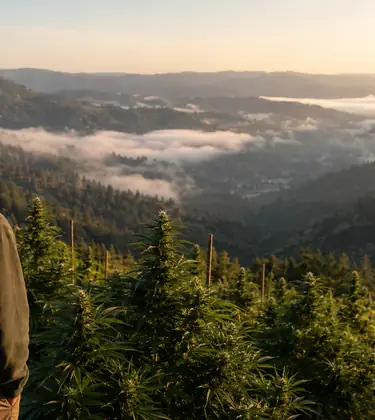
That emptiness is the whole point. Remote canyons, redwood cover, private timber parcels, and roads that turn to gravel within twenty minutes of the highway. If you wanted to grow cannabis outdoors in America without anyone watching, this was the address.
The climate handled the rest. Coastal fog moderates the summer heat, the dry season lines up neatly with flowering, and the season runs long enough for full-term outdoor plants to finish in early October. Growers up there call that harvest month Croptober. The name has since spread to every legal market in the country.
How did the Emerald Triangle become America's weed capital?
It started with cheap land. Through the late 1960s and 1970s, city people bought logged-over parcels in Southern Humboldt and Mendocino after the Summer of Love, chasing a self-sufficient life off the grid. The land was cheap because timber companies had already taken everything worth taking.
Cannabis paid the property tax. Nothing else those parcels could produce came close. Goats and firewood do not cover a mortgage. Forty plants on a south-facing bench did.
Then came the genetics. Seeds arrived from Afghanistan, Mexico, Thailand and Colombia in travelers' pockets through the 1970s, and Northern California growers started selecting hard for what survived their specific conditions. Early finishers. Mold resistance. Tight structure that could shrug off an October rain. Thousands of small independent plots ran that experiment in parallel for a decade, with no coordination and no published results. That is where American outdoor cannabis actually got good, and the winners eventually filtered into seed catalogs on both sides of the Atlantic.
What did the government do about the Emerald Triangle?
In 1983 California launched the Campaign Against Marijuana Planting. Everyone calls it CAMP. Local police, state agents and federal officers flew helicopters across the hills every summer, cut gates, pulled plants and burned gardens. It grew into one of the largest law enforcement task forces the country has ever run.
By 2002 the state Attorney General's office reported that CAMP had seized more than three million plants since the program began, with roughly 40 percent of that season's total taken from the Emerald Triangle and neighboring Northern California counties.
The campaign failed on its own terms. Squeezing supply pushed prices up, higher prices justified the risk, and the risk selected for the people most willing to take it. Farms moved further from roads and deeper into the trees. A systematic aerial survey of Humboldt County later mapped 4,428 cultivation sites across 60 watersheds, with 68 percent of them sitting more than 500 meters from any developed road. Enforcement did not stop cultivation. It relocated it onto the steepest, most ecologically sensitive ground available, and researchers are still measuring what that did to the watersheds.
Feeling lost on how to start? Try taking our quiz!
Start a QuizWhat makes Emerald Triangle weed different?
Ask ten people and you get ten answers, most of them romantic. Here is the practical version from a breeding desk.
Full sun is a different input from a lamp. Outdoor plants in Humboldt get an intensity and spectrum no fixture reproduces, plus a real temperature swing when the coastal fog rolls in at night. Cold nights late in flower drive anthocyanin expression, which is why so much of the region's flower finishes purple without anyone forcing it.
Soil does more work than most people admit. Living soil with an established microbial population feeds a plant differently than a fully controlled nutrient schedule, and the terpene profiles coming out of those beds tend to read heavier and more layered. The earth and pine notes people associate with old Humboldt flower are not marketing.
Then there is the selection pressure. When the crop gets one shot a year and a bad weekend of rain can take all of it, you keep the plant that finished ahead of the weather and threw the least mold. Repeat that for thirty seasons across hundreds of farms and you end up with a regional gene pool tuned to one very specific set of problems.
The catch is that terroir does not travel. A cut selected for Salmon Creek fog will not automatically perform in a Michigan hoop house or a tent in Phoenix. This is exactly why our lab spends years stabilising a line before it ships. Regional magic is real, and it stays regional unless somebody does the breeding work to make it repeatable somewhere else.
The unexamined day is a wasted opportunity. Reflect on what you did, what you learned, and how you can improve.
John Dewey
What did legalization do to Emerald Triangle farms?
Proposition 215 legalized medical cannabis in California in 1996 and the region boomed. Proposition 64 legalized adult use in 2016 and the region broke.
Legacy growers went legal in good faith. They applied for permits, paid county fees and state taxes, installed cameras, learned track-and-trace software and rebuilt water systems to code. Meanwhile the state licensed enormous outdoor and mixed-light operations on flat ground in the Central Valley and Santa Barbara County, where one farm could out-produce an entire Humboldt watershed. Wholesale prices collapsed. Compliance costs did not.
The result was attrition. Farms sold, walked away or went back underground. Hydroponics shops closed. Trimmers stopped showing up in the fall. Restaurants, mechanics, hardware stores and school enrollments all felt it, because the cash that had circulated through those towns for forty years simply stopped moving.
Is the Emerald Triangle finished in 2026?
No, but it is a smaller and stranger place than it was in 2015.
In April 2026 the U.S. Department of Justice issued a final order placing FDA-approved marijuana drug products and marijuana covered by a qualifying state medical license into Schedule III of the Controlled Substances Act, with a further DEA hearing on broader rescheduling opening in June. For licensed medical operators the practical win is tax treatment, since Section 280E does not reach Schedule III. Everything outside that carve-out stayed in Schedule I, so this is not the finish line anyone in Humboldt was hoping for.
Locally the mood has moved. At a July 2026 economic briefing, Humboldt growers pointed to the state finally releasing its Appellation of Origin regulations, research funding landing at Cal Poly Humboldt's cannabis program, a new low-impact camping rule that opens the door to farm stays, and the fact that 78 percent of Humboldt voters rejected Measure A, a ballot measure that would have written the industry out of the county's general plan.
The appellation piece is the one worth watching. California is building a wine-style system where a region's name carries legal protection and ties to in-ground, sun-grown production. If Humboldt gets to defend its name the way Champagne does, the region stops competing on price per pound and starts competing on origin. That is the only fight it can realistically win.
Which strains carry Emerald Triangle DNA?
You cannot buy a Humboldt farm in a seed pack. What you can buy is the West Coast lineage those farms fed into, because the elite California cuts of the 2000s and 2010s all trace back through the same Northern California breeding network.
Our clearest example is Purple Punch. It came from crossing Larry OG with Granddaddy Purple, two California lines, and it inherited both the cold-night colour response and the dessert nose that made West Coast flower famous. Short, stocky, 50 to 60 days of flowering, and no greenhouse required to run it outdoors.
Wedding Cake comes at it from the Cookies side. Girl Scout Cookies crossed with Cherry Pie, with OG, Durban Poison and Granddaddy Purple further back in the file. Our version leans 80 percent indica and finishes in around eight weeks, which matters a great deal when your outdoor season ends the day the rain starts.
Barney's Farm has been doing this work since Derry started hauling landrace seeds back from Afghanistan and the Himalayas in the 1980s and set up in Amsterdam in 1986. Different mountains, same job. Find the plants that survive a hostile season, keep the ones worth keeping, and stabilise them until they perform for a grower who is not you. Forty years and more than forty Cannabis Cups later, the method has not changed.
The Emerald Triangle built the American cannabis palate on illegal ground, with no protection and no upside beyond the crop itself. Legalization repaid that with paperwork and a price crash. Whether appellations and rescheduling are enough to square the account is still open, and the people asking are the ones who never left.
Barney’s Farm has been developing premium cannabis genetics since 1986, with more than 40 Cannabis Cup wins. Explore our full cannabis seed catalog and find the genetics that fit how you actually medicate.