Pollen Presses: Turning Kief into Hash Pucks
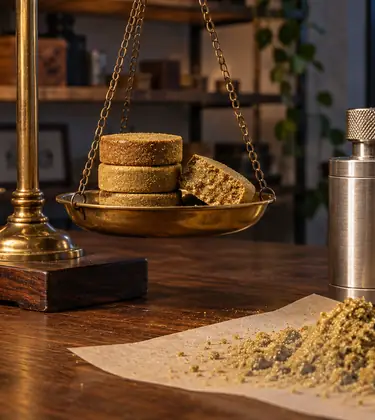
Every grinder with a screen collects it: a fine, golden dust in the bottom chamber that piles up between sessions. A pollen press turns that loose powder into a firm coin of hash you can crumble over a bowl or tuck away for later.
The tool is simple, a small metal cylinder with a screw handle. A clean puck takes good kief, a little warmth and some patience, and in some states the result counts as a concentrate under the law.
Key takeaways
- Kief is a pile of detached trichomes, the resin glands sifted from cannabis flowers, and it holds more THC than the flower.
- A pollen press, also called a kief press, squeezes kief into a solid disc of hash known as a kief puck.
- Pressing adds no THC, since turning THCA into THC takes far more heat than a warm press.
- Hashish seized near Rome averaged 18.0% THC from 2015 to 2022, climbing from 13.7% to 27.1%.
- Light is the biggest single cause of cannabinoid loss in storage, so keep pucks in the dark.
- Rosin uses heated plates to squeeze oil out of resin, while a kief puck is only pressed together.
- California lets adults carry 8 grams of concentrated cannabis and bans home extraction with volatile solvents.
Kief, pollen and hash, defined
Kief is the accumulation of detached cannabis trichomes, the tiny resin glands that frost a cured bud, usually collected by sifting flowers through a fine mesh screen or sieve. Like other concentrates, it contains a much higher concentration of THC than the flower it came from. A grinder with a screen does the sifting for you, and the powder in its bottom chamber is kief.
The word "pollen" is a misnomer. Real cannabis pollen comes from male plants, which shed it and die several weeks before seeds ripen on the females, while kief comes from the resin glands of the flowers. Wikipedia's hashish article notes that trichome resin is "sometimes erroneously called pollen," and sellers call screened grinders "pollen catchers." The pollen press takes its name from the same slang.
Pressed kief is also a traditional form of hash, made with no solvents at all. Traditionally, kief has been pressed into cakes of hashish for convenience in storage. In Morocco, the word kief also means something else, a traditional mix of finely chopped cannabis and tobacco.
Inside a kief press
A pollen press is a small metal cylinder, usually aluminum or brass, with a removable base at one end and a threaded handle at the other. You fill the chamber with kief, screw the handle down, and the piston packs the powder into a disc. In our experience, a press warmed in warm water makes a firmer puck than a cold one, because softened resin binds better.
Warmth does not activate the THC, though. Cannabis flower holds most of its THC as THCA, the acid form, which is progressively decarboxylated to THC with drying and especially under intense heating, such as smoking or cooking. In a 2016 lab study, decarboxylation conditions were examined at 80°C, 95°C, 110°C, 130°C and 145°C, or 176°F to 293°F, for up to an hour in a vacuum oven. A press warmed in your hand or in warm water never gets near that, so pressing changes the shape of the kief, not its chemistry.
Feeling lost on how to start? Try taking our quiz!
Start a QuizPressing kief at home, step by step
Knowing how to press kief is mostly about clean kief, gentle warmth and patience. In our experience, this routine gives a firm, even puck:
- Collect kief from the bottom chamber of a screened grinder and pick out any bits of leaf or stem.
- Warm the press for a few minutes in a sealed plastic bag in warm water, then dry it completely.
- Cut two small circles of parchment paper and lay one on the base inside the chamber.
- Fill the chamber with kief, leaving room for the piston, and lay the second circle on top.
- Screw the handle down until it stops, then give it a few more turns over the next 10 to 15 minutes as the kief settles.
- Remove the base and push the puck out with the handle.
Better kief starts with the plant. Resin-heavy strains fill a grinder's chamber faster, and two in our catalog stand out:
- Hindu Kush, a 100% indica line from the mountains between Afghanistan and Pakistan with 26% THC, carries a thick coat of resin and is one of the best plants in our catalog for dry sift.
- Gorilla Z, a GG4 and Original Z cross at 32% THC, is one of the most resin-drenched plants we sell, with a sweet, fruity terpene profile.
Check your state's home-grow rules first, since not every legal state allows it.
The unexamined day is a wasted opportunity. Reflect on what you did, what you learned, and how you can improve.
John Dewey
Potency and storage of a kief puck
A kief puck is as strong as the kief inside it, since pressing packs the resin tighter but adds no THC. Hash in general keeps getting stronger. In a 2023 study of more than 1,000 hashish samples seized by police south of Rome, the average THC content was 18.0%, and the yearly figure climbed from 13.7% in 2015 to 27.1% in 2022. The EU drugs agency's 2026 report puts the average THC content of resin seized in the European Union at 24.6%, twice that of herbal cannabis at 12%.
How you store a puck matters too. In a 1976 study of stored cannabis, exposure to light was the greatest single factor in loss of cannabinoids, air oxidation caused significant losses too, and both herbal and resin cannabis stayed reasonably stable for one to two years when kept in the dark at room temperature. In our experience, a tight puck in a dark, airtight tin keeps its smell longer than loose kief left in a grinder.
Rosin vs. pressed kief
The rosin vs. pressed kief question comes down to heat. Rosin is made by pressing flower, dry sift or ice water hash between heated plates, so moisture in the material turns to steam and forces the oil out, creating a solventless hash product. A kief puck is only warmed enough to bind, so nothing is squeezed out of it:
| Feature | Pressed kief puck | Rosin |
|---|---|---|
| Starting material | Kief | Flower, kief or hash |
| Heat | A warm press | Heated plates |
| What comes out | A solid disc of compacted kief | Sticky oil pressed out of the resin |
| Typical use | Crumbled into a bowl or a joint | Dabbed or vaped |
| Solvents | None | None |
| Feature | Starting material | Heat | What comes out | Typical use | Solvents |
|---|---|---|---|---|---|
| Pressed kief puck | Kief | A warm press | A solid disc of compacted kief | Crumbled into a bowl or a joint | None |
| Rosin | Flower, kief or hash | Heated plates | Sticky oil pressed out of the resin | Dabbed or vaped | None |
Both methods are solventless, which makes them the safer choice for making hash at home. Butane hash oil is another story. At a California burn center, the number of patients presenting with these burns increased over seven years, and of 101 patients treated for butane hash oil burns, three died.
Concentrate laws and home extraction
California defines concentrated cannabis as the separated resin, whether crude or purified, obtained from cannabis, and adults there may carry eight grams of cannabis in the form of concentrated cannabis on top of 28.5 grams of flower. Under that wording, a kief puck most likely counts toward the 8 grams. Other states set their own limits:
| State | Concentrate limit | Home extraction with solvents |
|---|---|---|
| California | 8 g, on top of 28.5 g of flower | Banned with volatile solvents unless licensed |
| Michigan | 15 g, inside the 2.5-ounce limit | Butane-type extraction banned in public, in vehicles and around homes |
| New York | 24 g, on top of 3 ounces of flower | Regulators can restrict or ban flammable gas solvents |
| Oregon | Up to 16 ounces kept at home | Unlicensed butane, hexane or propane extraction is a felony |
| State | California | Michigan | New York | Oregon |
|---|---|---|---|---|
| Concentrate limit | 8 g, on top of 28.5 g of flower | 15 g, inside the 2.5-ounce limit | 24 g, on top of 3 ounces of flower | Up to 16 ounces kept at home |
| Home extraction with solvents | Banned with volatile solvents unless licensed | Butane-type extraction banned in public, in vehicles and around homes | Regulators can restrict or ban flammable gas solvents | Unlicensed butane, hexane or propane extraction is a felony |
Mechanical methods are treated differently from solvents. Oregon counts a mechanical extraction process as making a cannabinoid concentrate, which adults may make at home, while unlicensed extraction with butane, hexane or propane is a Class B felony there.
From grinder dust to hash puck
A pollen press turns the kief from your grinder into a solid puck of hash with nothing but pressure and a little warmth. The puck is as potent as the kief inside it, keeps best in the dark and differs from rosin, which squeezes oil out under real heat. Press clean kief, keep solvents out of the kitchen and check how your state counts concentrates before you stock up.
Barney's Farm has been developing premium cannabis genetics since the 1980s, with over 40 Cannabis Cup wins. Explore our full seed catalog and find strains bred for every climate and skill level.