What Is Hash and How Is It Different From Modern Concentrates?
Walk into any US dispensary in 2026 and the concentrate menu reads like a chemistry exam. Live rosin, live resin, badder, sauce, diamonds, shatter, distillate, full melt. Somewhere on that menu, often in a quiet corner, sits a brick of hash. The oldest cannabis concentrate on earth, sharing shelf space with extracts that did not exist a decade ago.
Hash never went away. It just got out-marketed for a while. Now it is back in the conversation, partly because solventless is having a moment and partly because a lot of smokers got curious about what people were actually smoking before dab rigs existed. Here is what hash actually is, where it came from, how it stacks up against modern concentrates, and why it still earns space in a serious smoker's rotation.
What Is Hash, Exactly?
Hash, short for hashish, is a concentrate made by separating and pressing the resin glands, called trichomes, from the cannabis plant. The word comes from the Arabic ḥašiš, meaning hay or grass, and the substance has a documented history of use across Afghanistan, India, Pakistan, Iran, Lebanon, Morocco, Nepal, and Egypt going back centuries.
Trichomes are the tiny sticky bulbs covering cannabis flower. They are where almost all the THC, CBD, and terpenes live. Strip them off the plant, collect them, press them together, and you have hash. No solvents required. Just mechanical separation, sometimes a little heat, and pressure.
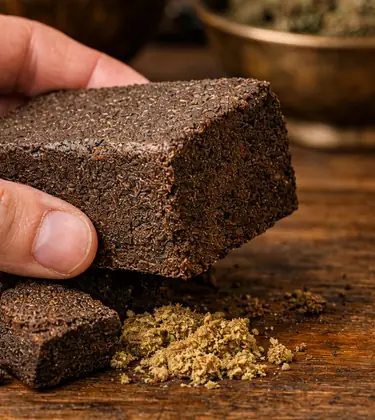
The color ranges from blonde to dark brown to nearly black depending on the technique and the starting material. The texture can be crumbly, pliable, or hard enough to need a knife. Good hash smells like the strain it came from, only louder.
Where Did Hash Come From?
Hash predates pretty much every cannabis product Americans buy today. The earliest mentions in literature show up in the 10th and 11th centuries in the Middle East and Central Asia. By the time European travelers were trading along the Silk Road, hash was already a fixture from Persia to North Africa.
The story most people know involves Napoleon's 1798 invasion of Egypt. French soldiers stuck in a Muslim country with no wine discovered hashish, fell in love with it, and brought it home with them. General Menou's October 1800 ban on hashish in Egypt is often called the first modern drug prohibition law. The ban did not work. The hash kept moving.
By the mid-1800s, hash had landed in Paris literary circles. The Club des Hashischins counted Victor Hugo, Charles Baudelaire, Alexandre Dumas, and Honoré de Balzac among its members, and the drug became the unofficial fuel of nineteenth-century European bohemia.
Morocco took over as the main hash supplier to Europe through the late twentieth century, then Afghanistan reclaimed the crown for premium quality. The hippie trail of the 1960s and 70s pulled Western travelers through Nepal, India, and Morocco, and they brought back both the product and the techniques. Most of what Americans now think of as solventless extraction traces back to those routes.
How Is Hash Made?
There are a few traditional methods, and they are all surprisingly low-tech.
Hand-rubbed charas. The oldest method, still practiced in India and Nepal. Workers walk through live cannabis fields rubbing flowers between their palms. Resin sticks to the skin, builds up into a black tar, and gets scraped off and rolled into balls.
Dry sift. Dried, cured cannabis is rubbed across fine mesh screens. The trichomes break off and fall through, leaving plant matter behind. The collected powder is called kief. Press it under heat and you have traditional Moroccan-style hash.
Ice water hash, also called bubble hash. A 1990s update on dry sift. Cannabis is agitated in ice water, which makes the trichomes brittle enough to snap off. The resin gets filtered through a stack of mesh bags, dried, and pressed. Bubble hash can be extremely clean and potent.
All three of these methods are solventless, meaning no butane, propane, ethanol, or CO2 touches the plant. The only inputs are physical force and temperature.
Feeling lost on how to start? Try taking our quiz!
Start a QuizWhat Are Modern Cannabis Concentrates?
Modern concentrates are everything that came after hash, mostly developed in the past twenty to thirty years as legalization spread and extraction labs got more sophisticated. The category breaks roughly into two camps.
Solvent-based extracts. Butane hash oil (BHO), propane hash oil, CO2 oil, and distillate. A solvent strips the cannabinoids and terpenes off the plant, then gets purged out, leaving a concentrated extract. This includes shatter, wax, crumble, sauce, and most vape cart oil. Done correctly in a licensed lab, the residual solvents are below safe thresholds. Done in someone's garage, this is how houses catch fire.
Solventless extracts. Rosin and live rosin. Rosin is made by pressing flower, kief, or bubble hash between heated plates. Live rosin uses fresh-frozen plant material and starts from bubble hash, preserving more terpenes. The industry has been moving steadily toward solventless methods, with THC concentrations in some concentrate products reaching 90 to 95 percent.
Live resin is a third category that confuses everyone. It uses solvents (usually butane) on fresh-frozen flower instead of dried and cured flower, which preserves more terpenes than standard BHO. The naming is a mess. Live resin has solvents. Live rosin does not. Pay attention at the dispensary.
The unexamined day is a wasted opportunity. Reflect on what you did, what you learned, and how you can improve.
John Dewey
Hash vs. Concentrates: What Is the Real Difference?
The clearest line is potency. Traditional hand-rubbed charas might test at 20 to 40 percent THC. Quality dry sift and bubble hash usually land between 40 and 60 percent. Modern solventless rosin commonly hits 70 to 85 percent. Distillate can be 90 percent and up, with terpenes added back in for flavor.
Higher numbers do not automatically mean a better experience. A lot of seasoned smokers find that hash and live rosin in the 60 to 70 percent range deliver more flavor, more terpene complexity, and a more balanced effect than ultra-stripped distillate. The full chemical fingerprint of the plant gets preserved when you avoid harsh processing.
Texture and use matter too. Hash gets crumbled into joints, packed in bowls, or pressed onto pipe screens. It burns. Modern dab concentrates are vaporized on a hot nail or in a vape cart. They do not burn well in a joint without help. Different products, different rituals.
Then there is the production question. Hash can be made by one person with a screen and patience. Most modern concentrates require expensive lab equipment, training, and licensing. The hash supply chain is closer to wine made by a small vineyard. The distillate supply chain is closer to industrial alcohol production.
Why Hash Still Matters in the Concentrate Era
This is the part where Barney's Farm earns its keep, because none of this works without genetics.
Hash quality starts in the seed. A plant has to produce dense, mature, well-formed trichomes in serious volume before any extraction technique can do anything with it. Strains bred for flower yield without trichome density make poor hash candidates. Strains bred for resin production tend to make extraordinary hash even with the simplest methods.
Barney's Farm has been breeding cannabis in Amsterdam for more than three decades, with an absurd number of Cannabis Cup wins on the wall, and a lot of that work has been about resin output. Strains in the Critical Kush and LSD families, for example, have built reputations as hash-friendly genetics because the trichome production is heavy and the cannabinoid profile holds up through extraction. Growers chasing solventless rosin yields tend to learn quickly which genetics deserve the press time and which do not.
The point is that a great hash and a great rosin both start with the same thing: a plant that was bred to make resin, grown carefully, and harvested at the right window. The technology on the back end is impressive. The biology on the front end decides what the technology has to work with.
How Do You Smoke Hash?
Hash is one of the most flexible cannabis products there is.
In a joint or spliff. Crumble small pieces of hash onto ground flower before rolling. Adds potency, depth, and a heavier high. This is the most common method worldwide.
On a pipe or bong. Place a small piece on top of a packed bowl, or on a screen by itself. A screen helps because pure hash can melt and clog.
Hot knives, the old-school move. Heat two metal knives, sandwich a small piece of hash between them, and inhale the vapor through a funnel. Crude, effective, and probably unnecessary in 2026.
Dabbing high-grade hash. Premium full-melt bubble hash and ice water hash can be dabbed on a quartz banger. Lower-grade dry sift will leave residue and is not worth the effort.
A small piece goes a long way. Start with a chunk the size of a match head if you are new to it.
Should You Pick Hash or Modern Concentrates?
Both. Different tools for different moods.
Reach for hash when you want flavor, ceremony, and a connection to several thousand years of cannabis tradition. Hash rewards slow consumption. It rolls into a joint with flower better than almost anything else. The high tends to feel rounded and full-body.
Reach for modern concentrates when you want speed, precision, or maximum potency. A live rosin dab hits in seconds. A vape cart fits in a pocket. Distillate edibles let you dose down to the milligram. These are conveniences hash cannot match.
The smartest move for most American smokers in 2026 is keeping both around. A jar of bubble hash for joints and bowls, a gram of live rosin for dab sessions, and the occasional cart for travel covers basically every situation.
The Bottom Line
Hash is the original cannabis concentrate, and despite a couple of decades of being overshadowed by flashier extracts, it has held its place because nothing else does what it does. Modern concentrates pushed potency and convenience forward in ways the old hash makers in the Hindu Kush could not have imagined. They did not replace the source material. They added new options to a category that already had a perfectly good foundation.
Both deserve respect. Both started with a plant that knew how to make resin. Take care of the genetics, and the rest of the supply chain has something worth working with.
Barney's Farm has been developing premium cannabis genetics since the 1980s, with over 40 Cannabis Cup wins. Explore our full cannabis seed catalog and find strains bred for every climate and skill level.