Is Smoking Weed a Sin? What the Bible Really Says About Cannabis
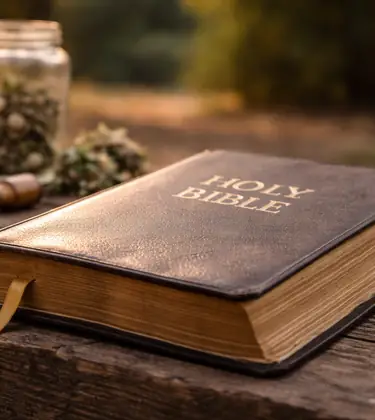
People have been growing, smoking, and debating cannabis for thousands of years. And for just as long, religious communities have been arguing about whether the plant belongs in a faithful life or falls squarely into the "sin" category. With legalization spreading across the U.S. and 76% of Americans now saying marijuana use is morally acceptable or not a moral issue at all, the question keeps getting louder: is smoking weed actually a sin?
The short answer? The Bible never mentions cannabis by name. Not once. There is no verse that says "thou shalt not smoke weed." But that hasn't stopped centuries of interpretation, debate, and flat-out argument. So let's dig into what scripture actually addresses, what archaeology has uncovered, and where the conversation stands today.
Does the Bible Mention Cannabis?
Technically, no. The word "marijuana" or "cannabis" doesn't appear anywhere in the Old or New Testament. But there's a term that's been sparking heated academic debate for nearly a century: kaneh bosm.
In Exodus 30:22-23, God instructs Moses to create a holy anointing oil using a recipe that includes myrrh, cinnamon, cassia, olive oil, and something called kaneh bosm, typically translated as "aromatic cane" or "sweet calamus." Polish anthropologist Sula Benet first proposed in 1936 that this term actually referred to cannabis. Her argument rested on linguistic parallels between the Hebrew kaneh bosm and the Assyrian qunnabu, a term widely accepted by scholars as meaning cannabis. The root "kaneh" means reed or stalk, and "bosm" means aromatic. Say "kaneh bosm" out loud a few times. Sound familiar?
Now, mainstream biblical scholars aren't unanimous on this. Many still argue the ingredient was calamus or lemongrass. But Benet's theory has never been fully dismissed either, and it gained serious traction in 2020 when archaeologists made a discovery that shifted the entire conversation.
Did Ancient Israelites Actually Use Cannabis in Worship?
Yes, apparently they did. In 2020, researchers analyzing residues on altars at a 2,800-year-old Judahite shrine at Tel Arad in Israel's Negev desert found traces of THC, CBD, and CBN on one of the limestone altars, mixed with animal dung to help it burn slowly at lower temperatures. The other altar contained frankincense. The findings were published in the journal of the Institute of Archaeology of Tel Aviv University.
This is the first concrete archaeological evidence of cannabis use in worship within ancient Israel. The shrine at Tel Arad dates to roughly 760-715 BCE and closely resembles the first Jewish Temple in Jerusalem, which raises an obvious question: if cannabis was burned at a border shrine, was it also used at the Temple itself? The researchers believe this is plausible but unproven.
What's clear is that cannabis wasn't some fringe substance in the ancient Near East. Neighboring civilizations like the Scythians, Assyrians, and Persians all used it. The idea that it played a role in Hebrew religious life isn't wild speculation anymore. It's backed by lab results.
What Does the Bible Say About Intoxication?
Here's where most of the "is smoking weed a sin" arguments actually live. The Bible has plenty to say about drunkenness and self-control, and those verses get applied to cannabis by extension.
Ephesians 5:18 warns against getting drunk with wine, calling it "debauchery," and instead urges believers to be "filled with the Spirit." Proverbs 23:20 cautions against hanging with drunkards. 1 Peter 5:8 calls for a "sober mind." And 1 Corinthians 6:12 makes the point that while all things may be lawful, "I will not be dominated by anything."
The logic goes: if the Bible condemns intoxication from alcohol, that same principle extends to any substance that clouds judgment. And since THC produces psychoactive effects, smoking weed falls under the umbrella of things scripture warns against.
But there's a counterpoint that doesn't get enough airtime. The Bible clearly permits alcohol in moderation. Jesus turned water into wine at a wedding. Paul told Timothy to drink a little wine for his stomach. Scripture consistently draws the line at excess, not at consumption itself. So the question becomes: does every use of cannabis equal intoxication, or is there a parallel to the "glass of wine with dinner" model?
Feeling lost on how to start? Try taking our quiz!
Start a QuizCan Christians Smoke Weed?
This is the million-dollar question that churches across America are wrestling with right now. And the honest answer depends heavily on which Christian tradition you ask.
Conservative evangelical denominations tend to treat any recreational cannabis use as sinful, drawing heavily on the intoxication verses and the "body as a temple" language from 1 Corinthians 6:19-20. The reasoning is straightforward: if your body belongs to God, you shouldn't fill it with substances that impair your ability to think, pray, or function.
More progressive traditions take a different view. They point to Genesis 1:29, where God tells humans He has given them "every seed-bearing plant on the face of the whole earth." Cannabis is a seed-bearing plant. They also emphasize individual conscience, the absence of any direct prohibition, and the growing body of research showing cannabis has legitimate medicinal applications for pain, anxiety, and inflammation.
And then there's the legality factor. Romans 13 calls on believers to submit to governing authorities. For decades, Christians could dodge the moral question entirely by pointing to federal law. That card is getting harder to play as legalization spreads and 64% of Americans now support making marijuana legal. In states where recreational use is fully legal, the "obey the law" argument flips: if the law permits it, that particular biblical objection disappears.
The unexamined day is a wasted opportunity. Reflect on what you did, what you learned, and how you can improve.
John Dewey
Does Cannabis Fit the "God's Plants" Argument?
One of the most common pro-cannabis biblical arguments centers on Genesis 1:29 and the idea that God created all plants for human use. It's a compelling surface-level point, but it also has limits. Poison ivy is a plant. Hemlock is a plant. Nobody's arguing those are divine gifts meant for consumption.
The more honest version of this argument acknowledges that creation includes plenty of things with both potential benefits and potential risks. Cannabis is one of them. The question isn't whether God made the plant. Obviously, He did. The question is what responsible use looks like.
At Barney's Farm, we've spent over 30 years working with the cannabis plant, and one thing we've learned through decades of breeding and genetics research is that cannabis is incredibly diverse. A high-CBD strain grown for pain relief is a fundamentally different experience than a high-THC strain like Gorilla Z concentrate designed to launch you into orbit. Talking about "cannabis" as one monolithic thing makes as much sense as lumping a light beer and a bottle of Everclear into the same conversation. The plant itself is neutral. Intent, dosage, and context determine the outcome.
Is the Real Question About the Plant or the Person?
Strip away the theological jargon and the verses people throw back and forth, and you land somewhere surprisingly practical. Scripture's consistent concern isn't about specific substances. It's about what you do with them and why. Are you using cannabis to numb out, avoid responsibility, or escape reality? That pattern is going to be problematic whether your vice is weed, whiskey, social media, or shopping. Are you consuming thoughtfully, within legal boundaries, without it controlling your life? That's a different situation entirely.
The Greek word pharmakeia shows up in a few New Testament passages (Galatians 5:20, Revelation 18:23) and is sometimes translated as "sorcery" or "witchcraft." It's also the root of our modern word "pharmacy." Some theologians use this as evidence that the Bible condemns drug use broadly. Others point out that the term specifically refers to the use of substances in occult practices, not to someone eating a gummy on their couch after a long day.
Context matters. It always has.
Where Does Marijuana and Christianity Stand Today?
The cultural ground is shifting fast. Recreational cannabis is now legal in nearly half of U.S. states. Medical programs exist in all but a handful. And the demographic that's driving a lot of the remaining opposition? Older, more conservative voters, many of whom hold deep religious convictions. But even within that group, attitudes are evolving.
Some churches are beginning to treat cannabis the way they already treat alcohol: permissible in moderation, problematic in excess, and a matter of individual conscience rather than blanket prohibition. Others are holding the line. And a small but growing number of faith communities are actively exploring the historical and spiritual connections between cannabis and ancient worship, especially in light of the Tel Arad findings.
What's clear is that the old "just say it's illegal and move on" approach is over. Christians who take their faith seriously are being forced to actually wrestle with the question, weigh the biblical principles, and make informed personal decisions. That's probably a healthier place to be than blind prohibition ever was.
The Bottom Line
The Bible doesn't say smoking weed is a sin. It also doesn't say it's fine. What it offers are principles: stay sober-minded, don't let any substance control you, take care of your body, obey the law, and use your freedom responsibly. Where you land within that framework is between you, your conscience, and whatever higher power you answer to.
At Barney's Farm, we believe in respecting the plant. We've dedicated three decades and over 40 Cannabis Cup wins to understanding the science, genetics, and potential of cannabis. Whether you approach it from a spiritual perspective, a medical one, or you just like the way a good strain makes a sunset look, we think informed, intentional use is always the right call. The ancient Israelites may have been burning cannabis in their temples 2,800 years ago. The conversation has been going on for a very long time. We're just finally catching up.
Barney's Farm has been developing premium cannabis genetics since the 1980s, with over 40 Cannabis Cup wins. Explore our full seed catalog and find strains bred for every climate and skill level.