Hemp Beyond CBD: Hempcrete, Bioplastics and the Industrial Comeback
American farmers planted more acres of hemp for fiber last year than for CBD flower. The fiber earned thirteen and a half million dollars. The flower earned five hundred and seventy-four.
That ratio is the whole industrial hemp story in two numbers, and almost nothing written about the crop acknowledges it.
This guide covers what the federal data actually shows, the one genuine breakthrough of the last two years, which industrial claims survive checking, and which famous one does not.
The legal line everything hangs on
Hemp and cannabis are the same plant species, separated by a number written into federal law. The 2018 Farm Bill, codified at 7 U.S.C. 1639o, defined hemp as the plant Cannabis sativa L. and any part of it, including seeds and all derivatives, with a delta-9 tetrahydrocannabinol concentration of not more than 0.3 percent on a dry weight basis. Below that line the plant is an agricultural commodity. Above it, a controlled substance.
The distance involved is easy to underestimate. Insane OG, OG Kush crossed with Bubba Kush and Granddaddy Purple, tests around 32% THC. That is roughly a hundred times the legal hemp ceiling, in a plant of the same species.
That definition is about to change, and anyone writing about hemp in 2026 should know it. A law approved in November 2025 rewrites the threshold to measure total tetrahydrocannabinols, the acid form included, and adds a cap of 0.4 milligrams per container. It takes effect 365 days after enactment, which lands in November 2026.
The practical consequence is large. Measuring total THC instead of delta-9 alone will disqualify plants that pass today, and the per-container limit is aimed squarely at the intoxicating hemp drinks and gummies that grew up inside the old wording.
What the federal numbers show
USDA surveys the crop every year, and the survey tells a story of collapse and partial recovery. Hemp production was worth $824 million in 2021. In 2022 it was worth $238 million, a fall of 71 percent in a single year, with planted acreage down 48 percent. The cause was straightforward: farmers had planted for a CBD market that never received federal permission to exist, since FDA has consistently held that adding CBD to food or supplements is prohibited.
Recovery has been real but uneven. Value climbed for four consecutive years to reach $739 million in 2025, with planted area for the Nation in 2025 for all utilizations totaled 49,267 acres, up 9 percent from 2024.
Inside that recovery sits the number this article opened with. Fiber took 21,693 harvested acres, more than any other use, and returned $13.5 million at twenty cents a pound. Floral hemp took 16,880 acres and returned $574 million.
Fiber occupies the most American land and earns the least American money. Every industrial hemp ambition runs into that fact first.
The breakthrough nobody covered properly
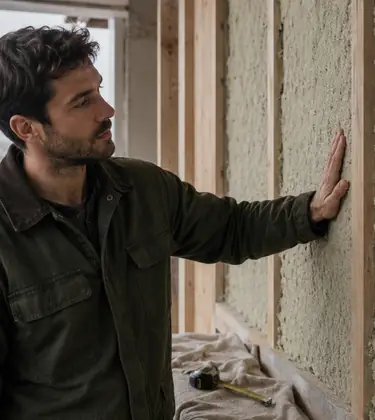
One genuine thing did happen, and it happened in a document almost nobody reads. Hempcrete entered the American residential building code. The 2024 International Residential Code carries Appendix BL Hemp Lime Hempcrete Construction, which means a builder now has a recognized standard to point at when a plans examiner asks what the material is.
That matters more than it sounds. Before this, hempcrete existed in a permitting limbo where every project was an argument. A model code appendix converts an argument into paperwork.
Two caveats belong with the good news. The IRC is a private model code adopted state by state, not federal law, so its appendix binds nobody until a jurisdiction adopts it. And hempcrete has no federal regulatory footprint at all: a full-text search of the Federal Register returns zero documents mentioning it.
Feeling lost on how to start? Try taking our quiz!
Start a QuizWhat hempcrete is, and what it is not
The most repeated claim about this material is also the most wrong. Hempcrete is hemp hurds, the woody core left after fiber is stripped, mixed with a lime binder and water. Its virtues are thermal and hygroscopic. Measurements collected in the engineering literature put its thermal conductivity in the range of 0.06 to 0.6 watts per meter kelvin and its density at roughly 15 percent that of ordinary concrete.
Its compressive strength is around 0.3 megapascals. Structural concrete runs between twenty and thirty. Hempcrete is therefore not able to be used for load-bearing elements in construction, and it gets cast around a separate timber frame that does the structural work.
Which makes the widely circulated headline that hempcrete is seven times stronger than concrete not merely wrong but inverted. It is roughly one percent as strong in compression, and that is fine, because it is insulation and enclosure and was never meant to hold a roof up.
The carbon case is more defensible and still worth stating carefully. Lime reabsorbs carbon dioxide as it cures, and peer-reviewed life cycle work published in the Journal of Cleaner Production estimates net capture between 1.6 and 79 kilograms of CO2 equivalent per square meter. That is a wide range, which is what an honest figure looks like at this stage.
The unexamined day is a wasted opportunity. Reflect on what you did, what you learned, and how you can improve.
John Dewey
The hemp car that never existed
Every hemp article eventually mentions Henry Ford's hemp car. It was not a hemp car. Ford unveiled a plastic-bodied vehicle in Dearborn on August 13, 1941. The New York Times account the following day described it as made of strong material derived from soy beans, wheat and corn, with no mention of hemp. The man who built it, Lowell Overly, described the material as soybean fiber in a phenolic resin. No records of the exact formula survive.
Hemp entered the story decades later through repetition. The likely source of the confusion is that the car was reportedly designed to run on hemp-derived fuel, which is a different claim about a different part of the vehicle.
The same caution applies to hemp bioplastics generally. Bioplastics of all kinds remain under one percent of global plastic production, and starch dominates that fraction. What genuinely exists at industrial scale is hemp fiber used as reinforcement inside a conventional or plant-derived polymer, which is a composite, not a hemp plastic. Natural fiber composites really are used in car door panels and interior trim across most major manufacturers. The plastic in them is not made from hemp.
Where hemp quietly works
Two industrial uses have cleared every hurdle and get almost no attention. Hemp seed as food has been federally settled since December 2018, when FDA responded to three separate notices covering dehulled hemp seed, hemp seed protein and hemp seed oil, and had no questions about any of them. That is why hemp hearts sit in ordinary supermarkets while hemp CBD does not. The seed business is the legitimate one, and it has been legitimate the whole time.
Hemp fiber in composites is the other, and the constraint there is processing, not agronomy. Separating bast fiber from the stalk requires decortication, and the United States lost that infrastructure entirely after 1938. Building it back is a capital problem: fiber selling at twenty cents a pound cannot fund the plant needed to process it.
What a seed company knows about the same plant
Here is the part we can speak to, because it is the mirror image of our own work. Hemp and drug cannabis are one species pulled in opposite directions by breeders over roughly the same period. Fiber breeders selected for tall unbranched stalks, long bast fibers, fast growth and as little resin as possible. We selected for the exact opposite: short internodes, dense branching, enormous flower mass and resin production so heavy it coats the leaves.
Both programs worked. That is why a hemp field looks like bamboo and a flower room does not, and why you cannot usefully make rope from one or extract from the other.
Height is the one trait both programs kept. Amnesia Haze reaches 200 to 250 cm outdoors over 75 to 85 days of flowering, which is hemp territory, and it is still a 22% THC sativa with citrus and earthy incense. Tall and fibrous are not the same instruction to a breeder, and four decades of selection took the two plants somewhere different.
The plant that gives you a wall and the plant that gives you an evening separated a long time ago, and the 0.3 percent line simply wrote that separation into law.
Where this leaves the industrial case
Hemp is defined federally as cannabis testing under 0.3 percent THC, a threshold that becomes stricter in November 2026 when total THC replaces delta-9 and a per-container milligram cap arrives.
US production collapsed 71 percent in a single year after the CBD market failed to receive federal authorization, then recovered to $739 million in 2025. Fiber now takes more acreage than flower and earns roughly a fortieth as much, at twenty cents a pound.
Hempcrete's entry into the 2024 International Residential Code is the real advance, though it remains a non-structural insulating infill with compressive strength around one percent of concrete. Hemp bioplastic remains largely aspirational, fiber composites are genuine, and Henry Ford's car was made of soybeans.
Barney's Farm has been developing premium cannabis genetics since the 1980s, with over 40 Cannabis Cup wins. Explore our full seed catalog and find strains bred for every climate and skill level.