How to Talk to Your Kids About Cannabis (Without Being a Hypocrite)
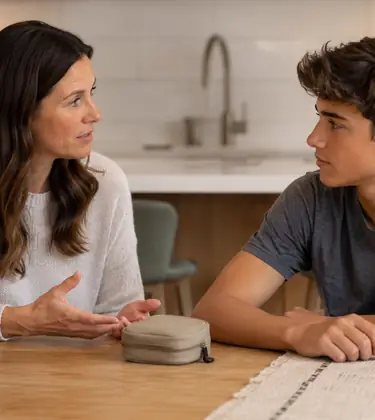
You have been putting this off. Maybe your kid found a vape cart in a friend's backpack. Maybe they asked you a question at dinner and you changed the subject like an amateur. Maybe you just did the math and realized they are the same age you were the first time you got high behind a Wendy's.
Here is the part nobody says out loud: most parents are not scared of the conversation. They are scared of being called a hypocrite halfway through it.
Good news. The research on this is better than you think, and some of it is genuinely surprising.
Your kids are smoking less than you did
Start with the numbers, because they demolish the premise of most panic.
Federal survey data released in July 2026 shows past-year cannabis use among 12 to 17 year olds sitting at 8.7 percent, down from 10.9 percent in 2021. Meanwhile use among adults 26 and older climbed to 20.6 percent from 17.3 percent over the same stretch. The generation doing the parenting is using more than ever. Their kids are using less.
The long-running Monitoring the Future survey of American students found that teen drug use never bounced back after the pandemic dip, which is the opposite of what almost every researcher predicted. Past-year cannabis use came in at 8 percent of 8th graders, 16 percent of 10th, and 26 percent of 12th graders in the 2025 results.
Flip that around and it becomes the most useful sentence you can say to a teenager: 91 percent of 8th graders, 82 percent of 10th graders, and 66 percent of high school seniors did not use cannabis in the past month. When your kid tells you everybody does it, they are wrong, and now you have the receipts.
The honesty trap
Every parenting blog on earth tells you to be honest about your own use. The actual data is messier.
A study of 561 middle schoolers found that kids whose parents disclosed past drug use and framed it with regret ended up with weaker anti-drug attitudes than kids whose parents said nothing. The researchers had hypothesized the exact opposite. Their explanation for why the confession backfires was blunt: kids hear "Mom and Dad used and they turned out fine."
It gets more specific. Researchers at Washington State University surveyed teens in a legal state and found that teens who believed their parents used cannabis held friendlier attitudes toward trying it. Roughly a third believed their father used, a quarter believed their mother did. The strangest finding: closeness to a non-using mother was protective, but closeness to a cannabis-using mother flipped into a risk factor. Warmth amplifies whatever you are modeling. It does not neutralize it.
None of this means lie. Lying torches your credibility the second they figure it out, and they will. It means the "I smoked too, so let me level with you" opener is not the magic key everyone treats it as. Skip the war stories. Skip the regret monologue. Answer the question you were asked, keep it short, and move to the part that matters, which is what you expect from them now.
Why DARE failed and what that teaches you
If you sat through DARE in a gymnasium, you already suspect it did nothing. You are right. A meta-analysis of the program found an effect size on actual drug use of about 0.06, which in plain English is close to zero. Later evaluations found DARE graduates in some samples used more than kids who got nothing. The Surgeon General eventually classified it as an ineffective prevention program, and DARE itself swapped the curriculum out in 2012.
The failure mode was not the topic. It was the delivery. Uniformed adult lectures. Fear imagery. Zero interaction. A message so obviously overstated that when kids discovered weed did not ruin anyone's life on contact, they threw out everything else you told them along with it.
Your kitchen table has the same failure mode available. Overstate the danger and you get one round of compliance followed by permanent disbelief.
Feeling lost on how to start? Try taking our quiz!
Start a QuizWhat is actually different now
Here is where your experience genuinely does not transfer, and it is worth saying plainly.
Average flower potency has climbed from roughly 5 percent THC decades ago to somewhere north of 15 percent today, and concentrates go far beyond that. A dab pen is not a bowl passed around a parking lot. That is not scare messaging, it is arithmetic, and teenagers respect arithmetic more than adjectives.
On the brain question, be careful. The largest study yet, following more than 11,000 kids from ages nine to seventeen and backing up self-reports with hair testing, found flatter growth in memory, attention and processing speed among teen users. The researchers also said, in their own words, that it does not prove cause, that the effects were modest, and that the kids who went on to use had actually tested better in late childhood. Present it that way. A teenager who catches you inflating one study stops listening to the next twenty.
The unexamined day is a wasted opportunity. Reflect on what you did, what you learned, and how you can improve.
John Dewey
The stuff that works
Talk early and often, in small doses, instead of scheduling one summit meeting. Federal guidance suggests starting the broader tobacco, alcohol and drugs conversation around preschool age, long before cannabis specifically is on the table.
Age-stage it. Four to eight is a pure safety conversation about not eating candy you did not get from a parent. Nine to twelve is body and brain and school. Thirteen to fifteen is peers and myths. Fifteen to eighteen is driving, legal exposure, and how to get out of a car with an impaired driver in it without losing face.
Frame it as an adult product with an age gate, the same category as alcohol. "Legal at 21 and used carefully" is a sentence a teenager can actually hold in their head. "Bad and stupid" is not.
And keep the one statistic that should motivate you to open your mouth at all: not wanting to upset their parents is the reason kids most often give for not using drugs. Your opinion carries more weight than you believe it does, right up until you spend it on hysteria.
The unglamorous part: lock your stuff up
If you consume and there are small kids in the house, this is the section that matters most.
Emergency room data on edible exposures in children under six went from roughly 200 cases in 2017 to more than 3,000 in 2021, and nearly a quarter of those kids were hospitalized. Gummies do not look like medicine to a four year old. They look like gummies.
A locking box costs less than an eighth. There is no argument here.
What we have learned growing in family houses
We have been breeding seeds in Amsterdam since 1986, and over four decades a very specific kind of email keeps arriving: a parent who grows a few plants legally at home and wants to know how to do it without turning their kid's house into a curiosity magnet.
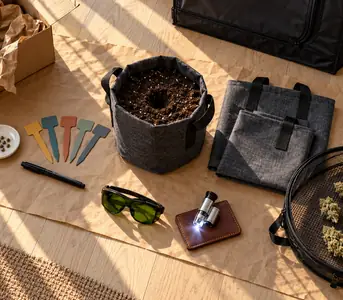
The honest answer is that the plant is the least of your problems. Cured flower in an unlocked drawer is the risk. A tent with a padlock, a carbon filter, and a rule that the tent is not a room anybody else opens solves nine tenths of it. Kids raised around a boring, locked, unremarkable grow tent tend to find it about as thrilling as the water heater.
The second thing we have learned is that potency selection is a real lever, and most people never touch it. Growers chase the biggest number on the label out of habit. If you are consuming in a house with teenagers, the strongest option on the shelf is rarely the one you actually want sitting in your cabinet.
Our own catalogue skews potent, so this takes some deliberate picking. Purple Punch Auto is one of the gentler entries we offer, at 22 percent THC with a stated 1 percent CBD, which is unusual in a modern autoflower. It stays compact at 80 to 100cm indoors, finishes in 65 to 70 days from seed, and produces 180 to 250g per plant. Small, quiet, quick, and not a sledgehammer.
Bubblegum Auto sits at 21 percent, the lowest we currently list on our US store, in a dense 85/15 indica structure that runs 70 to 75 days seed to harvest. We built it for beginners, which in practice also means it is forgiving for people who are growing around a busy household rather than babysitting a tent.
Both ship as collectible souvenir seeds, and germination is governed by your own state's law.
The bottom line
You are not going to nail this in one conversation, and you do not have to. Teen use is falling. Your kid is more likely to abstain than not. The products are stronger, the evidence on harm is real but modest, and the fastest way to lose the argument is to pretend otherwise.
Say less than you planned. Answer what they actually asked. Lock the cabinet. Then bring it up again in a month like it is no big deal, because eventually it will not be.
Barney’s Farm has been developing premium cannabis genetics since 1986, with more than 40 Cannabis Cup wins. Explore our full cannabis seed catalog and find the genetics that fit how you actually medicate.