How to Roll a Joint: Step-by-Step for Beginners
Rolling a joint is one of the oldest cannabis rituals on the planet. Mexican field workers were doing it in the 1850s, blending cannabis with tobacco and sparking up after long days in the sun. Jazz musicians in the 1920s ran with it, passing "jazz cigarettes" around smoky speakeasies while prohibition pushed alcohol underground. The joint survived decades of criminalization, propaganda, and cultural shifts. And here we are, still rolling.
If you've never rolled one yourself, you're in the right place. This is a no-nonsense, step-by-step joint rolling tutorial built for people who are tired of watching their friends do it and want to finally learn.
Why Learn to Roll by Hand?
Pre-rolls are everywhere. In the U.S. alone, pre-roll sales hit $4 billion in recent years, making them one of the fastest-growing product categories in legal cannabis. They're convenient. They're consistent. But they're also someone else's work.
Rolling your own joint gives you total control. You pick the strain, the paper, the size, the density. You decide how much goes in. According to research from the University of Pennsylvania and RAND Corporation, the average joint contains around 0.32 grams of cannabis, but that number varies wildly depending on the roller. Some people pack half a gram. Others go full gram in king-size papers. The point is: when you roll it yourself, it's yours.
At Barney's Farm, we've spent over 30 years breeding cannabis strains that deserve to be rolled properly. From our Amsterdam coffee shop roots to lab-tested genetics sourced across the Himalayas, Afghanistan, and the American West Coast, we know what good flower looks like. And good flower deserves a good roll.
What You Need
Gather your supplies before you start. Nothing kills momentum like scrambling for a filter tip mid-roll.
Rolling papers. King-size papers give you more room to work with, which is helpful when you're learning. Hemp papers burn slow and even. Rice papers are thinner and nearly tasteless. Avoid anything bleached or flavored if you want to actually taste your weed. The rolling paper market has grown substantially as cannabis culture has expanded, and modern papers come in rice, hemp, flax, and other plant-based materials.
Filter tip (crutch). A small rectangle of stiff paper or thin cardboard, rolled into a cylinder. This goes at the mouthpiece end of your joint. It keeps plant material out of your mouth, adds structural support, and lets you smoke the joint all the way down without burning your fingers. Most rolling paper packs include perforated tips. Use them.
Cannabis flower. About 0.3 to 0.5 grams for a standard joint. More if you're using king-size papers and feeling generous. The quality of your flower matters. A lot. Properly cured, trichome-rich bud from a well-bred strain will grind evenly, burn smoothly, and taste like something worth remembering.
Grinder. A two- or four-piece grinder breaks your bud into a consistent texture without pulverizing it. You want pieces small enough to pack evenly but not so fine that they restrict airflow. Fingers work in a pinch, but they're sticky and imprecise.
A flat surface. A rolling tray, a clean table, a hardcover book. Something to catch what falls.
Step-by-Step: How to Roll a Joint
Step 1: Grind Your Weed
Break your bud into small, uniform pieces. Remove any stems. If you're using a grinder, two or three twists should do it. Check the consistency. You want something that looks like coarse sea salt, not powder.
This is where your strain choice shows up. Dense indica-dominant buds from strains like our Critical Kush or 8 Ball Kush will grind differently than airy sativa flowers like Amnesia Haze or Liberty Haze. Denser bud needs a bit more effort to break apart. Airier bud grinds faster but can sometimes be trickier to pack tightly. Both roll well once you get a feel for the texture.
Step 2: Make Your Filter Tip
Take your filter paper and fold the first few millimeters into a small accordion pattern, three or four folds. Then roll the remaining paper around those folds to create a tight cylinder. The accordion creates a barrier that blocks plant material while still allowing smoke to flow through.
The diameter of your filter sets the diameter of your joint. A wider filter means a fatter joint. A narrow filter means a slimmer smoke. For beginners, aim for something roughly the width of a pencil.
Step 3: Fill the Paper
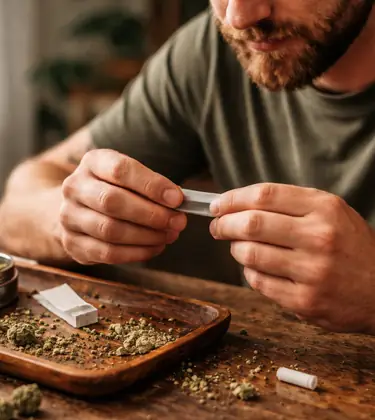
Hold your rolling paper with the adhesive strip facing you, at the top, sticky side up. Place your filter at one end. Sprinkle your ground cannabis evenly along the crease of the paper, beside the filter.
Distribute the flower so it's slightly thicker toward the middle and thinner near the ends. This creates a gentle cone shape, which is the natural geometry of a well-rolled joint. You want even distribution. Clumps mean uneven burning, and uneven burning means that dreaded canoe where one side burns faster than the other.
Step 4: Shape and Tuck
This is the part that separates a rolled joint from a stuffed paper tube.
Pinch the paper between your thumbs and index fingers. Roll the cannabis back and forth gently to shape it into a cylinder. Don't rush this. You're packing the flower into a uniform shape before you seal anything. Spend 10 to 15 seconds just shaping.
Once the cannabis feels evenly packed, tuck the unglued edge of the paper around the flower and filter. Start the tuck at the filter end, where you have a solid anchor point. The filter gives you something firm to roll against. Work the tuck along the length of the joint from the filter outward.
Step 5: Roll and Seal
Roll upward with your thumbs, guiding the paper around the cannabis. Keep tension consistent. Too tight and you'll restrict airflow. Too loose and it'll burn fast and fall apart.
When the adhesive strip is the only thing left, lick it lightly and press it down to seal. Smooth the joint between your fingers.
Step 6: Pack and Twist
Use a pen, chopstick, or the end of a lighter to gently tamp down the cannabis from the open end. This ensures an even density throughout the joint and a smooth, consistent burn.
Twist the excess paper at the tip to close it off. This is your ignition point.
Feeling lost on how to start? Try taking our quiz!
Start a QuizThe Grind Matters More Than You Think
Here's something most rolling guides skip: your bud's moisture content and cure quality affect the roll as much as your technique does.
Flower that's too dry crumbles into dust and burns hot and fast. Flower that's too moist won't grind properly, clumps together, and can be nearly impossible to light evenly. Properly cured cannabis holds its shape when squeezed gently and springs back slightly. The trichomes should be visible, and the aroma should be present but not sharp.
This is where genetics and grow quality intersect with the rolling experience. At Barney's Farm, our breeding program focuses on terpene profiles and resin production alongside potency. Strains like Pineapple Chunk, with its dense bud structure and heavy trichome coverage, or Dos Si Dos, known for its sticky, aromatic flowers, were developed with the end user in mind. When you grow quality genetics and cure the flower properly, the rolling practically takes care of itself.
The unexamined day is a wasted opportunity. Reflect on what you did, what you learned, and how you can improve.
John Dewey
Common Beginner Mistakes
Overpacking. More weed doesn't mean a better joint. A packed-too-tight joint restricts airflow, burns unevenly, and wastes cannabis. You should be able to draw air through it with mild resistance, like sipping through a straw.
Skipping the filter. Some old-school rollers go filterless. For a beginner, that's a recipe for a floppy, hard-to-smoke mess. Use the crutch.
Rushing the tuck. The tuck is the hardest part. If you can't get the paper to catch on the first try, keep shaping the cannabis and try again. Patience here saves you from re-rolling.
Using stale or bone-dry weed. If your flower crumbles to dust when you touch it, it's too dry. You can rehydrate it slightly with a humidity pack (Boveda 62% is the standard), but prevention is better than cure. Store your cannabis in a sealed glass jar, away from light and heat.
Uneven distribution. If one end of your joint is significantly thicker than the other, it will burn unevenly. Take the extra five seconds to spread the flower out before you start rolling.
A Quick Note on Papers
The paper you roll with affects your smoking experience. Thicker papers burn faster and can impart a papery taste. Ultra-thin papers let more of the flower's flavor come through but can be harder to handle for beginners.
Hemp papers are a solid middle ground. They're sturdy enough for beginners, burn at a moderate pace, and complement cannabis flavor rather than competing with it. Modern rolling papers are manufactured from rice, hemp, and flax, each offering different burn characteristics and flavor profiles.
If you're rolling with a Barney's Farm strain that has a complex terpene profile, like Gelato or Gorilla Z, go with a paper that stays out of the way. Unbleached hemp or rice paper will let the flower speak for itself.
Once You've Got the Basics Down
Rolling is a physical skill. Your first joint will probably look rough. Your tenth will look better. By your fiftieth, you'll be rolling without thinking about it.
Once you're comfortable with the standard straight roll, you can experiment. Cones give you a wider cherry and more room at the tip. Inside-out rolls (also called backrolls) use the minimum amount of paper by rolling in reverse and burning off the excess, reducing paper taste even further.
Some rollers swear by specific rituals. A certain way of packing. A particular paper fold. The way they twist the tip. These habits develop naturally over time, and they're part of what makes hand-rolling feel personal. The pre-roll industry might be booming, as Cannabis Science and Technology reports, with pre-rolls expected to grow at about 10% annually through the end of the decade. But a machine can't replicate the satisfaction of sparking something you built with your own hands.
Final Thoughts
Rolling a joint is simple, repeatable, and deeply satisfying once you get the hang of it. You need flower, paper, a filter, and a few minutes. The rest is practice.
So grab your papers, grind your bud, and roll one up. Your hands will figure it out faster than your brain thinks they will.
Barney's Farm has been developing premium cannabis genetics since the 1980s, with over 40 Cannabis Cup wins. Explore our full seed catalog and find strains bred for every climate and skill level.