How Rolling Machines Work
A skilled hand roller in the 1870s managed about four cigarettes a minute. The cigarette machine James Bonsack patented in 1881 managed 120,000 in a ten-hour shift, which is two hundred a minute. One device did the work of fifty people, and the industry was rebuilt around it inside a decade.
A rolling machine for weed is doing exactly what that machine did. Every one sold today, from a two-dollar plastic roller to a cone-filling rig in a production room, runs some version of the four steps Bonsack wrote into his patent: meter the material, form it into a cylinder, wrap the paper around it, and close it off.
Two rollers and a loose belt
The mechanism in a joint roller machine is simpler than it looks, and it has been documented in patents for over sixty years. A 1975 patent describes it precisely as a machine of the twin roller and endless band type, where a band loop runs between two rollers. A 1961 patent describing the same design as already-established prior art puts it in one sentence: the rolling of the tobacco and the wrapping of the paper is done by an apron loosely embracing a pair of rollers, with the paper entering between the nip of the rollers.
Slack in that belt is the whole trick. A 1977 patent on a belt-and-shaft version says it plainly, describing how slack in the belt forms a groove or cradle, which opens to receive material and closes to roll it. The sequence runs like this:
- The band is depressed between the rollers to form a trough, and the material goes in.
- The rollers are turned together by moving the band with the fingers, which shapes the material into a roll.
- The paper is fed between the rollers, the gum is moistened, and the rollers are turned again to complete the cigarette.
One detail from the 1975 patent explains something most people never work out. The machine has an adjustable band guide that alters the effective length of the band loop between the rollers, and changing that loop length changes the diameter of what you make. A pinner and a fat one come off the same machine because the loop is longer or shorter.
Cones changed what the machine has to do
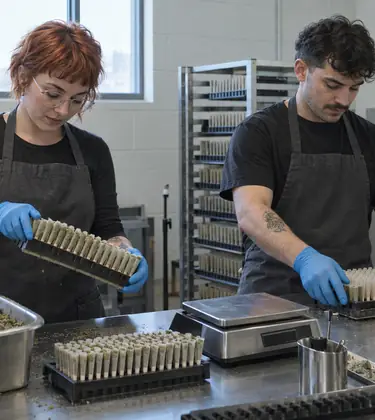
A pre-rolled cone arrives already formed and already glued, so nothing needs rolling. What is left is filling, and filling a narrow paper tube evenly is a different engineering problem. The knock box is patented, and the patent is unusually candid about the mechanism. A cone-loading device granted in 2022 describes a body with a socket, a plate whose openings rotate to align with the channels holding the cones, and a cap that pushes the loaded cones back out. The settling step is a knock. The user picks the device up and bangs its bottom surface against a hard surface, which the patent says may aid in settling the tobacco into a bottom section of each wrapper.
Commercial equipment splits the job further. A 2025 patent on cone filling and packing describes shaking and tilting the plate to guide filling material into the cones, then moving thin rods in a gentle up and down circular pattern to pack, then extruding the finished cones onto a catcher. Notice that the real compression happens at extrusion, not at the tamping stage, and that the patent specifies gentle packing.
What you load matters as much as how you knock it. A cone channel is narrow and the material has to travel down it, so flower that grinds loose and springy drops and settles, while sticky resin-heavy flower bridges near the top and leaves the tip empty. Acapulco Gold, a 70 percent sativa that flowers with fat colas, breaks down into the light even grind that behaves well in a cone.
Worth flagging honestly: the vibration tables sold for cone filling are not documented anywhere in the patent record as a primary filling mechanism. The mechanisms that are documented are impact settling and manual shake-and-tilt. If a supplier tells you vibration is the professional method, that is a sales claim rather than an engineering one.
Electric rollers are two different products
The category covers two machines that have almost nothing in common. At the industrial end is a genuinely sophisticated device. A 2021 patent for a cigarette rolling machine describes uniformly metered charges deposited into a trough formed in a belt, a computer-controlled stepper motor driving the belt, filters abutted to the ends, the paper entrained into the bight to encircle the material, and the twinned pair drawn across a knife and parted into two. It also includes belt tension sensors whose computer commands wind the belt around a tensioning spindle or apply holding torque, which is how tension is held steady through the roll.
That tension loop is the real answer to why machine-rolled product is consistent. Belt tension sets packing density, the machine measures and holds it, and a thumb cannot.
At the consumer end is the small electric joint roller sold online, for which no patent appears in the record at all. They exist and some of them work, but they are not the machine described above and the engineering behind them is not public.
Feeling lost on how to start? Try taking our quiz!
Start a QuizDensity is the variable that matters
The argument about hand versus machine lives here, and the tobacco engineering literature has measured all of it. Draw resistance is not a matter of opinion. ISO 6565 covers the measurement of the draw resistance of cigarettes and pressure drop of filter rods, and the standard is explicitly applicable to cigarettes, filter rods, and by extension to cylindrical tobacco products similar to cigarettes. A joint is a cylindrical smoking article, so the method was written to cover its shape. The standard defines pressure drop as the static pressure difference across the article when air passes through it at a fixed 17.5 milliliters per second, and draw resistance as that pressure drop when the flow comes from aspiration. For a yardstick, the most widely used research cigarette in the world draws at 128 mm of water.
Airflow inside the rod behaves like a packed bed. Regression work on pressure drop found that viscous flow accounted for 79 percent of the total pressure drop in tobacco columns, with inertial flow contributing 19 percent. You are not pulling air down a pipe, you are pulling it through packing.
Density then governs the burn. Classic combustion research found that the distance burn rate falls as tobacco rod density rises, while the mass burned per minute stays constant. A tighter roll burns more slowly along its length without consuming material any faster.
Diameter matters just as much, and here there are hard numbers. An experimental study varying rod circumference found that the maximum instantaneous burn rate ran from 1.84 mm/s to 2.48 mm/s as circumference was reduced from 24 mm to 17 mm, with the thinner cigarettes showing higher combustion temperatures and smaller coals. Thin burns faster and hotter. That is measurement, not preference.
Grind feeds into the same chain. Tobacco research found firmness increasing with shred width in machine-made cigarettes, and firmness correlating with pressure drop. For cannabis specifically, research presented at a Canadian chemistry conference and reported by Scientific American compared 1 mm, 3 mm and 5 mm grinds, finding the 1 mm grind delivered the most cannabinoid per puff while the 5 mm grind produced a longer-lasting joint, with the fine grind finishing in roughly half as many puffs.
The unexamined day is a wasted opportunity. Reflect on what you did, what you learned, and how you can improve.
John Dewey
Why a machine roll feels different
Put the measurements together and the difference between a machine roll and a hand roll stops being mysterious. A machine applies the same belt tension along the entire length, so density is even end to end. A hand roll is almost always denser where the fingers worked hardest, which is usually the middle, and looser at the ends. Even density means even draw resistance, which means an even burn rate, which is the whole of what people mean when they say a machine roll burns better. The failure modes follow from the same chain:
- Rolled too tight and pressure drop rises, so you pull harder, which raises the coal temperature.
- Packed too loose and air races through, so it burns fast and runs down one side.
- Filled unevenly and the burn front reaches the loose part first, which is what a canoe actually is.
- Compressed evenly at a moderate density and none of those happen, which is the only thing a machine is really selling.
The best rolling machine for you is therefore the one that suits what you feed it, because a machine cannot fix what you put in. Grind too fine and the packed bed becomes restrictive no matter how evenly it was rolled. Grind too coarse and you get channels that burn ahead of the rest. A machine makes a consistent version of whatever you loaded.
Runtz Muffin shows the problem from the other side. It is dense and resin-heavy enough that a fine grind clumps against the belt, and a slightly coarser one rolls clean. That variable has a name in the tobacco literature, shred width, and it is set before the machine is switched on.
The machine has not changed much
Bonsack's four steps were meter, form, wrap and cut, and every device in this article is doing some subset of them. The hand roller forms and wraps, and you meter and cut yourself. The cone filler only meters and settles, because the forming and wrapping were done at the factory. The industrial machine does all four with a stepper motor and a tension sensor.
What the measurements add is a reason to care. Density controls draw resistance, draw resistance controls how hard air moves through the packing, and airflow controls how hot the coal burns. A machine is worth using because it holds that chain steady from one end of the roll to the other, which a hand cannot reliably do. Barney's Farm has been developing premium cannabis genetics since the 1980s, with over 40 Cannabis Cup wins. Explore our full seed catalog and find strains bred for every climate and skill level.