Macro Shots and Trichome Close-Ups: Cannabis Photography as a Genre
Every technical problem in cannabis photography comes from one number. The glandular heads people are trying to photograph measure 40 to 110 micrometers across, according to a 2023 study of trichome development in high-THC inflorescences. The thickest of them is about the width of a human hair.
Photograph something that small and ordinary photography stops working. Depth of field collapses to almost nothing, the subject is glossy and wet-looking, and the light that makes it look good is the light that blows it out.
What is in the frame
The structures are capitate-stalked glandular trichomes, and they are where the plant makes what it is grown for. Cannabinoids and terpenes are produced in glandular trichomes, which is why a photograph of them reads as a photograph of potency rather than of surface texture.
The anatomy matters for framing. A stalked trichome is a column topped by a roughly spherical head, and inside that head sits a disc of secretory cells. The 2020 University of British Columbia work that mapped this found stalked trichomes carrying 12 to 16 secretory disc cells against eight in the smaller sessile ones, and described the large mushroom-shaped stalked trichomes as the richest source of THC and CBD-forming metabolites.
So the shot everyone wants, the forest of translucent globes on stalks, is not a decorative choice. It is the part of the plant that does the work.
Subject choice does more here than gear does. A plant like Cherry Poppers, which carries pronounced trichome production with a crystalline appearance and a generous calyx-to-leaf ratio, leaves the resin unobstructed. When the subject is 40 micrometers across, half the battle is clearing foliage out of the frame before you start.
Why one frame is never enough
Macro proper begins at life-size. A macro photograph is one where the image captured is life-size or larger, a reproduction ratio of 1:1 or greater, and a macro lens is one capable of that ratio.
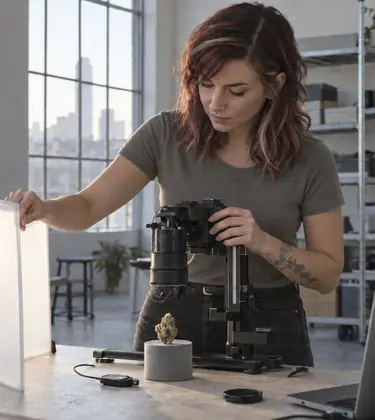
At those magnifications depth of field becomes vanishingly thin, often less than a millimeter. A single trichome head is deeper than the zone that will be sharp, so one exposure cannot render even one gland front to back.
Knowing how to photograph buds is mostly about accepting that. The standard answer is to take many frames at different focus distances and merge them. Focus stacking is a digital image processing technique that combines multiple images taken at different focus distances to give a greater depth of field than any of the individual source images, and the Wikipedia entry names macro photography and optical microscopy as its two typical examples.
The obvious alternative, stopping the lens down, fails for a reason built into optics. Any optical system has a resolution limit set by diffraction, and the smaller the aperture, the harder that limit bites. Past roughly f/8 to f/11 on most macro setups you are trading real sharpness for the illusion of depth.
Most macro weed photos that circulate online are focus stacks, whether or not the photographer mentions it. Published work shows the scale of the effort involved. Erik Christiansen, whose photographs fill the 2015 book Green: A Field Guide to Marijuana, takes between 25 and 40 macro shots of each bud at different focal points and stacks them, according to Slate's 2015 profile of his work.
Light is the second problem
Trichome photography has one recurring problem. Trichome heads are glossy spheres, and glossy spheres do exactly what physics says they will do. Specular reflection is the mirror-like reflection of light from a surface, as opposed to diffuse reflection where light scatters away in many directions. A resin head reflects your light source back at the lens as a hard white dot, and a hundred of them turn a bud into a field of blown highlights.
The fix is to make the source large. Softness depends mostly on the size of the source, its distance from the subject, and the thickness of its diffusion, which means a big diffuser close in. Technical guidance from microscopy makes the constraint explicit: diffusion accessories are unlikely to have the desired effect unless the diffuser is large relative to the specimen being illuminated. With a subject a tenth of a millimeter wide, almost any diffuser qualifies as large, which is why a sheet of paper an inch away outperforms an expensive light three feet back. A few practical consequences follow:
- Get the diffusion close enough that it wraps the subject, since distance is what turns soft light hard again.
- Kill reflections of the room, because a dark ceiling above the set removes a highlight you will otherwise spend an hour retouching.
- Work with the bud slightly off axis to the light, so the highlight rolls off the side of each head instead of sitting in the middle of it.
Feeling lost on how to start? Try taking our quiz!
Start a QuizCredentials the genre has collected
Cannabis photography is now taken seriously enough to have institutional credentials, and they are worth knowing if you are pitching this work. Christiansen's photographs were published by Chronicle Books in a 396-page hardcover in 2015, and the design press covered the book as design, not as advocacy. On the scientific side, Ted Kinsman, an associate professor in the School of Photographic Arts and Sciences at the Rochester Institute of Technology, published a book of cannabis microscopy in 2018, and a cannabis trichome image of his received an Award of Excellence in the electron micrograph category of the BioCommunications Association's 2018 juried salon. The Oakland Museum of California staged a cannabis exhibition the year before.
What is missing is art criticism. There is mainstream press coverage, there is professional imaging recognition, and there is no body of critical writing about cannabis photography as photography. That absence is itself a fair description of where the genre sits.
The unexamined day is a wasted opportunity. Reflect on what you did, what you learned, and how you can improve.
John Dewey
Product work runs into the rules
Cannabis product photography runs into a constraint that has nothing to do with lenses. A 2023 peer-reviewed analysis extracted the policies of eleven major social platforms and found that all prohibited sales, nine prohibited paid advertising, and four prohibited unpaid promotion including user-generated content. The authors concluded that the policies are ambiguous, which is the practical experience of every photographer who has had an account restricted without knowing which rule applied.
State law adds its own layer. Washington's cannabis statute bars outdoor signage from containing depictions of cannabis plants, cannabis products, or images that might be appealing to children. New York's guidance prohibits advertisements that depict cannabis consumption. The better the photograph, the fewer of the channels it can legally run in.
A camera that measures instead of illustrates
The most interesting development is that this photography stopped being illustration and became measurement.
Growers have judged harvest timing for decades by watching trichome heads shift from clear to milky to amber. A 2023 paper on automatic trichome gland analysis stated flatly in its own abstract that the importance of this transition, as it impacts quality and describes maturity, had never been investigated. The rule everyone follows had no research behind it.
It is being investigated now, with cameras. A 2026 study built a two-stage machine vision pipeline on high-resolution macro images captured with low-cost smartphone systems, detecting trichomes and then sorting them into clear, milky or amber classes at 98.6 percent accuracy. The result carries a twist: the authors reported that stigma coloration, not trichome color, provided the robust visual indicator of peak chemical maturity.
Separate work on 25 genotypes found the grower's amber rule of thumb a useful approximation for stigmas in most cases, while recommending genotype-specific study. Photograph carefully enough and you are no longer illustrating the harvest decision. You are taking the measurement it depends on.
Choosing a subject worth the effort
Color is the other variable a photographer controls before switching the camera on, and it is the one most people ignore. Diffused, low-contrast lighting is what this subject demands, and a uniformly green bud photographed that way goes flat. Something like Bubblegum Gelato, which throws deep purple against green under crystalline trichomes, holds its separation under exactly that light. A short checklist before you set up:
- Pick a bud with resin standing proud of the surface, since a shot of buried trichomes is a shot of leaf.
- Cut the sugar leaves back before shooting, not in post.
- Shoot the specimen fresh. Heads collapse and dull within hours of handling.
- Set up so the bud does not move at all between frames, because a stack of forty exposures forgives nothing.
Small subject, long process
Cannabis macro photography is a technical discipline with a fixed set of problems and known solutions. The subject is tens of micrometers across, which destroys depth of field, so you stack dozens of frames. It is glossy, which produces specular highlights, so you make the light source large and close. It is legally awkward to publish, so the best images often live in books and galleries instead of advertising.
And the work has quietly become useful beyond looking good, because a camera that can resolve a trichome head can also count and classify it. Barney's Farm has been developing premium cannabis genetics since the 1980s, with over 40 Cannabis Cup wins. Explore our full seed catalog and find strains bred for every climate and skill level.