How Old Do You Have to Be to Buy Weed? Age Laws by State
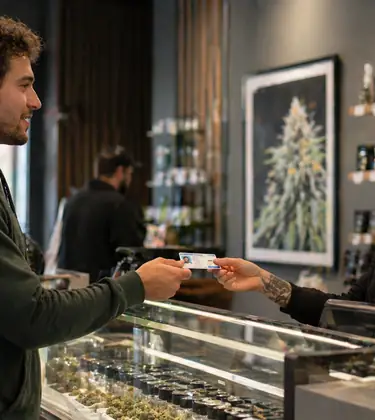
You walk into a dispensary, the budtender asks for your ID. That is the moment that separates the curious from the legal customer. Cannabis rules in America are a patchwork stitched together by fifty different state legislatures and one tangled federal code, but one number shows up almost everywhere: 21. Here is the actual map of who can buy what, where, and at what age.
How Old Do You Have to Be to Buy Weed in the U.S.?
For recreational purchases, you need to be 21. That is the rule in every state that has legalized adult-use cannabis. There is no state where someone 18, 19, or 20 can walk into a recreational dispensary and buy weed without a medical card.
The number of states where this applies keeps shifting. Recreational cannabis is legal in 24 states, three U.S. territories, and the District of Columbia, with another batch running medical-only programs. As of early 2026, around 39 states have legalized cannabis in some form.
Federally, the picture is messier. Cannabis was a Schedule I controlled substance for over fifty years, putting it in the same legal category as heroin. That changed when President Trump's December 2025 executive order directed the DEA to reschedule marijuana to Schedule III, with the first move taking effect in April 2026. Rescheduling is not legalization. Adult use under federal law is still off the books, and crossing state lines with cannabis remains illegal regardless of what your origin and destination states allow.
Which States Let You Buy Recreational Weed at 21?
In every state with recreational sales, the age is 21. Full stop. Alaska, Arizona, California, Colorado, Connecticut, Delaware, Illinois, Maine, Maryland, Massachusetts, Michigan, Minnesota, Missouri, Montana, Nevada, New Jersey, New Mexico, New York, Ohio, Oregon, Rhode Island, Vermont, Washington, and Washington D.C. all run on the same number.
Two places sit in legal limbo:
Washington, D.C. has legal possession but no retail sales. Congress blocks the city from setting up a regulated market, so a gifting economy fills the gap. You "buy" something else and weed comes along for the ride. Still 21 to possess.
Virginia legalized possession and home cultivation back in 2021 but has no licensed retail. As of early 2026, the state legislature finally approved a retail framework, with sales expected to begin January 2027.
Within legal states, possession limits, edible caps, and home grow rules vary wildly. New York lets you carry up to three ounces. California caps you at one. Always check what is allowed where you actually are.
Can You Get Weed Before 21 with a Medical Card?
In most medical marijuana states, the cardholder minimum is 18. With a valid medical card and a qualifying condition, an 18-year-old can enter a medical dispensary and buy directly. A handful of states sit at 19 or 21 instead.
For people under 18, the system runs through caregivers. A minor patient typically needs:
A qualifying diagnosis. Pediatric epilepsy, certain cancers, severe chronic pain, autism in some states, and other listed conditions vary state to state.
Two physician recommendations. Colorado is one example where minors need approval from two doctors instead of one.
A registered caregiver. A parent or legal guardian becomes the cardholder, buys the product, and administers it. The minor never enters the dispensary.
Reciprocity is its own minefield. Some states honor out-of-state medical cards. Most do not. If you carry a card in one state and travel to another, look up the rules before you go. A card from Maine does not get you into a New York medical dispensary.
Feeling lost on how to start? Try taking our quiz!
Start a QuizWhy Is the Legal Age for Weed 21 and Not 18?
You can vote at 18. You can sign a lease, take out loans, get drafted. So why is weed pegged to 21?
The short answer is that 21 was copy-pasted from alcohol policy. The federal alcohol minimum got locked in by a 1984 highway funding law that pressured states to raise their drinking age, and when Colorado and Washington rolled out the first recreational cannabis programs in the early 2010s, they reused that number wholesale.
The longer answer involves the "brain development until 25" argument. You have heard it. It shows up on news segments, in legislative testimony, even on some government health pages. A 2025 review of the neuroscience literature found that no study actually identifies age 25 as a developmental finish line, and that around 90 percent of brain growth is complete by age 5, with executive functions like impulse control and emotional regulation stabilizing between 18 and 21.
A separate Canadian analysis comparing different minimum legal ages found that the optimal age varies by outcome: 21 for educational attainment, 19 for mental health, and 18 for general physical health. There is no single magic number. International data backs this up: Canada and Germany legalized at 18 or 19, with no observable wave of brain damage among young adults.
That does not mean adolescent use is risk-free. Heavy daily use under 18 has real associations with cognitive and mental health issues. But the specific case for 21 over 19 or 20 rests more on policy alignment with alcohol than on any cliff in your prefrontal cortex.
The unexamined day is a wasted opportunity. Reflect on what you did, what you learned, and how you can improve.
John Dewey
What Happens If You Get Caught Buying Weed Underage?
Penalties range from forgettable to serious depending on the state, the amount, and how you got it.
In most legal states, possession of a small amount by someone under 21 is treated as a civil infraction or low-level misdemeanor. Think of a parking ticket you definitely do not want, but not a record-ruiner. California's underage possession of small amounts brings fines and possible drug education rather than jail.
Buying with a fake ID escalates everything. Forged identification can compound the cannabis charge with an identity-fraud charge, and dispensary scanners catch most fakes instantly. The budtender is not your friend on this one. Their license depends on saying no.
In states with no legal market, possession of any amount can still mean criminal charges. Idaho, Indiana, Kansas, Nebraska, Wyoming, and South Carolina maintain full prohibition or extremely limited programs, and getting caught there with weed bought legally elsewhere becomes a problem the moment you cross the state line.
What ID Do You Need to Bring to a Dispensary?
Bring a real, government-issued, photo ID that clearly proves your age. The standard menu:
Driver's license. Out-of-state licenses work fine in recreational states.
State-issued ID card. For people who do not drive, this is the workhorse.
Passport or passport card. Useful for international visitors and often the only ID accepted if your driver's license is expired.
Military ID. Active duty, reserves, and dependents.
Permanent resident card. Where accepted, this works for non-citizens.
A few rules of thumb. Expired IDs are dead in the water, even if expired by a single day. Photocopies and phone photos of IDs do not count. Vertical-format licenses (issued to drivers under 21 in many states) sometimes get refused even after the holder turns 21, so update yours once you hit the milestone. And many dispensaries are still cash-only thanks to federal banking restrictions, so hit the ATM before you arrive. There is usually one inside, but it charges.
Barney's Farm Has Outlived Most U.S. Cannabis Laws
Barney's Farm started breeding in Amsterdam in 1986. That was 26 years before Colorado and Washington became the first U.S. states to legalize recreational cannabis, and a decade before California cracked open the medical door with Proposition 215 in 1996.
We have watched American cannabis policy rewrite itself in slow motion. In 1986, getting caught with a few ounces of weed in the U.S. could mean federal time. In 2026, an adult with a driver's license can walk into a glass-fronted dispensary in 24 states and pick up Cannabis Cup-winning genetics. The shift is one of the largest legal pivots in modern American history.
The strains that built the legal market here were not invented in U.S. dispensaries. They were bred in Amsterdam coffee shops and basement gardens by people who did not wait for permission. Amnesia Haze, the legendary sativa, was already a global benchmark when most American adults still associated weed with stoner movies. LSD, the indica-leaning Barney's classic named for its mind-bending high, was a connoisseur favorite decades before any state legalized adult use.
When you turn 21 and buy your first jar at a dispensary, you are mostly buying the descendants of those classics. Most modern hybrids on a U.S. dispensary menu trace back through three or four generations to Old World breeders who were cooking up genetics while the DEA was kicking down doors. Knowing where the lineage came from is part of being a real cannabis consumer rather than just a customer.
The age laws will keep changing. More states will legalize, the federal schedule will keep shifting, and the rules around medical access for younger patients will keep getting argued in state legislatures across the country. The constant is the plant itself. Bring your ID, buy from a licensed shop, respect the limits in your state, and the rest of the system will sort itself out around you.
Barney's Farm has been developing premium cannabis genetics since the 1980s, with over 40 Cannabis Cup wins. Explore our full cannabis seed catalog and find strains bred for every climate and skill level.