How Many Americans Actually Use Cannabis? What the 2026 Data Shows

Sixty-one point six million Americans used cannabis in the past year. Forty-three point eight million used it in the past month. Roughly one adult in five.
And for the first time since the federal survey started climbing, the number went down.
This guide covers the newest national figures, the finding that daily cannabis users now outnumber daily drinkers, how much states differ, and what people are actually doing with it.
The headline numbers
The National Survey on Drug Use and Health is the federal instrument here, and its 2025 results were published in July 2026.
Past-year cannabis use among Americans aged twelve and over came in at 21.2 percent, or 61.6 million people, with past-month use at 15.1 percent, or 43.8 million.
By age, past-year use runs 8.7 percent among 12 to 17 year olds, 33.7 percent among 18 to 25 year olds, and 20.6 percent among everyone 26 and over. That middle number is the one worth sitting with. A third of American adults in their late teens and early twenties used cannabis last year.
The line bent down
The 2024 survey put past-year use at 22.3 percent and 64.2 million people, with past-month at 15.4 percent. The 2025 survey came in lower on both: 21.2 percent and 15.1 percent.
The adolescent drop is sharper. Past-year use among 12 to 17 year olds fell from 10.4 percent to 8.7 percent in a single year.
These are the same survey, the same methodology, consecutive years, so the comparison is clean. After more than a decade of increases, cannabis use in the United States declined.
One year is not a trend and it would be foolish to declare one. But the figures had risen consistently from 19.0 percent past-year in 2021, and that run has stopped.
Daily users now outnumber daily drinkers
The single most striking finding in recent cannabis research is not about how many people use it. It is about how often.
Analysis of four decades of survey data by a Carnegie Mellon researcher found that in 2022 there were 17.7 million daily or near-daily cannabis users against 14.7 million daily or near-daily drinkers. That had never happened before.
The scale of the change is easier to see across the whole period. In 1992 the same measure showed 0.9 million daily cannabis users against 8.9 million daily drinkers. That is a roughly fifteenfold increase in high-frequency cannabis use in thirty years.
Total consumption grew faster than participation. Between 2008 and 2022, past-year use rose 120 percent while total days of use rose 218 percent, from 2.3 billion to 8.1 billion days a year.
The usage patterns differ fundamentally. Median cannabis users report 15 to 16 days a month. Median drinkers report 4 to 5. About 42 percent of cannabis users report daily or near-daily use against 11 percent of drinkers.
The researcher's own framing was that this pattern resembles tobacco use more than it resembles typical drinking, which is a useful and uncomfortable comparison.
Feeling lost on how to start? Try taking our quiz!
Start a QuizWhat Gallup finds when it just asks
Survey instruments matter, and Gallup's phrasing produces lower numbers than the federal survey because it asks specifically about smoking.
Its most recent figure has 15 percent of Americans saying they smoke marijuana, up from 7 percent in 2013. Forty-seven percent say they have tried it at some point.
Separate Gallup work found 9 percent of US adults use cannabis regularly, defined as at least ten days a month, with about 19 percent using at least monthly. That breakdown showed use concentrated among lower-income and less-educated respondents, at 16 percent regular use below $24,000 in household income against 5 percent above $180,000.
The doubling since 2013 is the durable finding. Whatever the absolute number, self-reported use has roughly doubled in a decade.
The unexamined day is a wasted opportunity. Reflect on what you did, what you learned, and how you can improve.
John Dewey
Where people live changes everything
State-level variation is enormous, and it maps onto legal status without being fully explained by it.
Research using the federal survey found past-month use at 15.1 percent in states with legal sales against 9.5 percent in states without. At the extremes: Vermont at 19.5 percent, Oregon 18.5 and Washington 18.3, against Utah at 6.1 percent, Texas 7.1 and Wyoming 7.2.
Vermont's rate is more than three times Utah's.
The important caveat sits in the same analysis. Increases in adult use occurred in both legalization and non-legalization states, which means legal status is not doing all the work. States that legalized were frequently states where use was already higher, and use rose everywhere over the period.
Access is now the normal condition and not the exception. Pew reports that 53 percent of Americans live where recreational use is legal, and 79 percent have at least one dispensary in their county, with around 15,000 dispensaries nationwide. Support for some form of legalization sits at 89 percent.
Smoking still wins, but not alone
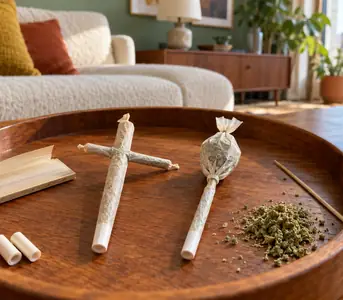
Consumption method is where the culture has shifted most and the data is clear. Among past-year users in the 2025 survey, 74.8 percent smoked it, 49.2 percent ate or drank it, 39.2 percent vaped it, and 14.5 percent dabbed concentrates. Those add to well over 100 percent because most people do more than one.
Smoking remains dominant, which surprises people who assume edibles have taken over. What has actually happened is that roughly half of all users now also consume orally and four in ten also vape, without abandoning flower.
The figures barely moved between 2024 and 2025, which suggests the method mix has settled instead of continuing to shift.
What 61.6 million people means for a plant
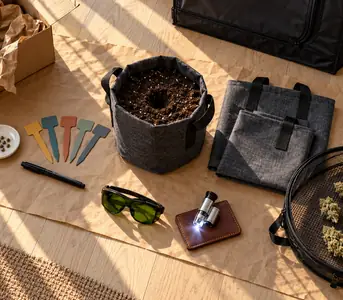
Here is the number that interests us most, and it is one nobody publishes. Nobody counts home growers. The federal survey asks how people consume, not where their cannabis came from, so a category that certainly includes millions of people is entirely invisible in the national statistics.
What we can infer is that the market described above is nothing like a monolith. Forty-two percent of users are consuming daily, which is a very different relationship to supply than the person who has an edible twice a year. Daily consumption at legal retail prices is expensive, and the arithmetic pushes hard toward growing.
That is also why the plant itself has changed. A crop bred for occasional users can be a single spectacular cultivar. A crop bred for daily consumers needs range, because nobody wants the same thing every evening for a year, and it needs yield, because the economics only work at volume.
Blue Sunset Sherbert is a good example of the modern middle of that range, Sunset Sherbet crossed with Purple Punch at 28% THC, unusually quick at 59 to 63 days, sweet candy and citrus zest that starts creative and lands heavy. Watermelon Z sits alongside it at 28% with a fixed 63 day flower, watermelon and grape, uplifting rather than sedating.
Four decades of breeding has taught us that the useful question is not which plant is strongest. It is which three or four plants cover a year without boredom, and that is a question the survey data suggests tens of millions of Americans are now quietly answering for themselves.
One more number worth knowing
Support and participation are not the same thing, and the gap between them is the most politically interesting figure in the whole dataset.
Around one American in five used cannabis last year. Nearly nine in ten support legalizing it in some form. That is an enormous gap, and it tells you the politics of this stopped being driven by users a long time ago.
It also explains why legalization keeps winning in states where use rates are unremarkable. People are not voting for their own consumption. They are voting on whether the criminal law should be involved at all, which is a different question and one that a majority answered years ago.
The short version
61.6 million Americans used cannabis in the past year and 43.8 million in the past month, according to federal data published in July 2026. Both figures fell from the previous year, the first decline after a sustained climb, with the sharpest drop among teenagers.
Daily or near-daily cannabis users have outnumbered daily drinkers since 2022, and total days of consumption more than tripled between 2008 and 2022.
State rates vary by a factor of three, legal-sales states run substantially higher, and use rose in non-legal states too. Three quarters of users smoke, half also eat or drink it, four in ten also vape.
Barney's Farm has been developing premium cannabis genetics since the 1980s, with over 40 Cannabis Cup wins. Explore our full seed catalog and find strains bred for every climate and skill level.