Home THC Test Kits: Can You Check Potency Yourself?
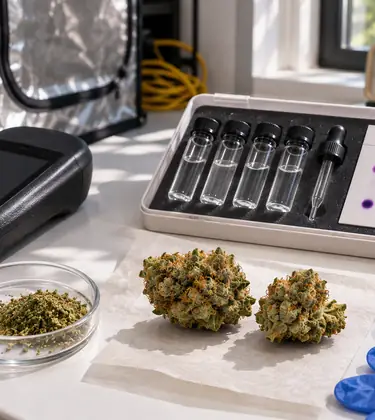
A jar says 30% THC, the high says otherwise, and the label is the only number you have. Home potency testers promise a second opinion, from pocket scanners that read a bud with light to small chemistry kits that show colored spots.
A THC test kit for potency is a different product from the drug tests sold at pharmacies, which look for THC in urine or saliva. This one measures the plant, and how far you can trust its number depends on the method inside the box.
Key takeaways
- Home potency testers estimate THC in flower or infusions, a different job from drug tests that screen urine or saliva.
- In a 2023 Colorado study, about 70% of dispensary samples tested more than 15% below their labeled THC.
- A 2024 study found a portable near-infrared scanner predicted THCA in whole buds with an average error of 13%.
- Home readings are best for comparing your own batches, while label claims need a licensed lab.
Potency testing, explained
Lab potency numbers come from chromatography. A licensed lab dissolves a small sample, runs it through a column that separates each cannabinoid and measures every one against known standards, usually with HPLC, high-performance liquid chromatography. Liquid chromatography reports THCA and THC separately, while gas chromatography heats the sample and turns much of the THCA into THC along the way, so the two methods can print different-looking numbers for the same bud.
Raw flower holds mostly THCA, which becomes THC only when heated. That is why labels list total THC, which adds the THC to 87.7% of the THCA, the share left after part of the acid breaks off as carbon dioxide. Any weed potency test, at home or in a lab, should say which of the two figures it reports. Labs usually correct for moisture and report potency by dry weight, while a home device reads the bud as it is, so a damp sample can read lower.
A home tester tries to estimate the same numbers without the lab, the solvents or the calibrated standards, and that shortcut explains most of its error.
Labels miss more often than shoppers think
Researchers in Colorado bought 23 samples from 10 dispensaries along the Front Range, tested them by HPLC and compared the results with the packaging. The average measured THC was 14.98%, far below typical label claims, and ~70% of the samples were more than 15% lower than the THC printed on the label, the 2023 PLOS ONE study found. The authors called for urgent steps to make labels more accurate. The key results look like this:
| What the study measured | What it found |
|---|---|
| Samples tested | 23, from 10 dispensaries |
| Lab method | HPLC |
| Average THC measured | 14.98% |
| Average gap below the lowest label figure | 23.1% |
| Samples more than 15% under the label | About 70% |
| Samples at half the labeled maximum | 3 |
| What the study measured | Samples tested | Lab method | Average THC measured | Average gap below the lowest label figure | Samples more than 15% under the label | Samples at half the labeled maximum |
|---|---|---|---|---|---|---|
| What it found | 23, from 10 dispensaries | HPLC | 14.98% | 23.1% | About 70% | 3 |
That gap matters for anyone who doses or pays by potency, and it is the main reason home testers sell. They cannot fix a label, but they can show whether two jars that claim the same number come anywhere close.
Feeling lost on how to start? Try taking our quiz!
Start a QuizScanners, color kits and labs
Every cannabis potency tester on the home market falls into one of two families, and a licensed lab sits above both. Before buying a home THC tester, it helps to see them side by side:
| What it is | Handheld NIR scanner | Thin-layer test kit | Licensed lab test |
|---|---|---|---|
| How it works | Reads near-infrared light bounced off the sample | Separates cannabinoids on a coated plate with solvent | Separates and measures each cannabinoid against standards |
| Sample | Whole or ground flower | A pinch of ground flower | A small sample sent to the lab |
| What you get | An estimated THC or THCA percentage | Colored spots that show rough ranges | Exact figures for each cannabinoid |
| Sample after | Kept | Used up | Used up |
| Best for | Comparing your own batches | Seeing which cannabinoids dominate | Labels, sales and settling doubts |
| What it is | How it works | Sample | What you get | Sample after | Best for |
|---|---|---|---|---|---|
| Handheld NIR scanner | Reads near-infrared light bounced off the sample | Whole or ground flower | An estimated THC or THCA percentage | Kept | Comparing your own batches |
| Thin-layer test kit | Separates cannabinoids on a coated plate with solvent | A pinch of ground flower | Colored spots that show rough ranges | Used up | Seeing which cannabinoids dominate |
| Licensed lab test | Separates and measures each cannabinoid against standards | A small sample sent to the lab | Exact figures for each cannabinoid | Used up | Labels, sales and settling doubts |
Thin-layer chromatography, the method behind most color kits, is a simplified cousin of the lab method. It shows which cannabinoids dominate and roughly how much, but it gives a range instead of a precise percentage. Scanners answer in seconds and cost the most up front, while color kits cost little per test but take longer and some practice to read. A third device, the infusion tester, reads a few drops of homemade butter, oil or tincture and estimates its strength, which helps when dosing edibles at home.
The unexamined day is a wasted opportunity. Reflect on what you did, what you learned, and how you can improve.
John Dewey
How close handheld scanners come
Near-infrared scanners are the closest thing to a lab in your pocket, and published tests show their limits. In a 2024 study of a portable scanner used on whole buds before harvest, the best model predicted THCA with a prediction error average of 13%, against reference results from a lab instrument. On a bud near 25% THCA, a 13% error means the reading can land about three points either side of the true value.
A second 2024 study tested a rugged handheld sensor built for Austrian authorities to sort legal from illegal cannabis on the spot. In the hands of non-expert users, the achieved classification accuracy is higher than 80%, the authors report, for a simple legal-or-illegal call instead of a percentage. Both teams worked with carefully calibrated research setups, so a consumer device on a kitchen counter should not be expected to do better.
Every scanner reading is a prediction from a model built on lab-tested samples. Moisture, grind size and strains unlike the ones behind the model all push the number around, which is why repeat readings and a steady routine matter more than the device's price.
Strains worth checking at home
Our strain pages give target THC figures, and a home reading on your own harvest shows how close your garden comes. Two make good benchmarks:
- LFG, a Lemon Cherry Gelato and Gelato 41 cross created with B-Real of Cypress Hill, reaches up to 32% THC, a high ceiling to test against.
- Wedding Cake Auto, a Wedding Cake and BF Super Auto #1 cross, has tested at 26% THC with 2.4% CBD, a useful target for testers that read both.
Light, feeding and harvest timing all move those numbers, so treat them as a benchmark for your own grow, and test each harvest at the same point in the cure.
Testing at home, step by step
Anyone working out how to test THC at home should aim for consistency, since a device that reads every batch the same way is more useful than one that is sometimes right. A routine keeps the numbers steady:
- Take small pieces from several buds and grind them together, so one dense top cola does not skew the result.
- Let the sample sit until its moisture matches your usual cure, since water changes near-infrared readings.
- Zero or calibrate the device as its maker directs before every session.
- Take three readings on fresh portions of the sample and average them.
- Write down each result with the strain, harvest date and storage conditions.
- Send one sample from each harvest to a licensed lab, where labs accept consumer samples, and compare.
Color kits need the same care with weight, since they compare a measured pinch against a reference, and pocket scales often read less precisely than they display. Weigh twice, and keep the sample size the same every time.
Limits of a home reading
A good home reading answers one question, roughly how strong a sample is. It leaves several others open:
- Home testers do not screen for pesticides, mold or heavy metals, which only a full lab panel catches.
- Most devices report THC and CBD, and few read minor cannabinoids or terpenes reliably.
- A finished edible is harder to read than flower, since sugar, fat and flour all change the result.
- Concentrates and vape oils need a device calibrated for them, since a flower model reads them poorly.
- A home number carries no legal weight on a label or in a dispute with a seller.
For safety questions, the certificate of analysis from a licensed lab remains the document to ask for, and a dispensary should hand it over for any batch it sells.
Numbers to trust, numbers to check
A home THC test kit measures the plant, not your body, and even the best ones give an estimate rather than a lab-grade figure. Labels miss too, as the Colorado study showed, so a home scanner or color kit earns its place by comparing batches, checking infusions and flagging a label that looks too good. For a number you can sell or dose by, a licensed lab still sets the standard.
Barney's Farm has been developing premium cannabis genetics since the 1980s, with over 40 Cannabis Cup wins. Explore our full seed catalog and find strains bred for every climate and skill level.