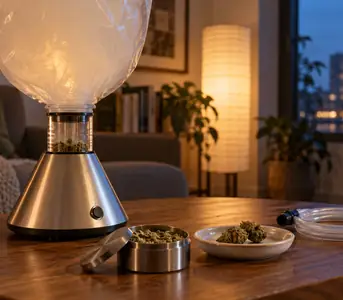
Eucalyptol: The Cooling Terpene in Cannabis
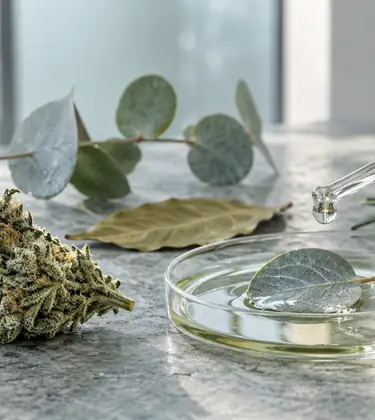
Suck on a eucalyptus cough drop or rinse with classic mouthwash and you have met eucalyptol. It is the cool, medicinal note in eucalyptus, bay leaves and rosemary, chemists also call it 1,8-cineole, and koalas live on the leaves that carry it.
Cannabis makes it too, in tiny amounts. The eucalyptol terpene has a real record in human trials, but the doses in those trials are far beyond anything a bud holds.
Two names, one camphor-scented molecule
Eucalyptol is a monoterpenoid colorless liquid and a bicyclic ether. In plain English, it is a terpene with an oxygen atom locked into a double ring, which sets it apart from limonene and myrcene, built from carbon and hydrogen alone. Its formula is C10H18O. It smells fresh and camphor-like, tastes spicy and cool, and boils at 176 to 177 °C (349 to 351 °F).
Its two names come from two plants. In 1870, the chemist F. S. Cloez named the main part of Eucalyptus globulus oil eucalyptol. Cineole takes its name partly from Artemisia cina, a wormwood relative whose oil is mostly 1,8-cineole. The numbers 1 and 8 mark the two carbon atoms that the oxygen links together. The FDA's list of synthetic flavoring substances allowed in food covers it under three names: eucalyptol, 1,8-epoxy-p-menthane and cineole.
Bay leaves, rosemary and your mouthwash
Bay leaves contain essential oils, such as eucalyptol, and in the Mediterranean bay laurel it makes up about 45 percent of that oil. It turns up in spice racks and medicine cabinets alike. You will find eucalyptol in:
- Eucalyptus oil, where it makes up about 70 to 90 percent.
- Camphor laurel oil, at about 50 percent, and the oil of California pepperwood, at about 22 percent.
- Rosemary, Spanish sage, ginger and galangal, along with cannabis.
- Listerine's original mouthwash, whose 2008 formula listed eucalyptol at 0.092 percent next to menthol, thymol and methyl salicylate.
- Cough suppressants and other commercial mouthwashes.
Insects notice it, too: eucalyptol has insecticidal and insect repellent properties. Koalas are the famous exception to eucalyptus being hard to eat. They live mostly on eucalyptus leaves and can digest the terpenes and other plant toxins in them thanks to liver enzymes called cytochrome P450. Their habit of sleeping around 20 hours a day comes from a low-energy diet, not from a terpene buzz.
Cooling without the cold
Eucalyptol feels cool for the same reason menthol does. Both switch on TRPM8, a sensor in nerve endings that normally fires when the temperature drops. A 2012 study in Molecular Pain screened essential oils for compounds that switch on TRPM8 but not TRPA1, the sensor for painful cold and irritants, and eucalyptol stood out.
It did more than leave TRPA1 alone. It blocked it, damping the response to irritants such as the mustard oil compound allyl isothiocyanate. The authors concluded that 1,8-cineole is a rare natural antagonist of human TRPA1, meaning a blocker of that sensor, and suggested this may be behind the pain-relieving and anti-inflammatory reputation of eucalyptus oil. In skin tests on volunteers, it also eased the irritation caused by chemicals that trigger TRPA1.
That puts eucalyptol in a small group of cooling compounds that behave differently from one another, a group that also includes borneol, another terpene found in cannabis:
- Menthol, from mint, is the classic trigger for TRPM8.
- Borneol, the camphor-scented terpene alcohol in rosemary, works on the same sensor with a weaker chill than menthol.
- Eucalyptol switches on TRPM8 and also blocks TRPA1, a rare combination in a natural compound.
- 1,4-cineole, its close relative in eucalyptus oil, switches on both sensors instead.
Feeling lost on how to start? Try taking our quiz!
Start a QuizTrace amounts in cannabis
Eucalyptol in cannabis shows up in small amounts. A 2022 review of secondary cannabis terpenes in the journal Biomedicines put it at 0.010 to 0.07 milligrams per gram of dried flower in chemotype II plants, which carry THC and CBD in similar amounts, and 0.052 to 0.14 milligrams per gram in CBD-dominant chemotype III plants. The review gave no figure for the THC-dominant type that most dispensary flower belongs to, and even its top number works out to about 0.014 percent of the flower's weight. At levels like these, a lab report may simply mark it as trace, meaning there is too little for the test to measure reliably.
The same review lists eucalyptol among the terpenes typical of chemotype III, next to bisabolol, guaiol and eudesmol. That does not rule out THC-rich plants, as one of our strains below shows.
Does that trace do anything? In a 2023 cell study in Biochemical Pharmacology, researchers found that all terpenes, when tested individually, activate CB1 receptors, the receptor behind THC's high, at a fraction of THC's effect. Eucalyptol on its own reached about 40 percent of THC's response in that test. Mixed with THC at the ratio found in the plant, though, it made no measurable difference, while terpenes such as limonene, linalool and ocimene made THC's effect stronger.
The unexamined day is a wasted opportunity. Reflect on what you did, what you learned, and how you can improve.
John Dewey
Strains with a cool, herbal edge
Our strain pages rarely name minor terpenes, so one that does stands out:
- Biscotti Mintz is a Biscotti and Mintz cross whose page credits its appetizing aroma to limonene, caryophyllene and eucalyptol, with Kush-style flavor, chocolate chip cookie notes, creamy mint and spice. Its page describes a creative, focused and relaxing effect with a creeping, energizing body high, at 33 percent THC in 56 to 63 days of flowering.
- Thin Mint Frosting crosses Thin Mint with Banana Frosting, and its page describes cool mint and smooth vanilla on the nose, a gentle coolness on the finish and deep physical relaxation, at 30 percent THC in 56 to 63 days. The page does not name eucalyptol, so the cool note there is a flavor description, not a measured terpene.
To train your nose, set three things side by side: a crushed bay leaf, a mint leaf and a broken-open bud. The bay leaf gives you eucalyptol's sharp, medicinal cool, the mint gives you menthol's sweeter chill, and after a few rounds you will start to notice which one your flower leans toward. Eucalyptol boils at 176 to 177 °C (349 to 351 °F), well within the range dry-herb vaporizers reach, so ordinary settings release it. Monoterpenes like eucalyptol evaporate more easily than heavier terpenes, so store buds whole, cool and sealed, and grind only what you are about to use. If you grow either strain, both finish flowering in eight to nine weeks, and a slow dry in a cool, dark room keeps more of the light aromas than a fast, warm one.
Trials in lungs, sinuses and memory
The best-studied eucalyptol effects come from capsules of purified 1,8-cineole. In a 2003 double-blind trial, 32 people with steroid-dependent asthma took 200 milligrams three times a day or a placebo for 12 weeks while doctors tried to lower their steroid doses. The trial reported reductions in daily prednisolone dosage of 36 percent with cineole, against 7 percent with placebo. A 2023 review in Biomedicine & Pharmacotherapy lists clinical trials in chronic obstructive pulmonary disease, asthma, bronchitis and rhinosinusitis, or sinus inflammation, and describes anti-inflammatory, antioxidant and antimicrobial activity in lab work.
Smell alone may do something. In a 2012 study, 20 volunteers did serial subtraction, counting backward in fixed steps, and visual tasks in a room scented with rosemary oil, and those with more 1,8-cineole in their blood performed better, though higher levels also went with a drop in contentment. That study measured a link between two numbers, not cause and effect.
Now the math. The asthma trial used 600 milligrams a day. At the highest level reported in cannabis, 0.14 milligrams per gram, matching that would take more than 4 kilograms of flower a day, about 9 pounds. In a bud, eucalyptol is a matter of smell and taste.
Concentrated oil is another story. Wikipedia's entry on eucalyptus oil notes that severe poisoning has occurred in children after swallowing 4 to 5 milliliters, and a 2021 study in Epilepsy Research opens by noting that eucalyptus and camphor oils can trigger seizures. Keep essential oils locked away from children, and never swallow them undiluted.
Cool smell, tiny dose
Eucalyptol, or 1,8-cineole, is the camphor-scented terpene behind eucalyptus oil, bay leaves and classic mouthwash. It cools by switching on the same cold sensor as menthol and blocks the TRPA1 irritation sensor. Purified capsules have helped people with asthma cut their steroid doses in a trial, but cannabis carries a tiny fraction of that amount, and in the lab it did not change THC's effect at plant ratios.
Smell before you smoke. Barney's Farm has been developing premium cannabis genetics since the 1980s, with over 40 Cannabis Cup wins. Explore our full seed catalog and find strains bred for every climate and skill level.