Does Weed Affect Your Heart? What Smokers Need to Know
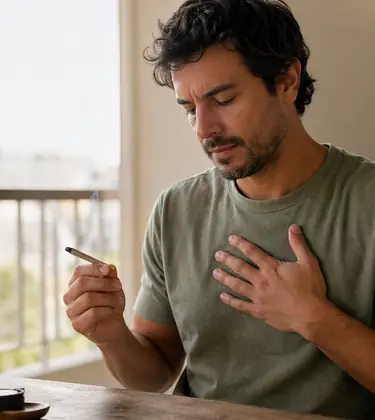
That rush of racing heartbeat a few minutes into a session? You are not imagining it. Cannabis interacts with your cardiovascular system in real, measurable ways, and the science has gotten a lot sharper in the past two years. Some of it is harmless and temporary. Some of it deserves your attention, especially if you are smoking daily or already have something going on with your ticker. Here is the honest rundown: what weed actually does to your heart, what recent research is showing, and how to consume without treating your cardiovascular system like a crash test dummy.
What actually happens to your heart when you get high?
About ten minutes into a session, your heart speeds up. Sometimes a little, sometimes a lot. THC binds to CB1 receptors spread throughout your cardiovascular system, switches on the sympathetic nervous system (think fight-or-flight), and tells your heart to punch the gas. Your blood vessels dilate, your blood pressure may dip or spike depending on dose, and your heart rate can jump by 20 to 50 beats per minute for one to three hours. That sensation of your chest pounding is called cannabis-induced tachycardia, and it is the most universally documented physical effect cannabis has on the body.
For most healthy people, this comes and goes without drama. Tolerance builds quickly. Regular consumers often barely notice the bump. First-timers, low-tolerance folks, and anyone who just took way too much edible usually feel it the hardest. The panic attack that sometimes rides along with a bad high? That is often just the racing heart feeding back into the anxiety, then the anxiety making the heart beat harder. Breathe, sit down, ride it out. It passes.
The same mechanism responsible for the buzz is the one poking your heart. If you are healthy, the cost is usually five or ten uncomfortable minutes. If you are not, the picture gets more complicated.
Does weed cause heart attacks?
This is where the research stops being reassuring. Two major studies presented at the American College of Cardiology's 2025 scientific session landed back-to-back and pointed the same direction. A retrospective study of 4.6 million healthy adults under 50 and a meta-analysis pooling data from over 75 million people found cannabis users had a 50% higher overall risk of heart attack, with users under 50 more than six times as likely to suffer one compared to non-users. The under-50 figure is especially striking because those participants had blood pressure, cholesterol, and other lifestyle factors in a healthy range at baseline.
A 2024 study published in the Journal of the American Heart Association looked at nearly 435,000 US adults across 27 states. It found that daily cannabis users had 25% higher odds of a heart attack and 42% higher odds of stroke compared with people who never used. Weekly use bumped those numbers up by smaller amounts. More use, more risk, pretty much a straight dose-response line.
Two caveats are worth flagging. These are observational studies, meaning they show correlation, not airtight cause-and-effect. And some data doesn't perfectly separate cannabis from tobacco, alcohol, or other drug use, which the researchers themselves admit. But the trend across studies is pointing in the same direction, and it is not the direction cannabis defenders would prefer.
Is it the smoke, or is it the THC?
A reasonable theory for years was that the smoke itself was doing most of the damage. Combustion produces carbon monoxide, tar, and polycyclic aromatic hydrocarbons. Any time you are lighting something on fire and pulling it into your lungs, you are introducing harsh compounds into your bloodstream. Smoke is smoke.
A UCSF study published in JAMA Cardiology in May 2025 complicates that theory. Researchers measured vascular function in 55 otherwise healthy regular cannabis users. Both smokers and edible users showed roughly half the vascular function of non-users, comparable to tobacco smokers. None of the participants used any nicotine. Translation: edibles do not give the vascular system a free pass. Whatever THC is doing inside the body happens even without smoke in the equation.
That said, smoking does stack the risks. You get the THC cardiovascular load plus the inhalation damage layered on top. It is additive. Switching to vape-only or gummy-only does not magic the risk away, but it does remove one vector.
Feeling lost on how to start? Try taking our quiz!
Start a QuizWho should actually be careful?
Not everyone needs to worry equally. If you are young, healthy, and smoking occasionally, cannabis-related heart events are rare. The risk profile changes fast once you add other variables.
People with existing heart conditions. If you have had a heart attack, been diagnosed with coronary artery disease, have arrhythmias, or uncontrolled high blood pressure, high-dose THC is not your friend. The short-term hemodynamic changes can push a vulnerable system into a bad place.
Daily users. The dose-response signal in the research is clear. The more frequently you consume, the higher the cardiovascular risk over time. A joint at a party is a different animal from three a day for five years.
People who also smoke tobacco. Stacked cardiovascular stressors compound the problem significantly, and the research consistently shows that the combination is worse than either alone.
Pregnant people. There is solid evidence of cardiovascular and developmental effects on the fetus, and every major medical body advises skipping cannabis during pregnancy and breastfeeding.
Older consumers. The 50-plus crowd is the fastest-growing cannabis demographic, and they are also more likely to have silent cardiovascular issues. Starting with very low edible doses, such as half of a 5-milligram gummy, is the standard recommendation for testing tolerance without triggering a cardiovascular episode.
The unexamined day is a wasted opportunity. Reflect on what you did, what you learned, and how you can improve.
John Dewey
How smokers who care about their heart actually consume
This is where real-world cannabis culture gets ahead of the research. We have been breeding and working with this plant at Barney's Farm since 1986, and a few habits keep heart-related hassles to a minimum without forcing anyone into full abstinence.
Mind the modern potency curve. Today's flower routinely hits 25 to 30% THC, a much more intense starting point than the 8 to 12% the average smoker was working with in the nineties. A racing heart scales with dose. Rolling a smaller joint, taking one or two pulls and waiting to feel where you are, and keeping sessions shorter are all simple, effective moves on high-potency flower. You can always take more. You can't take less.
Respect the dose curve. Smoking a bowl over twenty minutes gives you control over how much you take on. Slamming an edible you can't accurately measure does not. If you are working with edibles, start at 2.5 to 5 milligrams and wait a full 90 minutes before judging whether you need more.
Pick strains that keep things grounded. If you are already wound up, loading on a heavy sativa with racing-mind potential is a setup for the exact feedback loop we mentioned earlier. Indica-dominant relaxers are a better match for heart-mindful sessions, since they lean on body-calming terpene profiles rather than the racy, head-forward end of the spectrum. Barney's Farm classics like Purple Punch and Critical Kush both bring heavy, sedative indica profiles that pull you toward the couch rather than the ceiling. Thirty-plus years of breeding has taught our team that terpene profile matters as much as raw THC when it comes to how your body actually feels during a session. A myrcene-heavy indica reads very differently to your cardiovascular system than a revved-up limonene sativa.
Don't mix stressors. Caffeine plus high-dose THC is a documented combination for triggering palpitations. Same for nicotine plus cannabis. If your heart is already complaining, stripping caffeine out of a session day is an easy adjustment with a real payoff.
Take tolerance breaks. Cardiovascular tolerance builds fast, but if you are a daily consumer your baseline load stays elevated. A two-week break resets your receptors and your circulation. You also get your sensitivity back, which means a smaller amount hits harder when you come back.
Pay attention. Chest pain is a signal. An irregular heartbeat that lasts more than a few minutes is a signal. If something feels off, treat it like any other medical question and get it checked.
The bottom line
Cannabis affects your heart. It is documented, it is reproducible, and the 2024 and 2025 research has given us sharper numbers on the long-term picture than we had before. For young, healthy, occasional consumers, the absolute risk stays pretty low. For daily users, people with existing cardiovascular conditions, and heavy tobacco co-users, the risk stacks up faster than most of us were told a decade ago.
Nobody's saying stop. Plenty of us at Barney's Farm have been consuming since before most US states knew what legalization meant. What the research is telling us is that dose matters, method matters, and knowing your own body matters. Smoke smart, pick your strains carefully, and don't pretend the plant is perfectly neutral on your cardiovascular system. It isn't, and consuming with that knowledge is how you keep enjoying it for the long haul.
Barney's Farm has been developing premium cannabis genetics since the 1980s, with over 40 Cannabis Cup wins. Explore our full cannabis seed catalog and find strains bred for every climate and skill level.