
Does Smoking Weed Stain Your Teeth?
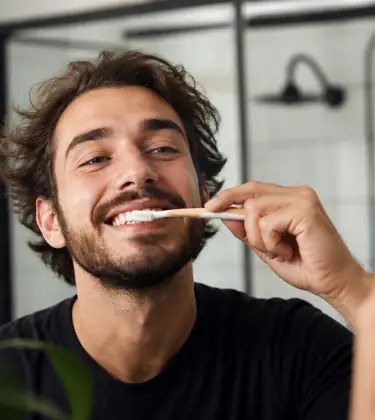
Quick answer up front: yes, smoking weed can stain your teeth. Anyone who has ever tipped out an ashtray or scraped resin off a glass piece already knows where this is going. The same gunk that turns your favorite bong from clear to amber leaves a similar deposit on the enamel inside your mouth. It builds slow, but it builds.
The good news is the staining from cannabis is mostly cosmetic, mostly reversible, and mostly avoidable with habits you should be running anyway. Here is what is actually happening up there, what the science says, and how to keep your smile looking like you take care of yourself.
Why Does Weed Turn Your Teeth Yellow?
Three culprits do most of the work: tar, plant resins, and tannins.
Tar is the dark, sticky residue that combustion creates regardless of what is burning. Joint, blunt, pipe, bong, the source of smoke does not change the basic chemistry. The smoke carries microscopic particulates that drift past your teeth on the way in and out. Enamel is harder than bone but it is not smooth at the microscopic level. It has tiny pits and ridges that grab onto pigmented compounds, and over time those compounds settle in and darken.
Cannabis also packs natural plant tannins, the same family of compounds that turn coffee mugs and red wine glasses brown. Tannins and chromogenic compounds bind directly to the protein film coating your enamel and pull pigment in along with them. The longer they sit, the harder they are to lift off.
Then there is resin. The trichomes that make your buds frosty and your fingers sticky carry oils that do not burn cleanly. You see the residue on the inside of a glass piece after a few sessions. That same film deposits in much smaller amounts on teeth.
How Cannabis Stains Compare to Cigarette Stains
Cigarettes are worse on the staining front. Tobacco contains nicotine, which is colorless on its own but yellows aggressively when it hits oxygen. Smokers who try to fix discoloration with whitening strips and toothpaste usually find the results do not last long, which is why dentists generally recommend professional whitening for heavy smokers. Cannabis users typically see staining at a slower rate because most people smoke weed less frequently than cigarette smokers smoke cigarettes. A pack-a-day habit means twenty cigarettes daily. Even a heavy weed smoker is rarely lighting up that many joints.
The catch is that joints and blunts use rolling papers and tobacco-wrap leaves that add their own staining contribution. Bong and pipe smokers tend to fare slightly better because there is no paper combusting alongside the flower.
Does Vaping Weed Stain Your Teeth Less Than Smoking?
Generally yes, by a noticeable margin. Vaporizing flower or concentrate at controlled temperatures produces a vapor that carries the cannabinoids and terpenes you actually want, with far less particulate matter and combustion residue. No paper burning, no glowing cherry of plant material going up at 900 degrees Fahrenheit. The vapor is lighter, cleaner, and leaves less film on glass and on enamel.
Edibles, tinctures, and topicals do not involve smoke at all and contribute essentially nothing to staining. They have their own considerations, especially the sugar content of gummies and chocolates, but enamel pigmentation is not on the list.
Feeling lost on how to start? Try taking our quiz!
Start a QuizWhat About Cottonmouth, Bad Breath, and Gum Disease?
Yellow teeth are the cosmetic surface of the issue. Underneath that, cottonmouth is doing real work, and not the kind anybody wants. THC reduces saliva production. Saliva is your mouth’s built-in rinse cycle: it washes away particles, neutralizes acids, and keeps bacterial populations in check. Cut the saliva and you give plaque a longer runway. The same dryness is why your breath is rougher after a smoke session than after a workout. Bacteria multiply faster in a dry mouth, and the byproducts of that bacterial growth are what your nose is reading as bad breath.
A long-running Dunedin cohort study followed roughly a thousand New Zealanders from birth through their thirties and tracked their cannabis habits alongside dental exams. The researchers found that regular cannabis use through young adulthood was associated with a meaningful increase in periodontal disease compared to non-users, even after controlling for tobacco use. A follow-up published in JAMA Psychiatry that tracked the same group out to age 38 reached similar conclusions about gum health, while noting that long-term cannabis use was not linked to most other physical health markers the researchers measured.
Smokers are not doomed to bad teeth. The takeaway is that oral hygiene matters more for cannabis users than for non-users. Skipping a brush after a long sesh has bigger consequences when your saliva is running low. Throw in a sugar-loaded munchies run and the math gets even worse.
The unexamined day is a wasted opportunity. Reflect on what you did, what you learned, and how you can improve.
John Dewey
How Do You Get Stains Off Your Teeth From Smoking Weed?
A few habits handle most of the damage. None of them are exotic.
- Brush after sessions, not just in the morning and at night. A quick cleanup after smoking pulls fresh tar and resin off the surface before it has time to bond. Even a rinse with water helps when a toothbrush is not available.
- Floss every day, not just when something is stuck. Plaque hardens into tartar in days, and once it is tartar your toothbrush is not getting it off. The space between your teeth is where most of the trouble sets up shop.
- Drink water through and after a session. Hydration fights cottonmouth directly. Carrying a bottle is one of the easiest oral health upgrades you can make.
- Get cleanings twice a year. A dental hygienist with an ultrasonic scaler removes buildup that home tools cannot touch. This is also when surface stains get polished off, which keeps minor yellowing from compounding into major yellowing.
- Switch consumption methods sometimes. If you smoke flower exclusively, mixing in a vape or the occasional edible reduces total smoke exposure without forcing you to quit. All-or-nothing is a false choice.
For staining that is already there, most cannabis-related discoloration is extrinsic, meaning it sits on the surface of the enamel rather than embedded inside the tooth. Extrinsic stains respond well to professional cleanings and whitening treatments. Whitening strips and toothpastes can handle mild yellowing. For deeper stains, dentists offer in-office treatments that lighten teeth in a single visit, and take-home tray kits that work over a couple of weeks. Cutting back on smoking also lets the natural color return slowly over time, since fresh staining stops piling on top of the old.
Will Your Teeth Get Whiter If You Quit Smoking Weed?
Yes, gradually. The exact pace depends on how long you smoked, how often, and what your oral hygiene looks like, but stained enamel does fade once you stop adding new pigment to it. Saliva production rebounds when THC is out of the picture, which lets your mouth start cleaning itself properly again. Existing stains will not vanish overnight, but professional cleaning combined with no new exposure can produce visible improvement within a few months.
You do not have to fully quit to see a difference. Cutting back, switching some sessions to vaporized flower or edibles, and tightening up the brushing routine produces meaningful improvement on its own. The body is more forgiving than you think when you give it a break.
What Forty Years of Breeding Taught Us About Smoke and Smiles
Barney’s Farm has been growing, breeding, and judging cannabis since 1986. After four decades and forty-plus Cannabis Cup wins, one thing we know for sure: the smoothness of the smoke matters as much as the THC reading on the label. Properly grown, properly cured flower combusts at a more consistent temperature and produces less harsh smoke than rushed, badly dried bud. That harshness is part of what irritates gum tissue and part of what loads up resin in the throat and mouth.
Strain choice plays a smaller role in staining than people sometimes assume. A bowl of Pineapple Chunk and a bowl of any other classic flower will leave roughly comparable residues if you smoke the same amount of each. What changes the equation is method, frequency, and aftercare. Smoke a Pineapple Express bowl out of a clean glass piece, drink water through the session, and brush before bed, and your enamel will be in far better shape than the same bowl burned in a paper-heavy joint with no water and no nighttime routine.
Cannabis culture has shifted toward more health-conscious habits in the last decade. People are vaping more, microdosing more, paying attention to what their bodies are actually doing. Your teeth deserve the same upgrade. Good flower, clean glass, and basic dental hygiene cover ninety percent of it.
The Short Version
Smoking weed can yellow your teeth over time. Tar, resin, and tannins build up on enamel the way they do on glass. Compared to cigarettes, cannabis is generally less aggressive on teeth, though it is harder on your gums and dries out your mouth in ways that compound the problem. Vaping causes less staining than combustion. Edibles cause none from staining, though watch the sugar.
Most of what cannabis does to your teeth is reversible with basic hygiene, regular cleanings, and the occasional professional whitening. You can smoke and still have a smile that does not give you away. The trick is showing up for the boring habits that protect it.
Barney's Farm has been developing premium cannabis genetics since the 1980s, with over 40 Cannabis Cup wins. Explore our full cannabis seed catalog and find strains bred for every climate and skill level.