Does Home Insurance Cover a Legal Home Grow?
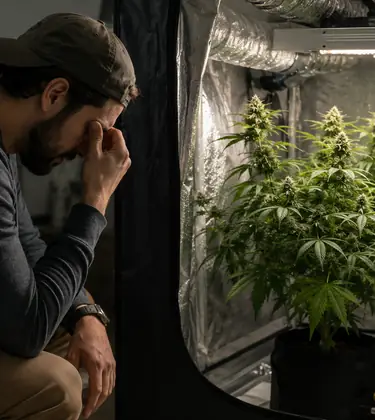
You pulled the permit-free, perfectly legal six plants your state allows. You bought a decent tent, a real carbon filter, a timer that does not melt. Then a fitting on the res line lets go at 3am and you wake up to water finding its way through the subfloor into the kitchen ceiling.
Here is the question nobody asks until it matters: will your homeowners policy pay for that?
The short answer is that your house is probably covered. Your plants almost certainly are not. And how you handled the electrical decides which of those two answers your adjuster leads with.
The federal gap that still runs the show
Insurance contracts do not care what your state legislature voted for. They care what federal law says, because that is the language printed in the exclusions.
That language just got more interesting. On April 23, 2026, the acting Attorney General signed an order placing FDA-approved marijuana drug products and medicinal marijuana products covered by a qualifying state-issued license into Schedule III, effective immediately. Read that twice, because the wording does the work. The relief attaches to licensed medical product. Your closet does not hold a state-issued license.
Adult-use cannabis went to a separate DEA administrative hearing that ran from June 29 to July 15, 2026, with only opponents of rescheduling cleared to testify, a procedural setup that drew loud objections from NORML and the National Cannabis Industry Association. No final rule on the broader move has landed.
So for the average person growing legally under state law in July 2026, the federal posture on your specific plants has not changed. And even when it does change, Schedule III is still a controlled substance. Standard homeowners forms exclude loss arising out of the possession or manufacture of controlled substances, and moving between schedules does not remove marijuana from that definition. Anyone telling you rescheduling automatically fixes your coverage is selling you something.
Does homeowners insurance cover weed plants? Do the plant math
Forget cannabis for a second and look at how a policy treats any living thing you grow.
Trees, shrubs and plants sit in their own small bucket, not in your general personal property limit. The typical cap is five percent of your dwelling coverage, with a per-item limit around $500 to $750, and that per-item figure includes debris removal. The bucket only opens for a named list of perils: fire, lightning, explosion, riot, aircraft, vehicles, vandalism, theft. Not "my plants died." Not "the RH hit 70 and I lost the top colas."
Now put a mature plant in that bucket. Six plants three weeks from chop are worth real money to you. To the form, they are six items with a $500 ceiling each, and only if the loss came from one of those listed perils, and only if the controlled substance exclusion does not slam the lid first.
There is also a second trapdoor. Policies exclude plants grown for business purposes. If your plant count is way past personal-use levels, or you sell to a neighbor, or your grow lives in a detached structure you built for it, an adjuster has a reasonable argument that you were running a business out of a residential building. That argument moves you from a small payout to no payout.
The case that set the tone
This is not theoretical. In Hawaii, a policyholder with a legal medical grow had 12 plants stolen and filed for roughly $45,000. USAA argued in federal court that the plants were illegal under federal law and therefore not covered property, and the insurer won.
The same reporting covers two other useful data points. A Colorado court later found harvested, packaged product could be covered while "growing crops" exclusions still knocked out the potted plants. And a Michigan insurer that paid $160,000 on a house fire went after recovery once it learned a butane extraction setup was involved, with courts agreeing the loss was not accidental and stemmed from an increased hazard the insured knew about.
Pattern worth memorizing: courts have shown some flexibility about finished product in a jar. Much less about plants in dirt, and none at all about solvents.
Feeling lost on how to start? Try taking our quiz!
Start a QuizWhat a grow room insurance claim actually looks like
Twenty-plus years of grower correspondence has taught us something the insurance articles skip. The claim that ruins people is not a claim about cannabis.
It is a burst pump line into a finished basement. It is a $19 power strip carrying 1,200 watts through a bedroom outlet on 1970s wiring. It is nine months of unvented transpiration turning the drywall behind the tent into a mold remediation invoice with four digits in it. Water and fire and mold are bread-and-butter covered perils, which is exactly why insurers scrutinize grows at all. The plants are worth a few hundred dollars to them. The building envelope is worth six figures.
The trap is causation. If the adjuster's photos show a daisy-chained power strip, an unpermitted subpanel, a dryer vent used as exhaust, or a hole cut through a firewall, the conversation shifts from "we cover water damage" to "this loss arose out of your cultivation setup." Once causation ties back to the grow, the controlled substance exclusion and the increased hazard argument both come off the bench.
Which means your coverage on a $400,000 structure is being decided by whether you paid an electrician $600.
The unexamined day is a wasted opportunity. Reflect on what you did, what you learned, and how you can improve.
John Dewey
Renters insurance and cannabis
Renters get the harsher version. A renters policy covers your stuff and your liability, and the plant sublimit that homeowners have is usually thinner or absent, since there is no dwelling limit to take five percent of.
The bigger exposure is liability and your lease. Most residential leases contain a clause about lawful use, alterations, or nuisance odor, and plenty now name cannabis directly even in legal states. If your grow triggers a habitability complaint from the unit next door, or water travels into the apartment below, your renters liability coverage becomes the only thing between you and the landlord's subrogation letter.
If you rent: read the lease before you read the policy. A grow that violates the lease gives both your landlord and your insurer an easy exit.
Should you tell your insurer?
Nobody enjoys this answer, but concealment is worse than a rate bump. Material misrepresentation on an application is grounds to rescind a policy after a loss, which means you paid premiums for nothing.
Ask in writing, and ask a specific question rather than a general one. "Do you cover cannabis?" gets you a shrug. "Under my current form, is water damage to the dwelling covered if the source is equipment in a legal personal-use home cultivation area?" gets you something you can hold onto later. Get the answer by email. Ask them to show you the clause.
Also ask three follow-ups: does a legal home grow affect eligibility or renewal, does the standard controlled substance exclusion apply to state-legal personal cultivation, and is there an endorsement available. Some carriers will not write you at all. Better to learn that at quote time than at claim time.
Genetics are a risk decision, and this is our lane
Insurance advice always stops at "call your agent." We will go further, because strain selection is one of the few levers you control before anything goes wrong.
Risk in a home grow is a function of two things: how long the equipment runs, and how much moisture sits in your buds. Both are genetics problems before they are equipment problems.
Shorter cycles mean fewer weeks of pumps, fans and ballasts running unattended. LSD Auto goes seed to harvest in 65 to 70 days and holds at 80 to 100cm indoors while still turning out 550 to 650 g/m² at 24% THC. That profile fits a small tent on a single dedicated circuit, which is the version of a grow an adjuster has almost nothing to complain about. Two auto runs finish faster than one long photoperiod run, and each one gives you a chance to dry the space out completely.
Moisture resilience is the other half. Dense indica-leaning colas in a humid room are how a grow becomes a remediation claim. Pineapple Chunk flowers in 55 to 60 days, reaches 90 to 110cm indoors, pushes 28% THC, and was selected for resistance to mold and pests. Hardy genetics do not replace ventilation, but they widen the margin on the night your dehumidifier quits.
Two more habits from our side of the fence. Do not run more plants than your exhaust can actually handle, because odor complaints are how neighbors and landlords find out. And keep your grow inside your legal plant count with room to spare, since the moment your count looks commercial, the business exclusion is a live argument.
Before you flip the switch
Colorado's official home cultivation guidance is the plainest checklist any state publishes: have equipment installed by a licensed electrician, use wall surfaces that do not absorb water like painted concrete or plastic, ventilate hard enough to clear excess heat and moisture, and lock up any nutrients or pesticides.
Every item on that list is also an item on an adjuster's list. Add three of our own: put the grow on its own breaker, put a water sensor on the floor under the reservoir, and photograph the finished install before your first seed goes in the dirt.
Grow proud, grow legal, and grow like somebody is going to inspect it. Because if something goes sideways, somebody will.
Barney's Farm has been developing premium cannabis genetics since the 1980s, with over 40 Cannabis Cup wins. Explore our full cannabis seed catalog and find more Amsterdam classics, USA-bred hybrids, and award-winning strains.