What's Inside A Disposable Vape, And Why It Can't Be Recycled
A disposable vape is the only consumer electronic device most people buy knowing they will throw it away within the week. It has a rechargeable-grade lithium cell in it, the same chemistry as a phone or a power tool, and it is built so you cannot get at it.
That combination is why disposable vape waste has become one of the hardest problems in the waste industry, and why the cannabis version of the device sits in an even stranger legal position than the nicotine one.
Nine vapes on a workbench
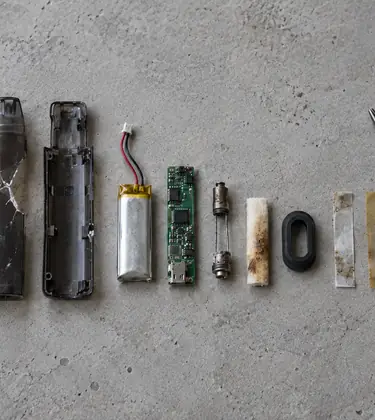
Somebody has done the teardown, properly, in a lab. A 2024 study in Science of the Total Environment dismantled nine types of popular single-use vapes and ran the parts through X-ray fluorescence and pyrolysis gas chromatography. The median dry mass of vapes was about 50 g, made up of as much as 80 percent plastic or as much as 85 percent metal depending on the model. Polycarbonate was the principal plastic in the casing, and nylon was always used in the wick.
Inside a typical device you have a lithium-ion cell in an aluminium and plastic laminate pouch, a copper-based printed circuit board, a nickel alloy heating coil, a foamed wick holding the liquid, an airflow switch, an LED, rubber gaskets, adhesive foam pads and plastic tape holding the whole lot together. The same study found cobalt, lead, mercury, barium and gold in various components.
The airflow switch deserves a mention because it is the least expected part. An engineering teardown at UNSW Sydney describes what is in there as a battery, a pressure sensor like a modified microphone, an LED light, a heating element and a reservoir. There is a tiny microphone in your vape, listening for you to inhale.
Glue holds it shut, not screws
The reason a recycler cannot deal with these is a design decision, not an oversight. The UNSW teardown is blunt about it. Single-use vapes, the authors write, contain valuable resources yet are not designed to be recycled, and there are no practical means to collect or recycle them, so most end up as e-waste in landfill. A separate engineering analysis published in Joule found that the metal interior of the casing and exposed wiring create a real risk of shorting the cell while trying to get it out, which makes home disassembly unsafe and recycling at scale impractical. Three things have to be true before you can recycle a disposable vape at scale, and the device fails all three:
- It has to come apart on a defined path. This one is bonded, taped and press-fitted with no designed release.
- Its materials have to separate cleanly. This one mixes polycarbonate, nylon, aluminium, copper, nickel alloy and a lithium cell in a 50 gram object.
- It has to be clean. This one is soaked in residual e-liquid or cannabis oil, which makes every internal component a contaminated item.
Vape battery disposal therefore comes down to somebody sitting at a bench with pliers. At a proper facility the built-in battery is removed and the rest of the device is broken down by machine and by hand before the fragments are sorted and cleaned. One small operator who published his own numbers found he could strip about 60 pens an hour that way, which is less than a full box of batteries in a working day.
Almost six a second
The volumes make the design problem into a public one. US PIRG's 2025 report puts it at 5.7 disposable vapes thrown away per second in 2023, up from 4.5 per second the year before, which works out at nearly half a million devices a day in the United States alone. The lithium inside the disposables sold each year weighs close to 30 tons, enough for about 3,350 electric vehicle batteries.
In the UK, where single-use vapes have actually been banned from sale since June 2025, the research charity Material Focus still counted 6.3 million vapes and pods binned every week in 2026, down from a peak of 8.2 million but a long way from zero. A ban removes the supply. It does not remove the habit or the hardware already in circulation. Three numbers worth holding onto from that UK research:
- 1.18 billion vapes thrown away over four years.
- Enough lithium discarded annually to build about 5,000 electric vehicle batteries.
- 43 percent of people who tried to recycle a vape at a supermarket collection point could not do so.
Feeling lost on how to start? Try taking our quiz!
Start a QuizBin lorries keep catching fire
This is the part that turns a litter story into an industrial one. A policy briefing from the UK's Environmental Services Association recorded more than 1,200 incidents reported in 2023/24, a 71 per cent increase on the previous year, with the fires estimated to cost over a billion pounds annually once you count damaged infrastructure, lost business and emergency response.
The mechanism is simple and it is the reason a lithium battery vape cannot go in any household bin. A cell that is crushed, punctured or compacted goes into thermal runaway. The Joule team pushed a nail through a disposable vape in a lab and measured the outside of the casing at 270 degrees Celsius. A bin lorry compactor does the same thing, at scale, to a load of dry paper and plastic.
The unexamined day is a wasted opportunity. Reflect on what you did, what you learned, and how you can improve.
John Dewey
California will not let you call it disposable
Cannabis vape e-waste has its own rulebook, and California's is the strictest in the country. Since 1 July 2024, state law has required cannabis vape packaging to carry specific wording. A spent cannabis cartridge shall be properly disposed of as hazardous waste at a household hazardous waste collection facility or other approved facility, with the same requirement for an empty integrated vaporiser. The same law forbids advertising or labelling that indicates a cannabis cartridge or vaporiser is disposable, or that implies it may be thrown in the trash or recycling streams.
Read that twice. In California it is legally a hazardous waste item, and it is legally not a disposable one, whatever the shop calls it. There is a twist worth knowing. When California legislators moved in 2026 to ban single-use nicotine vapes outright on fire and waste grounds, cannabis vapes were amended out of the bill's scope. The product with the strictest disposal labelling in the country is also the one exempted from the ban aimed at exactly that problem.
Growing skips the hardware entirely
We are a seed company, so the obvious point is the one we are entitled to make: the plant does not come with a battery in it.
Everything above is a hardware problem. The oil is a separate subject, and we have written about what is actually inside a vape cart, distillate, added terpenes and cutting agents included. Neither problem exists in dried flower, which arrives as a plant and leaves as compost.
For anyone making the switch back, the practical question is what grows easily enough to be worth it. The two answers sit at opposite ends of the catalogue.
- Cherry Cola Auto runs 70 to 80 days from seed at 90 to 130 cm indoors, and its page describes a robust, naturally vigorous plant that performs across a wide range of environments. That is the profile a first-time grower wants.
- Thin Mint Frosting is the other end, a 30 percent THC F1 whose resin output buries the flower surface under trichomes, for growers who want the concentrate input without buying the concentrate.
Between them they cover most of the reasons people reach for a vape in the first place, and neither one leaves a lithium cell in a garbage truck.
A five-day product with a long afterlife
A disposable vape is roughly 50 grams of bonded plastic and metal wrapped around a lithium cell, built without a disassembly path, contaminated with oil, and thrown away by the hundreds of thousands per day in the United States. Every part of that sentence is a recycling problem, and they compound.
The regulatory response so far has been uneven. Britain banned the things and still bins millions a week. California made cannabis vape hardware a labelled hazardous waste and then wrote it out of the ban on single-use vapes. Neither approach has produced a way to actually process the device, because nobody has built one that works at the speed these are sold. Until somebody does, the only version of this product with a clean ending is the one that never had a battery. Barney's Farm has been developing premium cannabis genetics since the 1980s, with over 40 Cannabis Cup wins. Explore our full seed catalog and find strains bred for every climate and skill level.