Did the Founding Fathers Grow Weed?
Somewhere in America there is still a dollar bill floating around with a speech bubble inked next to George Washington's mouth reading "I grew hemp." People stamped those bills by the thousands in the 1990s and passed them hand to hand at shows, head shops and swap meets. The gag worked because it was partly true, and the part that was true made everybody want to know how far it went.
Here is the honest version. Washington grew hemp. Jefferson grew hemp. Neither of them was getting stoned on it, and the reason has more to do with plant breeding than with morality. The real story is stranger and more useful than the meme, because it explains how cannabis stayed a boring agricultural commodity in America for two centuries before anybody thought to criminalize it.
Did George Washington grow hemp?
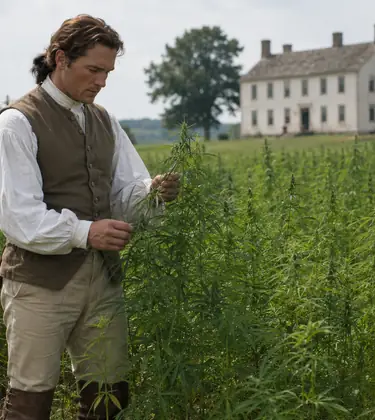
Yes, and he took it seriously. Hemp shows up over and over in his diaries and farm records at Mount Vernon through the second half of the 18th century. During the 1760s, with tobacco prices sliding, Washington considered hemp a possible replacement cash crop and planted it across his farm. He eventually decided wheat was the smarter commercial bet, but hemp never left the estate, because he needed the fiber more than he needed the profit.
His Potomac fishery was the most lucrative operation he ran, and it ran on rope and netting. Beyond that, the stalks became sail canvas, sacks, thread and cordage for a working plantation that had to make most of its own hard goods. Hemp was infrastructure. Nobody romanticized it any more than they romanticized nails.
The crop came back to Mount Vernon in 2018, planted in partnership with a University of Virginia hemp research program. It was the first harvest of the plant on that ground in generations, cut with a scythe by staff in period clothing while a familiar smell drifted across the field.
What did Washington actually write about hemp seed?
You have seen the quote on a t-shirt: "Make the most of the hemp seed, sow it everywhere." That line is a mangled remix of something Washington genuinely wrote, and the original is a lot less exciting.
In a letter dated 6 January 1794, writing to the men running Mount Vernon while he was president, Washington mentioned handing his gardener a few seeds of East India hemp and told them to track down the saved seed and make the most of it at the proper season for sowing. That is an estate owner telling staff not to waste seed stock.
Read the rest of that letter and the fantasy dies fast. He is annoyed about an unfilled ice house, asking how many oats have been threshed, and chasing a bundle of pecans he sent down from Philadelphia. Hemp shares a paragraph with the pecans. That placement tells you precisely how novel he found it.
Was growing hemp required by law in colonial America?
The folklore overshoots here too, and the truth is still worth knowing. The first Virginia General Assembly sat in 1619 and passed a batch of laws covering drunkenness, gambling, mulberry trees and vineyards. Clause eleven dealt with hemp: householders who had the seed were required and enjoined to make trial thereof the next season.
Look closely and that is narrower than the popular claim that every farmer was forced to grow weed. It applied to householders who already held seed, and it asked for a trial planting rather than a full crop. What it does represent is the earliest known cannabis legislation in North America, and the intent behind it is unmistakable. The colony was desperate for fiber and willing to legislate to get it. Massachusetts and Connecticut passed cultivation laws of their own in the decades that followed, and hemp remained a mandated or heavily encouraged crop across the Chesapeake colonies well into the 1700s.
An empire that moved on wooden ships needed rope. A ship of the line burned through tons of cordage, and every yard of sail was canvas. Colonial hemp policy was naval policy wearing a farmer's hat.
Feeling lost on how to start? Try taking our quiz!
Start a QuizDid Thomas Jefferson farm hemp?
He did, at Monticello and at Poplar Forest. Jefferson left detailed notes on how deep to plough for it, when to sow, what a hand could process in a day, and what yield to expect from tolerable ground. He also wrote about hemp as a staple commodity of Virginia alongside tobacco, flax and cotton, and floated it as one of the crops that could carry the state once tobacco fell away. The part usually left out of the patriotic retelling is who did the labor: enslaved people planted, broke and processed the hemp at both Monticello and Mount Vernon, and no historian has found evidence that either man smoked what they grew.
The unexamined day is a wasted opportunity. Reflect on what you did, what you learned, and how you can improve.
John Dewey
Did the Founding Fathers smoke weed?
Almost certainly not, and the reason is agronomic rather than moral. Fiber hemp and drug cannabis are the same species dragged in opposite directions by centuries of selection, and the fields these men planted were engineered to produce nothing worth inhaling.
A fiber crop gets sown dense on purpose. Crowd the plants and they stretch upward, stay skinny, branch as little as possible and pour their energy into the long bast fibers running up the stalk. Colonial growers wanted height, stem quality and a reliable seed return. Nobody was walking the rows pulling males before they could throw pollen. Nobody was protecting females from fertilization to force them to keep swelling resin. Every plant in a colonial hemp field was allowed to seed, which is the fastest way known to shut down flower development and cannabinoid production.
Colonial farm records do mention separating male plants from female ones, and modern growers love to read that as proof somebody was chasing sinsemilla. The opposite is true. Fiber production depends on timing the male harvest correctly, because male stalks mature earlier and yield the finer, softer fiber a weaver actually wants. Sorting the sexes in an 18th century hemp field was a textile decision. Nobody was building a flower room.
How modern breeding pulled the plant the other way
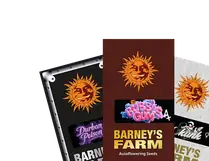
This is where four decades of our own work sits. At Barney's Farm we have spent our entire existence running colonial agriculture in reverse: isolating females, controlling pollination down to the individual plant, and selecting generation after generation for trichome density, terpene expression and cannabinoid load. Derry began collecting the raw material for that in the 1980s, spending years hauling landrace genetics out of Afghanistan and the Himalayas and carrying them back to Amsterdam before most of Europe had a serious breeding program at all.
The gap between a Mount Vernon hemp plot and a modern flowering room took centuries of selection pressure aimed in the opposite direction. A colonial farmer measured success in pounds of fiber per acre. We measure it in resin, structure and terpene profile, and we throw away far more plants than we keep to get there.
American breeders did the same kind of underground work through the late 20th century, and the results are now core to our catalog. Sour Diesel came out of that East Coast lineage, all fuel and sharp citrus with a head-forward effect that made it a New York staple decades before anyone could legally sell it. Blue Dream did the same job on the West Coast, marrying haze structure to sweet berry and becoming one of the most widely grown varieties in California history. Neither plant would be recognizable to a colonial farmer, and both descend from the exact same species he was legally obliged to try.
What is happening with American hemp law right now?
The modern chapter is worth knowing because it rhymes with the old one. The 2018 Farm Bill defined hemp by its delta-9 THC content, which accidentally opened a lane for intoxicating hemp products sold in liquor stores, gas stations and grocery aisles across states with no legal cannabis market.
Congress shut that lane in November 2025 by rewriting the definition inside a government funding bill. From 12 November 2026, finished hemp products carrying more than 0.4 milligrams of total THC and similar cannabinoids per container fall outside the hemp definition entirely and land under federal marijuana law. Bills to delay the change were still parked in committee as of late July 2026.
Four centuries after Virginia asked householders to give hemp seed a try, Washington is arguing over how many milligrams of THC a seltzer can is allowed to hold. The plant keeps getting redefined by whoever needs something from it.
So what is the real answer?
The Founding Fathers grew cannabis. They grew a great deal of it, wrote about it constantly, and treated it with the same energy a modern farmer brings to soybeans. What they did not grow was anything you would want to roll, because the breeding work that turned this plant into what sits in a jar today had not started yet.
That work took another two hundred years, several continents and a lot of people willing to break the law to do it. For the chapter where American hemp went from patriotic cash crop to federal contraband, read our piece on the 1937 Marihuana Tax Act.
Barney's Farm has been developing premium cannabis genetics since the 1980s, with over 40 Cannabis Cup wins. Explore our full seed catalog and find strains bred for every climate and skill level.