Croptober: Why Weed Prices Drop Every Fall
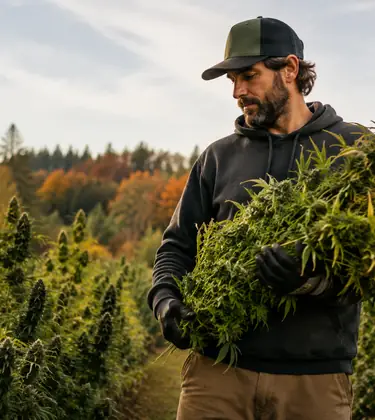
Every fall, cannabis Twitter fills up with photos of six-foot colas, mud-caked trimmers, and truck beds full of hanging branches. Somebody posts a hashtag. Somebody else says prices are about to crater.
They are right about the crater. They are wrong about the timing, and the gap between those two things is where all the interesting stuff lives.
What Croptober actually is
Outdoor cannabis is photoperiod dependent. Shortening late-summer daylight triggers flowering, the plants ripen through September, and growers race a first frost that arrives somewhere between late September and early November depending on latitude. One cut. One shot. The entire year's outdoor supply for the Northern Hemisphere comes down inside a six-week window.
Indoor operations run four to six cycles a year and can time harvests around demand. Outdoor growers get one October. That asymmetry is the whole story.
The term itself grew out of grower social media rather than any trade body, and nobody can point to who said it first. The culture behind it is much older. Northern California's Emerald Triangle of Humboldt, Mendocino and Trinity counties has been growing at scale since the back-to-the-land movement of the 1960s, chosen for remoteness and thin law enforcement, and the region's harvest calendar became the industry's harvest calendar by default.
The part everyone gets wrong
Here is the correction: prices do not bottom in October.
Track the national wholesale spot index across the last cycle and the shape is not what the folklore predicts. Mid-October 2025 sat at $1,119 a pound. It drifted down through November and December. Then in late January 2026 it hit $987, the low point of the entire year, before recovering to roughly $1,060 by April.
That is a drop of nearly 12 percent, and it landed a full quarter after the harvest.
The reason is boring and physical. Fresh-cut flower is wet. It has to dry, cure, get tested, get packaged, and move through distribution before it is anything a wholesaler can buy. Six to twelve weeks, minimum. The October harvest is a promise. January is when the bill comes due.
That same late-January week, California's index fell 10.8 percent and hit its lowest recorded level in more than a decade of price tracking, with outdoor sungrown material priced at or below what it cost to grow. Oregon set records in the same stretch.
If you are a consumer waiting on Croptober deals, stop shopping in October. Shop in January.
Croptober lands on a market that was already drowning
The annual harvest does not create oversupply. It detonates oversupply that was already sitting there.
Oregon's regulators publish the clearest math in the country. Their supply and demand analysis found demand at just 57 percent of supply in 2024, down from 71 percent the year before, with the annual harvest exceeding demand in more than 95 percent of modeled scenarios. The 2024 outdoor crop was the largest on record at the time. Then October 2025 beat it, topping 13 million pounds statewide.
Colorado tells the same story from a different angle. The state's official average market rate for flower fell to $649 a pound in September 2025, tying an all-time low, down from more than $1,700 in 2021. And that was after a 25 percent reduction in licensed cultivators over two years. Supply contracted and prices still fell.
Michigan is carrying roughly two years of demand in its supply chain. An ounce at retail there averaged under $60 in early 2026.
Feeling lost on how to start? Try taking our quiz!
Start a QuizWhat it looks like on the ground in Humboldt
Mendocino County farmgate prices give you the long arc. Around $3,000 a pound in 2009. Roughly $1,200 by 2014. Under $500 by the end of 2018. An average of $721 in 2024, with outdoor material reportedly moving as low as $300.
You cannot farm on $300 a pound. Public radio coverage of the region quoted a Humboldt grower calling it "a permanent extinction event" and describing a business model where you pay everybody except yourself. Another farmer was carrying more than $30,000 in unpaid local cannabis tax. By late 2025, over half of Humboldt's permitted cultivators were behind on their tax bills.
Not every economist agrees this is a catastrophe. Some argue cannabis is simply converging on the price of any other agricultural commodity, and that small farms will survive the way small wineries do, on terroir and story rather than volume. Both things can be true. Convergence to commodity pricing and a wave of family farms going under are the same event described from different chairs.
The unexamined day is a wasted opportunity. Reflect on what you did, what you learned, and how you can improve.
John Dewey
Fire season and harvest season are the same season
The other thing October brings to Northern California is smoke.
A peer-reviewed survey of nearly 200 cannabis farmers across Humboldt, Trinity and Mendocino covering the 2018 to 2021 fire seasons found that 86 percent reported health impacts from wildfire smoke and 70 percent saw reduced plant growth from smoke blocking sunlight. Two thirds received evacuation notices. Only 19 percent carried fire insurance, mostly because it was either unavailable or unaffordable.
Most striking, the researchers noted that fire worries were frequently outranked by worries about price and profitability. When the crop might not cover its own cost anyway, the fire becomes a secondary problem.
What changes for Croptober 2026
Two things worth watching this fall.
The federal hemp rules change in November 2026, tightening the definition to a hard cap of 0.4 milligrams of total THC per container and sweeping in delta-8 and similar isomers. Industry groups estimate this wipes out the large majority of the hemp extract business, a market that has been selling intoxicating products through gas stations and vape shops with no licensed grower involved. For the first time in years, licensed cannabis farmers may go into a winter without that competition.
Second, California's provisional licensing regime ended on the first day of 2026. Thousands of operators either converted to annual licenses or disappeared. Supply-side contraction is real this year in a way it has not been before.
Whether either of those puts a floor under the January 2027 price is genuinely unknown. Anyone telling you otherwise is guessing.
Four decades of watching harvests come in
We have been breeding cannabis in Amsterdam since 1986, which means we have watched a lot of Octobers go sideways for reasons that had nothing to do with the market.
The single most common outdoor failure we see is not a bad grower. It is a good grower running a strain that finishes too late for the ground it is standing on. Growers pick by THC number and picture, then find themselves in the third week of October with dense wet colas, falling temperatures, and botrytis eating the inside of the plant while the outside still looks perfect. Bud rot does not announce itself. You open a cola and half of it is grey.
The fix is unglamorous. Finish date first, structure second, potency third. A September finisher that comes in clean beats a monster October strain that comes in moldy, every single year, and the difference in the jar is total.
The second lesson is about density. In humid autumn air, a plant that packs enormous tight flowers with no interior airflow is a liability. Some of the best outdoor performers we have bred are the ones that hold slightly looser structure and dry from the inside out.
Shiskaberry is our answer to the calendar problem. It is a pure indica out of DJ Short Blueberry and Afghani that runs 50 to 55 days in flower, the fastest in our catalogue, and comes down in the second to third week of September. Outdoors it can produce 1,500 to 2,000g per plant at 28 percent THC. It prefers a drier climate, so it is a better fit for the West than for a soaked New England autumn, but where it suits the ground it is finished and jarred before most gardens have started to worry.
LSD takes the other route. Skunk #1 crossed with Mazar-I-Sharif, 30 percent THC, 60 to 65 days flowering with a harvest in the first two weeks of October, and a hardy constitution we describe as mold and disease resistant because it has earned that description in bad seasons. It is a Cup winner and it is very hard to kill, which is a better combination than it sounds.
Seeds ship as collectible souvenirs, and what you do with them depends on where you live.
So when do you actually buy
If you are a shopper, the discount window opens once the crop clears testing and lands on shelves, which in most markets means late November through February. Sungrown flower, smalls and extraction-bound material carry the deepest cuts. Indoor barely moves, and in Oregon this past January it was still commanding close to four times the state index.
If you are a grower, Croptober is the deadline you set nine months earlier when you chose what to plant. The price you get in January was decided in March.
Barney’s Farm has been developing premium cannabis genetics since 1986, with more than 40 Cannabis Cup wins. Explore our full cannabis seed catalog and find the genetics that fit how you actually medicate.