
Cannabis in the Ancient World: China, India, and the Scythians
People talk about weed like it's a modern invention. It isn't. Humans have been growing, eating, burning, and worshipping this plant for longer than most of written history goes back.
Long before California dispensaries or Amsterdam coffee shops, cannabis was already stitched into medicine, religion, and funeral rites across Asia. The proof is in the ground: braziers caked with resin, graves stuffed with whole plants, and pharmacy texts older than the Roman Empire.
Here's what archaeologists and historians have actually pieced together about the plant's deep past, from the peaks of western China to the open steppe of the Scythians to the temples of ancient India.
How old is the oldest evidence of cannabis use?
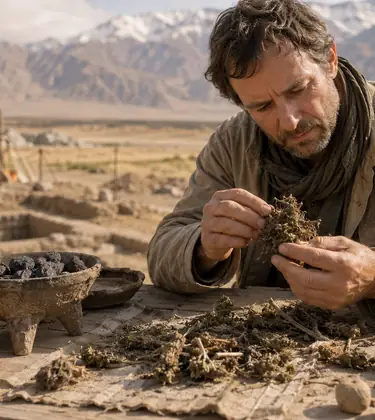
The oldest hard proof that people smoked cannabis to get high comes from a 2,500-year-old cemetery in the Pamir Mountains of far-western China, a site called Jirzankal. Archaeologists found wooden braziers there packed with burnt stones, and lab analysis showed that nine of the ten bowls had once held cannabis carrying unusually high levels of THC.
That detail is the whole ballgame. Most cannabis from that era was low in THC and grown for fiber and seed, not for the high. The plants burned at Jirzankal were potent, which tells researchers the people there were either hunting down wild high-THC plants or already steering the genetics toward a stronger effect.
Researchers proved the point by comparison. Cannabis dug up at another nearby site was the low-THC, fiber-and-seed kind, while the Jirzankal plants were loaded. The site also sits around 10,000 feet up, and cannabis grown at high altitude tends to produce more THC, so the location may have offered easy access to stronger plants, or steady traffic across the mountain passes may have crossbred local plants with potent strains from elsewhere.
And it all happened around a grave. The smoke almost certainly played a part in the funeral, filling a closed tent like incense while mourners sent someone off. Hemp as a fiber crop in China goes back thousands of years before this, but Jirzankal is the earliest clear sign of anyone using the plant to get loaded.
What's the history of cannabis in China?
China's history with the plant is one of the longest anywhere. Hemp fiber shows up pressed into Chinese pottery from the Neolithic, and people used it to make rope, cloth, fishing nets, and some of the earliest paper in the world. The plant was so ordinary it earned a blunt one-syllable name: “ma.”
Then it became medicine. Chinese tradition credits the legendary emperor Shen Nung, said to have lived around 2700 BC, as the father of the country's herbal medicine. There's physical backup for early use too: the grave of a shaman buried roughly 2,700 years ago in the Yanghai Tombs of northwest China held well-preserved cannabis that later tested positive for THC. Shen Nung's teachings were eventually written down in a herbal manual, the Shen Nung Pen-ts'ao Ching, that recommended cannabis for a long list of ailments.
Ancient Chinese physicians paid close attention to the plant. They noted differences between male and female plants and folded cannabis into treatments for pain, rheumatism, and other conditions, building a medical record that ran for well over a thousand years.
What stands out is how practical it all was. No mystery cult here, just farmers and doctors treating cannabis as a useful crop and a serious medicine, generation after generation. As trade along the Silk Road grew, that knowledge traveled west with the caravans, carrying Chinese cannabis and Chinese ideas about it deep into Central Asia.
Why were the Scythians smoking cannabis at funerals?
The Scythians were nomadic horse warriors who ruled a huge sweep of the Eurasian steppe between Siberia and Eastern Europe. They left almost no writing of their own, so most of what we know about their cannabis habit comes from the Greek historian Herodotus.
Around 440 BC, Herodotus wrote that the Scythians would crawl into small tents, throw hemp seeds onto red-hot stones, and shout for joy as the smoke poured out. For a long time, scholars assumed he was spinning tall tales about strange northern barbarians.
He wasn't. The THC-laced braziers in the Pamir mountains match his description almost beat for beat, hot stones and all. Archaeologists have also opened Scythian graves in southern Siberia that held burnt cannabis, tent poles, and small portable stoves, the exact kit Herodotus described. Hemp seeds turned up in the famous frozen Pazyryk burials in the Altai mountains as well, frozen in permafrost alongside the tattooed bodies of the steppe elite.
This was ritual, not a casual session. The smoke was tied to purification and funerals, a way of marking death and altering the mind at the same time. Because the Scythians rode the trade routes connecting China, India, and the West, they helped carry cannabis and the practice of using it across thousands of miles of the ancient world.
Feeling lost on how to start? Try taking our quiz!
Start a QuizHow did cannabis become sacred in ancient India?
In India, cannabis went a step past medicine and ritual. It became holy. The Atharva Veda, one of Hinduism's oldest sacred texts, lists cannabis among five sacred plants and describes it as a source of joy that frees people from anxiety.
The plant is bound tightly to Shiva, one of the most important gods in the Hindu pantheon, so closely that he's sometimes called the Lord of Bhang. Bhang is a drink made by grinding cannabis leaves into milk and spices, and by legend Shiva himself stumbled onto the plant's calming effect while wandering the mountains.
That tradition never died. Devotees still drink bhang during festivals like Holi and Maha Shivaratri, the same preparation described in texts written before most of today's major religions existed. Indian culture developed other forms over the centuries as well, from milder bhang to stronger ganja and the resin-heavy charas, often shared in a communal pipe.
The throughline is reverence. Where China treated cannabis as medicine and the Scythians used it for ritual intensity, India built the plant into devotion and daily spiritual life, and kept it there for thousands of years.
The unexamined day is a wasted opportunity. Reflect on what you did, what you learned, and how you can improve.
John Dewey
What do ancient landraces have to do with modern cannabis seeds?
Here's where the story circles back to the seeds in your grow tent. Every strain on the market today traces back, eventually, to plants like the ones the ancients used. Those originals were landraces: regional varieties shaped over centuries by local climate, altitude, and soil until they were perfectly tuned to one corner of the world. The same plasticity that let high-altitude plants pump out more THC thousands of years ago is the raw material every breeder still works with.
Barney's Farm was built on exactly that material. In the 1980s, before there was an internet or a real seed-bank industry, our founder spent three years traveling through Afghanistan, Pakistan, India, Nepal, Thailand, Myanmar, Vietnam, and China, gathering landrace genetics from the same mountains and valleys that fill these ancient stories. That collection became the backbone of everything we've bred since.
You can still taste that history in the catalog. Critical Kush carries Hindu Kush and Pakistani Kush in its lineage, the same rugged region where people and cannabis have shared ground for millennia. It's a pure indica that finishes fast and lands like a hammer, built for deep relaxation at the end of a long day.
Laughing Buddha runs the opposite direction. It's a sativa born from a pure Thai landrace crossed with a Jamaican line, bright and energetic with a sweet, almost tropical nose. If the Scythians shouted for joy off a tent full of smoke, Laughing Buddha is the same feeling in seed form, minus the funeral.
What cannabis's ancient history tells us today
Strip away a few thousand years and the pattern looks familiar. People used cannabis as medicine, as a doorway to ritual and the divine, and as a straightforward source of joy. Those three threads run through China, the steppe, and India, and they're the same reasons people reach for the plant now.
Cannabis outlasted empires, trade routes, and a century of prohibition, and it's still here, still being bred and refined, still doing the jobs it did for the shaman in the Yanghai grave. Set against that timeline, the modern legalization wave looks less like a revolution and more like a homecoming.
Barney's Farm has been developing premium cannabis genetics since the 1980s, with over 40 Cannabis Cup wins. Explore our full seed catalog and find strains bred for every climate and skill level.