Cannabis Drive-Thrus and Vending Machines: The New Face of Weed Retail
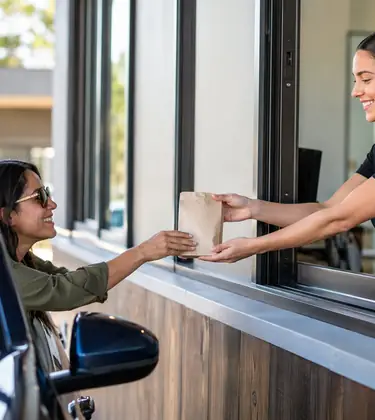
The first drive-thru dispensary in America opened on April 20, 2017, in Parachute, Colorado, a town of about 1,100 people. It was built inside a converted car wash.
That detail says more about the industry than any market forecast. Cannabis retail did not invent the drive-thru. It moved into America's existing drive-thru infrastructure and started selling weed out of it. A car wash in Colorado. A former bank in Arizona. A dead Starbucks in Connecticut.
Nine years later there are enough of these that Leafly runs a search filter for them, and the interesting question has shifted from whether they exist to which states will admit it.
The car wash that started it
Tumbleweed Express opened in Parachute because Parachute needed the money. Cannabis was already generating around 30 percent of the town's sales tax revenue by 2016, and the state's marijuana enforcement division had never seen anyone propose the model before. Coverage at the time quoted the town manager calling it a very creative and innovative idea and the operator saying he just saw a need for his customers. No grand strategy. A small town with a closed car wash and a legal product people wanted to buy without getting out of the truck.
Arizona followed in October 2017, when All Greens in Sun City opened a window inside a former bank. The owner's pitch was accessibility, not novelty: customers arriving in wheelchairs and with walkers found the drive-thru easier than the lobby. Las Vegas got one in November 2018 at NuWu, on Las Vegas Paiute tribal land, regulated by the tribe rather than the state. New Jersey's first opened on Route 17 in Lodi in 2022. Connecticut's first opened in Manchester in August 2024 in a building that used to be a Starbucks.
Who actually allows this
Colorado wrote it into the rules. A retail store may serve customers through a walk-up or drive-up window, provided the area outside is under the licensee's control, which excludes public streets and sidewalks, and video has to record the customer's vehicle.
Alaska went permanent in August 2023 with the strictest conditions in the country. Staff must physically view photo ID. Every person in the vehicle has to be 21 or older, with an exception for the customer's own young children in required car seats. No product can be displayed at the window.
Ohio issued guidance in December 2023 requiring the window to be physically attached to the building, banning walk-up service at a drive-up window, mandating a separate silent alarm, and demanding lighting good enough to read license plates.
Illinois joined in June 2026, when a broad cannabis bill legalized drive-through and curbside service alongside doubling possession limits and extending dispensary hours to 2am with local approval. Missouri already allowed drive-thrus and has become the country's most aggressive market for them.
Washington banned both formats in one sentence of statute: no vending machine for cannabis sales, no drive-through facility dispensing through a window or door. Massachusetts effectively bans drive-thrus by requiring any order fulfillment unit to sit inside the building, bolted down. That same requirement, read from the other direction, quietly describes an in-lobby vending kiosk.
California is deciding right now
This is the live story.
Assembly Bill 2697 would let licensed California retailers and microbusinesses sell to a customer in a vehicle through an on-premises drive-through, subject to local opt-in, using a fixed-pane security window with a secure transfer drawer. Delivery-only licensees are excluded, which draws a deliberate line between drive-thru and delivery as competing channels.
It passed the Assembly 55 to 9 in May and cleared Senate committee 7 to 3 in June. As of the end of July it is sitting on the Senate floor awaiting a third reading.
The bill's author framed it around access. A dispensary owner in Placerville testified that a significant portion of her customers rely on cannabis as medicine, including seniors, veterans and people with mobility conditions. Law enforcement opposition argued the bill prioritizes speed of sale over public safety, creates a direct link between purchase and vehicle operation, and makes ID checks harder.
The narcotic officers' association also made a specific point worth holding onto: no California statute authorizes drive-thru liquor sales.
Meanwhile California already has a drive-thru dispensary. Harborside in Desert Hot Springs has operated one since December 2019 under a grandfather provision for operators who applied before the state rule took effect.
Feeling lost on how to start? Try taking our quiz!
Start a QuizThe Louisiana problem
That line about liquor is true in California, and it collapses the second you drive to Louisiana.
Louisiana has sold frozen daiquiris through car windows since 1981. The state's open container law exempts frozen alcoholic beverages in sealed containers and specifies that it does not apply unless the lid is removed, a straw protrudes, or the contents have been partially consumed.
The workaround was invented by a shop owner in Lafayette who responded to a local ordinance by taping over the lid and the straw hole and handing the straw to you separately. Legal as long as the tape is intact. The 1982 state law that followed did not kill the business, it accelerated it.
Forty-five years of drive-thru cocktails on a technicality about tape. The lesson is that American law has never objected to selling intoxicants to people in cars. It objects to selling them unsealed. Which is precisely what a fixed-pane window with a security drawer is designed to solve.
The unexamined day is a wasted opportunity. Reflect on what you did, what you learned, and how you can improve.
John Dewey
Missouri built the 24-hour drive-thru
The 2026 format is not the drive-thru. It is the drive-thru that never closes.
A dispensary in Overland opened a 24/7 drive-through in March 2026. Local reporting found only two other nearby operations running 24-hour windows, in St. Peters and Pevely. Neighbors raised concerns about overnight traffic. Missouri leaves hours to municipalities, so St. Louis caps sales at 10pm while towns a few miles away do not.
A month later a Chicago-based operator launched St. Charles County's first 24-hour drive-thru off I-70 in O'Fallon. One Missouri chain now runs drive-thru windows at five of its eight locations. State recreational sales cleared $1.3 billion last year.
That same Chicago company had been publicly lobbying Illinois to legalize drive-thrus. Illinois then did, in June.
Vending machines are a longer, sadder story
Automated cannabis retail has been about to happen for roughly a decade.
The list of attempts is long. A robotic-arm kiosk deployed in Los Angeles in 2019, born when the founder got stuck in a 30-minute line at a dispensary with nine parking spaces serving 700 customers a day. A machine installed in a Colorado dispensary in 2023 that verifies ID, takes payment, then packages, labels and dispenses while you watch through a window. Units from vendors in Boston, London, Halifax and Arizona, some biometric, some priced from $16,000.
Most stalled. Regulators prefer human oversight. Point-of-sale integration is a nightmare. A machine holds a few hundred SKUs, which forces customers toward bestsellers and strips out the variety that makes a dispensary worth visiting. And the cheapest fix for a long line usually turns out to be another human behind another register.
Where automation is actually landing is quieter. In July 2026 California regulators approved RFID-powered self-checkout at a Sacramento dispensary, the first in the state, after observing that it satisfied age verification and state track-and-trace requirements. No robot arm. Just a reader that scans multiple tagged products at once and talks to the compliance system.
The most advanced consumer-facing machines in America right now are selling hemp, not marijuana. An Austin operator has deployed ten smart kiosks running three-tier age verification: physical ID inspection, ID scan, then facial recognition matching the face to the scanned ID before payment releases and product drops. A law fellow at the University of Texas raised the obvious question about what happens to that face data afterward, which is the right question and one almost nobody in this industry has answered properly.
The compliance stuff nobody talks about
Illinois has a biometric privacy law with a private right of action, meaning individuals can sue over improperly collected face and fingerprint data. Texas, Washington and New York have their own versions. A kiosk that scans faces in the wrong state is a lawsuit generator.
Then accessibility. A vending machine is a physical interface with height and reach requirements and a digital interface that needs screen reader and voice alternatives. Replacing a human with a touchscreen removes the person who was quietly making the store accessible. Accessibility happens to be the most persuasive argument operators make for drive-thrus, and it works because it is true. Applying the same standard to the machines is going to be less fun.
What this means for growing your own
We have been breeding cannabis in Amsterdam since 1986, and we have watched retail get progressively more convenient in almost every legal market on earth. The thing convenience does not solve is selection.
Every automated format narrows the menu. A vending machine holds a few hundred products. A drive-thru window is optimized for people who already know what they want and pre-ordered it. Both push demand toward whatever is already selling, which pushes cultivators toward whatever is already selling, which is how you end up with fifteen versions of the same three strains on every shelf in a state.
Home growing is the counterweight. It is the only part of the supply chain where the person consuming the flower picks the genetics, and where a strain survives because somebody likes it rather than because it moves units through a window at 3am.
If you want to understand what the automated shelf is optimized for, look at what sells. Gorilla Z is our flagship and it is the kind of thing every commercial menu wants: GG4 crossed with Original Z, 32 percent THC, 55 to 65 days in flower, 700 to 800g per square meter indoors and up to 2,500g per plant outdoors. It is the number people are shopping for and the yield operators are shopping for at the same time.
Runtz is the other archetype, the strain that built the modern dispensary menu. Original Z crossed with Gelato, 29 percent THC, a fast 55 to 60 day flower, harvest in the third to fourth week of September, and around 1,500g per plant outdoors. Balanced 50/50, sweet, and popular enough that it has been counterfeited on shelves in half the country.
Growing either one yourself takes about as long as it takes a dispensary to change its menu. Seeds ship as collectible souvenirs and germination depends on where you live.
Where this goes
Drive-thrus are winning because the argument for them is genuinely good and the argument against them is mostly about optics. Vending machines are losing because they solve a problem that cheaper solutions already solved.
Watch California's Senate floor in the next few weeks. If AB 2697 passes, the largest cannabis market in the world opens a channel it has spent eight years refusing, and every state still sitting on the fence gets a much bigger example to point at.
Barney's Farm has been developing premium cannabis genetics since the 1980s, with over 40 Cannabis Cup wins. Explore our full seed catalog and find strains bred for every climate and skill level.