Cannabis and Bone Healing: What the Fracture Research Actually Found
In 2015 a team in Israel broke rats' femurs, gave some of them cannabidiol, and found the healed bones held more load before failing. The press release said the clinical potential was undeniable. Fox News said marijuana can heal a broken bone and make it stronger.
Eleven years later, the human evidence points the other way, and the study did not say most of what it is quoted as saying.
This guide covers what that experiment actually found, why the endocannabinoid system genuinely does matter to bone, what happens when researchers look at people instead of rats, and what surgeons are seeing.
A rat study, not a human one
Purified CBD improved fracture strength in rats. That result has never been tested in a human being. In humans, the observational evidence associates heavy cannabis use with lower bone density and, in orthopedic databases, with higher rates of nonunion and malunion. Those two facts are not contradictory, and understanding why is the useful part.
What the rat study said
The paper is worth reading closely, because much of what circulates about it is invented. Researchers broke the femurs of rats, gave some of them cannabinoids for eight weeks, then measured how much force each healed bone could take before it failed. Bones from the animals given CBD held more load and absorbed more energy before breaking, though they were no stiffer than the others. In the authors' own words, maximal load and work-to-failure were markedly increased by CBD.
Three things follow that rarely travel with the headline. The effect belonged to CBD, not cannabis. The abstract states that this effect is not shared by THC, and that THC actually attenuated the CBD effect by week eight. The mechanism was collagen, not mineral. CBD raised expression of a gene encoding an enzyme that catalyzes lysine hydroxylation, involved in collagen crosslinking. The callus material density was unaffected. And it did not heal faster. Callus size was transiently smaller at week four and back to control level by weeks six and eight.
The word "markedly" is doing a lot of work, and the abstract contains no percentage at all. Any figure you have seen for how much stronger the bones were did not come from this paper.
The overreach came from the publicity. A co-author was quoted in the university's press release saying the clinical potential of cannabinoid-related compounds is simply undeniable at this point, and the release asserted that the healed bone would be harder to break in future, which the study never tested.
The biology underneath is real
None of this means the underlying science is nonsense. It is the most solid part of the subject. Bone cells carry cannabinoid receptors. A review in the Journal of Clinical Endocrinology and Metabolism records that CB2 is more highly expressed than CB1 in bone cells, including osteoblasts, osteocytes and osteoclasts, with GPR55 present on osteoclasts as well.
Knock out CB2 in mice and they develop accelerated age-related bone loss resembling human osteoporosis. Human genetics agrees at least partly: variants in the CB2 gene have been associated with postmenopausal osteoporosis and low bone density, though the association replicates in some populations and not others.
There is a catch that should temper any simple story. Deleting CB1 or CB2 separately worsens age-related bone loss in mice, but deleting both together protects against it. Results also flip depending on mouse strain and sex. So the endocannabinoid system regulates bone. That is established. It does not follow that consuming cannabinoids improves bone, and those two claims get conflated constantly.
Feeling lost on how to start? Try taking our quiz!
Start a QuizWhat happens when you study people
Here the picture inverts, and the numbers are worth sitting with. Researchers in Edinburgh compared 170 regular cannabis smokers against 114 controls who were themselves cigarette smokers. Heavy use meant more than 5,000 lifetime occasions, and the heavy group averaged over 47,000. Their bone density ran roughly 5% lower in heavy users compared to non-cannabis-smoking cigarette smokers, and fractures were more common in the heavy group. Moderate users showed no difference at all.
The heavy users also had lower body mass index and markedly lower vitamin D, which are themselves causes of low bone density, and the authors noted plainly that cause and effect cannot be inferred from an observational study.
Then a nationally representative US sample found nothing. Analyzing 4,743 adults in NHANES, researchers reported in Archives of Osteoporosis that no association between cannabis and bone mineral density was observed at any level of use.
Those two studies look like a contradiction and are not. NHANES defined heavy use as five or more days in the past month. Edinburgh defined it as tens of thousands of lifetime sessions. The national survey never sampled the extreme end where the signal appeared.
A 2024 systematic review screened 2,620 papers and found four human studies on recreational cannabis and bone density, split two to two. That is the entire world literature.
The unexamined day is a wasted opportunity. Reflect on what you did, what you learned, and how you can improve.
John Dewey
What the surgeons are seeing
The orthopedic databases are newer, larger and more consistent, and this is where the practical concern lives. A review of 159,998 patients found documented cannabis use an independent risk factor for nonunion after nonoperative scaphoid fracture treatment, with nonunion at two years running 10.1% in cannabis-only users vs 7.7% in non-users.
A study of 970,747 distal radius fixations found cannabis-only use associated with higher odds of infection and malunion, and concluded that concomitant use of cannabis and tobacco poses an elevated risk of nonunion and malunion compared to tobacco use alone. Note the proportion: cannabis-only odds of malunion came out at 1.47 against tobacco-only at 1.92. Tobacco is still the bigger problem.
For balance, one large study found nothing. In 149,289 ankle fracture fixations, cannabis-only users were not at greater odds of 90-day adverse events, while tobacco users were.
Cannabis users also consumed more opioids after orthopedic surgery, not fewer, in several cohorts.
Why the rat and the human disagree
A 2026 orthopedic review states the reconciliation cleanly, and it is the thesis of this entire article. Its summary of the split is that smoked cannabis can impair cancellous bone healing in animal models, while cannabidiol may enhance fracture repair. Rodent studies dose an isolated compound under controlled conditions. Human users consume whole, variable products.
Read that again, because it resolves everything above. The rat received purified CBD at a controlled dose, with THC shown to work against the effect. The human in the database is smoking a whole plant whose dominant cannabinoid is the one that did nothing in the rat, delivering combustion products, often alongside tobacco, and typically with a lower BMI and less vitamin D.
They are not the same intervention. They are barely the same subject.
And there is no human trial. Nobody has run a randomized controlled trial of CBD for fracture healing in people. Eleven years after the rat study, the clinical potential that was undeniable in 2015 remains untested.
What we would tell someone with a cast
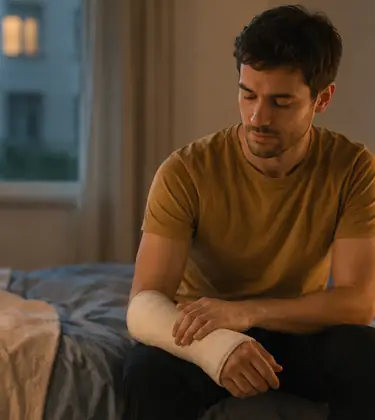
Nothing in our catalog will mend your arm faster, and we would rather say so than sell you a story. What the evidence supports is narrower and less exciting. If you are healing a fracture, the two things with real evidence behind them are not smoking anything and keeping your vitamin D and body weight in a sensible range, which is exactly where the Edinburgh cohort was failing.
If cannabis is part of how you sleep through a bad few weeks, the format is the part that matters, and combustion is the half carrying the documented association. Two from our catalog, for different reasons:
- Hindu Kush - Regular is the mountain landrace in regular form at 26% THC, 55 to 65 days at 80 to 120 cm, sweet sandalwood and earth over citrus. It makes a straightforward edible for anyone who would rather not inhale for a while.
- Candy Pack is five feminized seeds from the sweeter end of the catalog, sold as a mixed pack rather than a single cultivar. It suits anyone who would rather sample a few phenotypes across one run than commit the whole tent to a strain they have not grown before.
The genuinely interesting question this research raises is a breeding one. CBD did the work in that rat study and THC undid part of it, which is an argument for cannabinoid ratios as a selection target instead of a potency race. That is a long project, and the honest position today is that nobody has demonstrated it matters to a human bone.
Where the evidence leaves this
The famous 2015 study broke rats' femurs and found CBD increased maximal load and work-to-failure through collagen crosslinking. THC did not share the effect and attenuated it by week eight, healing was not faster, and the abstract contains no percentage improvement at all.
Bone cells really do carry cannabinoid receptors, and CB2 variants are associated with human osteoporosis in some populations. That establishes the system matters, not that consuming cannabinoids helps.
Human data runs the other way. Heavy cannabis users in Edinburgh had roughly 5 percent lower bone density and double the fracture rate, though with lower BMI and vitamin D as confounders; a US national sample found no association at much lower exposure levels; and orthopedic databases covering more than a million patients associate cannabis use with higher nonunion, malunion and infection rates, still below tobacco's. No human trial of CBD for fracture healing has ever been run.
Barney's Farm has been developing premium cannabis genetics since the 1980s, with over 40 Cannabis Cup wins. Explore our full seed catalog and find strains bred for every climate and skill level.