Can You Smoke Weed Stems? (And What to Do With Them Instead)
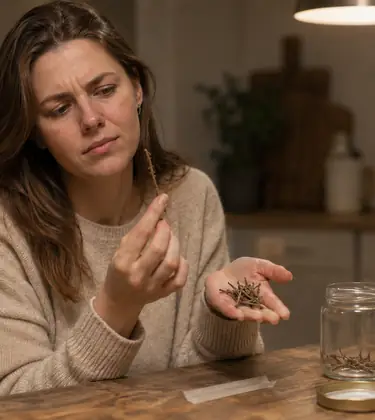
Somebody, somewhere, is looking at a bag of stems at the bottom of a jar and doing arithmetic.
The arithmetic never works. The gap between flower and stem is not a matter of degree, and once you see the actual numbers the question answers itself.
This guide covers what is really in a stem, why stem tea is chemically impossible, what you are inhaling when you burn one, the genuinely strange legal status of cannabis stalks, and the things worth doing with the pile instead.
The short answer
You can. It will not do anything useful, and it will taste like burning a chopstick. The cannabinoids in a cannabis plant are concentrated in the trichomes on the flower. Stems are structural tissue. They exist to hold the plant up and move water around, and the plant has no reason to put resin in them.
What is actually in a stem
A 2020 study in Scientific Reports measured secondary metabolites across every part of the cannabis plant in three different chemovars, and the spread is the whole story.
Inflorescence, meaning the flower, ran between 15.77 and 20.37 percent total cannabinoids. Leaves came in between 1.10 and 2.10 percent. And stem barks contained between 0.005 and 0.008 percent cannabinoids across all three chemovars, with roots lower still.
Take the top of the flower range against the bottom of the stem range and you are looking at a difference of roughly four thousand times.
To put that in usable terms, a gram of decent flower carries somewhere around 200 milligrams of cannabinoids. A gram of stem bark at those numbers carries about 0.05 to 0.08 milligrams. You would need something on the order of a couple of kilograms of stems to match a single gram of bud, and you would have to extract all of it perfectly.
The studies disagree, and that is worth knowing
Honesty about the evidence matters more than a clean headline, so here is the complication. The same lead author published a larger follow-up in Frontiers in Plant Science the following year, covering more chemovars, and got noticeably higher stem figures: stem bark between 0.06 and 2.33 percent total cannabinoids, averaging 0.58 percent, against roughly 15.9 percent for flower.
That is around seventy times higher than the 2020 measurement, and it moves the multiplier from four thousand to something closer to thirty.
Both papers agree completely on direction and scale, and both analyzed stem bark specifically, the peeled outer layer that sits closest to the resin-producing tissue. The woody core inside is lower again. Nobody has published a reliable number for the mixed handful of small stems that actually accumulates in a jar, and anyone quoting you a precise one is guessing.
Thirty times weaker is still a smoked joint's worth of effect from most of an ounce of woody material. The conclusion holds.
Feeling lost on how to start? Try taking our quiz!
Start a QuizWhy stem tea cannot work
The internet's favorite workaround fails on chemistry, not on technique. THC is fat-soluble and close to insoluble in water, at roughly 2.8 milligrams per liter at room temperature. Reference solubility data puts it in the same category as an oil. Water is the wrong solvent, and simmering does not change that.
Researchers who set out to extract cannabinoids into water with actual laboratory equipment found the optimal conditions for in-situ decarboxylation and extraction sat at 149.9 degrees Celsius across 42 minutes, using pressurized hot water extraction. Note the temperature. Water boils at 100 degrees at normal atmospheric pressure, so 149.9 requires a sealed pressure vessel. You cannot reach it in a kettle, a saucepan or a teapot, and no amount of simmering will get you there.
There is a second problem stacked on the first. Raw plant material contains THCA rather than THC, and converting one to the other takes sustained heat. Published decarboxylation work found THCA concentrations approaching zero after about 30 minutes at 110 degrees. Steeping in boiling water does not do that either.
So stem tea asks water to dissolve something that will not dissolve in it, from material that has almost none of it, in a form that has not been activated. Adding milk or butter helps a little with the solubility problem and does nothing about the other two.
The unexamined day is a wasted opportunity. Reflect on what you did, what you learned, and how you can improve.
John Dewey
What you are burning when you burn a stem
A cannabis stem is essentially wood. Analysis of hemp hurds, the woody inner core of the stalk, puts it at roughly 44 percent cellulose, 25 percent hemicellulose and 23 percent lignin. That is over 90 percent structural fiber.
Burning cellulose-rich material is well understood in combustion toxicology, and it produces acrolein and formaldehyde, both established respiratory irritants. Acrolein in particular is severely irritating to the airways and eyes, which is a reasonable explanation for why stem smoke makes people cough in a way flower does not.
That is a mechanism and not a measurement. Nobody has published a study analyzing cannabis stem smoke specifically, and the widely repeated claim that stems cause headaches traces back to forum posts and nothing else. The defensible statements are that stems carry almost no cannabinoids, that they burn harshly, and that burning woody material produces irritants.
Federal law says stalks are not marijuana
Here is the part almost nobody knows, and it is genuinely useful.
The federal definition of marihuana in the Controlled Substances Act carves out the mature stalks of the plant, fiber produced from those stalks, and preparations of those mature stalks, with the resin extracted from them expressly excluded from the carve-out. Mature stalks have never been a controlled substance under federal law. Neither has hemp fiber, hemp seed oil or hemp seed cake.
Which raises an obvious question: is the little stem running through a bud a mature stalk?
Florida's Supreme Court took it up in 1978, when the answer decided whether a defendant crossed a felony weight threshold. The state's expert argued mature stalks meant the main trunk and the material in evidence was just the little side branches. The court disagreed, finding it could not discern any meaningful distinction between stalks and stems, and held that stems had to be excluded from the weight.
Florida rewrote its statute afterward specifically to stop labs having to separate stalks and stems before weighing. The reasoning recorded for that change is the same conclusion this whole article reaches, arrived at by prosecutors: stems are of no drug value to the user.
What to do with them
Compost is the honest answer, and it is a better one than it sounds. Chop stems short, bury them in the pile instead of leaving them on top, and add a nitrogen source. Research on hemp residue decomposition found mass loss above 54 percent for residues worked into soil against residues left on the surface, and confirmed that nitrogen additions speed things up measurably. Woody material is slow, so give it depth, moisture and something green to work with.
Beyond that, the useful reframing is that stems are the wrong salvage target. Sugar leaf and trim run between roughly 1 and 2 percent cannabinoids in the same studies, which is somewhere between two hundred and a couple of thousand times what stem bark carries. Trim makes perfectly good edibles, butter and dry sift. Popcorn buds from the lower canopy are simply smaller flower and smoke fine.
If you have been throwing away trim and saving stems, you have the salvage backwards.
The real fix is upstream
This is where a seed company should be straight with you, because our interest is obvious and the advice is still correct.
Nobody smokes stems who has enough flower. Stem questions come from running short, and running short is a planning problem that gets solved at the start of a grow, not at the end of a jar. Work out what you actually get through in a year, then grow with margin, because an over-supplied grower composts stems without a second thought.
The other half is picking plants that give you volume without giving you a forest to manage. Glookies is the biggest producer in our catalog, GG4 crossed with Thin Mint Girl Scout Cookies at 29% THC, delivering 700 to 800 grams per square meter indoors and up to 3,000 grams from a single plant outdoors across a 60 to 70 day flower, sour diesel and key lime with a heavy but motivating effect. Jealousy is the tall option, Sherbert Bx1 crossed with Gelato 41 at 28%, reaching 220 cm outdoors for around 2,000 grams a plant in 65 to 70 days, apricot and citrus over fuel and pine.
Both of those also generate a serious quantity of trim, which is the material worth keeping. Four decades of breeding has convinced us that yield is unfashionable and underrated. It is the difference between a harvest you ration and a harvest you enjoy.
The short version
Stems carry a tiny fraction of what flower does. Published measurements put stem bark between 0.005 and roughly 0.6 percent total cannabinoids against 15 to 20 percent for flower, and the woody core is lower than the bark.
Stem tea fails on chemistry. THC barely dissolves in water, laboratory water extraction needs pressurized conditions around 150 degrees Celsius, and raw material has not been decarboxylated anyway.
Mature stalks are excluded from the federal definition of marijuana, and a state supreme court has held that stems count as stalks. Compost the stems, keep the trim, and grow enough that the question never comes up.
Barney's Farm has been developing premium cannabis genetics since the 1980s, with over 40 Cannabis Cup wins. Explore our full seed catalog and find strains bred for every climate and skill level.