Can You Smoke Weed in College Dorms? Campus Rules in Legal States
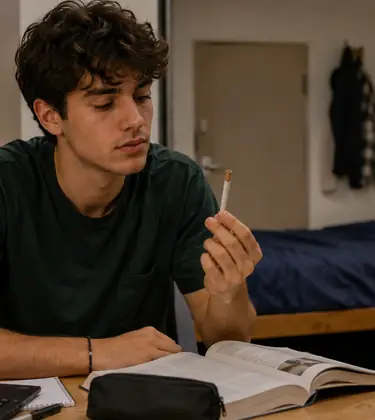
You are 21. You live in a legal state. You bought it from a licensed store, with a receipt, from a budtender who checked your ID. You carry it back to your dorm room, close the door, and the whole arrangement collapses.
Campus is a different country. Its own laws, its own police, its own courts, and none of them care what your state legislature decided. Here is what actually gets enforced, and what changed in 2026 that nobody has caught up with.
Can you smoke weed in college dorms if your state legalized it?
No. Not in Colorado, not in California, not in New York, not anywhere. Every college and university that takes federal money bans cannabis on campus, and that covers nearly every institution in the country, public and private.
This is not administrators being uptight. Schools are locked in by the Drug-Free Schools and Communities Act, which requires any institution taking federal funds to prohibit illicit drug use on campus. Federal money means Pell Grants, student loans, research grants, work study, the whole pipeline. A school that carves out a weed exception is gambling its entire financial aid operation on a policy change that has not happened.
Meanwhile the students are very much not abstaining. Federal survey data puts past-year cannabis use among adults aged 19 to 30 at roughly 42 percent, with 29 percent reporting use in the past month. That is the exact age bracket living in the buildings where it is most comprehensively banned. The gap between the rulebook and the hallway is enormous, and everyone knows it.
Why does federal funding decide what happens in your dorm room?
Because cannabis is still federally controlled, and campuses sit on the federal side of the line.
This got complicated in 2026. In April, the Department of Justice moved FDA-approved cannabis products and state-licensed medical marijuana into Schedule III. First federal reclassification of cannabis in over fifty years, and also very narrow. Recreational weed, the kind you buy at the adult-use dispensary near campus, stayed in Schedule I.
The bigger question is being settled right now. The DEA opened an expedited hearing on June 29, 2026, on whether to move marijuana as a whole from Schedule I to Schedule III, with proceedings set to conclude by July 15. If broader rescheduling lands, expect headlines suggesting campus rules are about to fall over.
They are not. Schedule III is still a controlled substance. Vicodin is Schedule III. Ketamine is Schedule III. You cannot use either of those in your dorm either. The drug-free campus obligation does not evaporate because a substance moved down a tier, and no university counsel is rewriting decades of policy on a hunch. Rescheduling changes tax law and research access. It does not hand you a bong in Baker Hall.
Can you get expelled for weed on campus?
Technically yes. Realistically, almost never on a first offense.
Expulsion sits at the far end of a long ladder, and schools rarely climb it for a kid with a grinder. The ladder usually runs:
Written warning and a conduct file. Mostly paperwork, and it sits on your record with the dean of students.
A fine and a mandatory drug education course. Usually an online module. You pay for it.
Housing probation. One more violation and you are out of the residence hall.
Loss of housing. The punishment students actually feel. Not expelled, just suddenly apartment hunting in October.
Parental notification. Many schools reserve the right to call your parents if you are a dependent under 21. This has ended more college weed careers than any campus cop.
Distribution is where it turns serious. Selling to your floor, even at cost, even to friends, puts suspension and expulsion genuinely on the table and pulls real prosecutors in. Holding a bag for six people is a completely different risk from holding a bag for yourself.
A campus conduct hearing is also not a criminal trial. Schools decide on a preponderance of the evidence, meaning more likely than not. No jury, limited right to an attorney, none of the rules of evidence you have seen on television. The residence contract you signed in August, not the state penal code, is what governs you.
Feeling lost on how to start? Try taking our quiz!
Start a QuizWill a weed violation destroy your financial aid?
This is where almost every article on the internet is running on stale information.
The old rule was brutal. A drug conviction while receiving federal aid could suspend your eligibility, and the FAFSA asked about it directly. Students lost years of funding over one misdemeanor. That rule is gone. The FAFSA Simplification Act killed the drug conviction penalty, and the Department of Education removed the drug conviction question from the FAFSA entirely starting with the 2023-24 award year. A weed conviction no longer strips your Pell Grant or your federal loans.
Do not read that as a green light. Everything else is still exposed:
Institutional scholarships. Merit awards from the university carry conduct clauses. The school giving you the money can take it back.
Athletic eligibility. Team drug policies are separate, stricter, and enforced by coaches with no interest in your state's ballot initiative.
Campus jobs. RA positions, lab work, anything with a conduct requirement attached.
A criminal record. If campus police refer it out, the state charge is a real charge, and it follows you into background checks and grad school applications.
The federal aid guillotine is retired. The rest of the machinery is fully operational.
The unexamined day is a wasted opportunity. Reflect on what you did, what you learned, and how you can improve.
John Dewey
Can an RA search your room because they smelled something?
Your RA is not a police officer, which cuts both ways.
They do not need probable cause, a warrant, or reasonable suspicion. They need the housing contract, which almost certainly lets staff enter for health, safety, or policy inspections. If they knock, smell smoke, walk in, and clock a pipe on the desk, that is a conduct referral. Fourth Amendment protections apply to the state acting as law enforcement, and a sophomore with a clipboard is not conducting a criminal search.
Actual police are a different story, and the law has moved fast here. Courts in legal states have been dismantling the assumption that cannabis smell alone justifies a search. The Illinois Supreme Court ruled that the odor of burnt cannabis by itself is not enough for police to conduct a warrantless vehicle search, and Pennsylvania, Minnesota, and Michigan have landed in similar territory. Once a substance is legal to possess, its smell stops being evidence of a crime.
Real shift, and it will not save you in a dorm. Those rulings constrain police, not conduct boards, which never needed probable cause. The gap between what police can prove and what your dean can act on is why students who beat a charge still lose their housing.
So where can a college student legally smoke?
Off campus, indoors, on private property, with permission from whoever owns it. That is the entire legal lane, and it is narrower than students assume. Public consumption is banned in nearly every legal state, so the quad, the parking garage, and the walk back from the dispensary are out. Rental leases routinely ban smoking, so an off-campus apartment is only as permissive as your landlord's contract. And if you are under 21, none of this applies to you anyway. Be precise about the age rules for buying weed before building a plan around it.
The genuinely legal social option, in a handful of states, is a licensed consumption venue. We mapped out cannabis lounges in the USA, and if you are travelling, cannabis-friendly hotels are the other rare place where the paperwork lines up.
The Barney's Farm take: play the long game
Here is what nobody tells freshmen. The dorm is a four-year problem with an obvious exit. You will eventually live somewhere with your own lease and your own closet, and that is when the interesting option opens up.
Derry started this in the early 1980s, hauling landrace genetics back from Afghanistan and the Himalayas because the plants he wanted did not exist in Europe yet. Forty-plus Cannabis Cups later, the obsession is still stability. A student growing one plant in a closet cannot afford a phenotype lottery. You get one shot, in a small space, with a landlord who may or may not be curious.
Which brings us to the most useful piece of grower knowledge for anyone in shared student housing: autoflowers do not care about your roommates. A photoperiod plant needs an uninterrupted 12 hours of darkness to flower properly. One housemate opening that closet door at 1am hunting for a phone charger, repeatedly, can stress the plant into throwing seeds and wreck the harvest. Autoflowers run on an internal clock instead of a light schedule. They are functionally immune to a house with four people in it, and they finish in roughly two months instead of five.
Two we would hand a first-time grower:
White Widow XXL Auto is the forgiving one. An Amsterdam classic rebuilt on our Super Auto lineage: 23 percent THC, 80 to 100cm indoors, mold and pest resistant, done in 70 to 75 days from seed. It tolerates mistakes, which is what you want on attempt number one.
Mimosa x Orange Punch Auto is the one for attempt number two. 24 percent THC, compact at 80 to 100cm, 65 to 70 days, and a limonene and linalool profile that lands as candied orange. Dense colas on a plant that refuses to sprawl.
Two notes. Home grow limits vary enormously by state, and a few legal states allow none at all, so check yours first. And the dorm is not the place. Growing on campus is not a conduct violation, it is a cultivation charge, which is a different universe of trouble.
The short version
You cannot smoke in your dorm, legal state or not, and no realistic federal change alters that. A first offense rarely means expulsion, but it can cost you your housing, your scholarship, and your Saturday to a drug education module. Your federal aid is safer than it used to be. Your institutional money is not. Your RA does not need a warrant.
Wait it out, get your own place, and grow something worth the wait.
Barney’s Farm has been developing premium cannabis genetics since 1986, with more than 40 Cannabis Cup wins. Explore our full cannabis seed catalog and find the genetics that fit how you actually medicate.