
Can You Own a Gun if You Smoke Weed? The ATF Question Explained
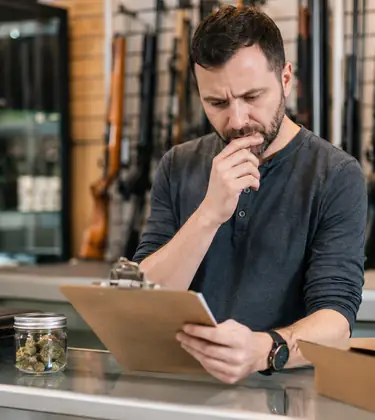
You walk into a gun shop, slide your ID across the counter, and the clerk hands you a clipboard with a federal form. About halfway through there is a question that turns honest cannabis users into liars or kills the sale on the spot. Welcome to ATF Form 4473, where federal law still pretends recreational marijuana does not exist in roughly half the country.
Twenty-four states allow adults to use cannabis recreationally. Thirty-eight allow medical use. The federal government does not care. If you are a regular consumer, you are a “prohibited person” at the gun counter. Here is what is actually on the form, what the law says, why it might be on its way out, and what it means for you right now.
What does ATF Form 4473 ask about marijuana?
Question 21.e of the federal Firearms Transaction Record asks every gun buyer purchasing through a licensed dealer the same thing: are you an unlawful user of, or addicted to, marijuana or any other controlled substance? Right below the question, the form spells out that cannabis remains illegal under federal law no matter what your state allows. There is no asterisk for medical patients. No carveout for adult-use states. No “it is just on weekends.”
Form 4473 is a seven-page document you fill out at any federally licensed firearms dealer before a background check runs. The dealer keeps it on file, and the ATF can request it during any criminal investigation. In 2024, Hunter Biden was convicted on three federal gun charges for lying on a Form 4473 question. That case is the highest-profile example, but plenty of others fly under the radar.
If you check “yes,” the dealer denies the sale. They have no discretion.
Why is cannabis use a federal gun ban in the first place?
The relevant statute is 18 U.S.C. § 922(g)(3), part of the Gun Control Act of 1968. It makes it a federal felony for any “unlawful user of or addicted to any controlled substance” to possess a firearm or ammunition. Cannabis is still Schedule I under the Controlled Substances Act, the same tier as heroin. That classification predates every modern dispensary, every state legalization vote, and every Cannabis Cup that Barney’s Farm has ever brought home from Amsterdam.
The Trump administration moved to reschedule certain marijuana products in late 2025. The Justice Department placed FDA-approved marijuana products and state-licensed medical marijuana products in Schedule III of the Controlled Substances Act, with a broader DEA hearing on full rescheduling scheduled for June 29, 2026. None of that automatically changes 922(g)(3). The “unlawful user” language stays in force unless Congress rewrites it or the courts strike it down.
The ATF’s reading has historically been broad. Use cannabis at all in a way the federal government considers unlawful, and you are a prohibited person while that use continues. State legalization is irrelevant to the federal question.
What happens if you lie on Form 4473?
Lying is a federal crime, separate from any drug charge. Penalties run up to ten years in prison and a $250,000 fine. The Bipartisan Safer Communities Act added a “trafficking in firearms” charge to the menu, with up to fifteen years attached, and the language is broad enough to cover cannabis consumers who buy guns through normal channels.
Prosecutions are rare but not theoretical. Most lies on the form never get caught. Most denied buyers never face charges. Two scenarios change that math fast: a self-defense incident where police pull your records, or any unrelated arrest where a search turns up cannabis. Investigators can pull your 4473 years after the fact. If your medical card or recent purchase log contradicts the box you checked, you are suddenly facing felonies that did not exist before the cops showed up.
The “no” answer relies on present-tense use. The question is in the present tense. Lawyers have argued that someone who used cannabis in the past but stopped is no longer an “unlawful user.” There is no clean federal definition of when use ends and rights return, which is part of the reason this fight is now in front of the Supreme Court.
Feeling lost on how to start? Try taking our quiz!
Start a QuizDid the courts strike down the cannabis gun ban?
In one circuit, yes. Everywhere else, undecided.
In 2023, the U.S. Court of Appeals for the Fifth Circuit overturned the conviction of Patrick Daniels Jr., a Mississippi man who had been sentenced to nearly four years in prison for possessing firearms while admitting to regular cannabis use. The Fifth Circuit said historical American gun regulation does not justify disarming a sober citizen based on past or occasional marijuana use. The same court applied that reasoning in early 2025 to a separate case, paving the way for Supreme Court review.
That decision relied on the Supreme Court’s 2022 ruling in New York State Rifle & Pistol Association v. Bruen, which requires modern gun regulations to match a historical American tradition of firearm regulation. The Fifth Circuit said no such tradition exists for permanently disarming people who occasionally use intoxicants.
The bigger fight is now at the Supreme Court. On March 2, 2026, the justices heard oral arguments in United States v. Hemani, which asks the same question on a national scale. A majority of the justices appeared skeptical that the law passes constitutional muster. The defendant, a Texas man, used marijuana about every other day and kept a legally purchased pistol in his home. A decision is expected by late June 2026. Most legal observers expect a narrow ruling that limits 922(g)(3) without nuking it entirely.
If you are looking for a strain that fits the political moment, Amnesia Lemon is a Cannabis Cup winner from 2004, made with the breeder Soma by crossing Amnesia Haze with Lemon Skunk, 26% THC across a 60 to 65 day flower, all citrus and sweet lemon — and a name built for a conversation about clearing records.
The unexamined day is a wasted opportunity. Reflect on what you did, what you learned, and how you can improve.
John Dewey
Can medical marijuana patients own guns?
State law says one thing. Federal law says another. The conflict is brutal for patients in particular.
The ATF sent an open letter back in 2011 telling licensed dealers to treat any medical marijuana cardholder as a prohibited “unlawful user.” That guidance has not been formally rescinded. Florida residents Vera Cooper and Nicole Hansell challenged the application of 922(g)(3) to medical patients, and the Eleventh Circuit revived that challenge in August 2025 after a district court initially dismissed it. The case is ongoing.
Concealed carry is a separate state-level question. Some states explicitly protect medical cannabis patients’ carry rights. Others quietly enforce the federal standard through state licensing. The honest answer for anyone with a medical card right now: state approval will not protect you from a federal prosecution if one comes. It will help you in court. It will not stop the indictment.
What this means for cannabis-loving gun owners
Barney’s Farm has been breeding cannabis genetics out of Amsterdam since 1986, racking up more than forty Cannabis Cup wins along the way. We have watched the legal landscape shift from total prohibition to a patchwork of state-level legalization in basically every English-speaking democracy that matters. The American gun rights conversation is the latest chapter, and it is one of the most consequential.
The cultural reality is simple. Millions of Americans own firearms, and millions of Americans use cannabis. Plenty do both. The federal government’s position has been that those two activities can never overlap legally. The Bruen test, the Daniels and Connelly rulings, and the upcoming Hemani decision are all chipping away at that position.
Until the Supreme Court rules, the situation on the ground has not changed. Form 4473 still asks the question. The dealer still has to deny the sale if you say yes. The penalty for lying is still measured in years. Anyone who values both their plants and their firearms should know exactly where the lines are drawn before walking into a shop.
For growers with a sense of cannabis history, classics like Acapulco Gold carry the kind of American counterculture lineage that maps onto this moment. Originally a Mexican landrace that defined high-grade cannabis for an entire generation of smokers, the modern Barney’s Farm version is a sativa-dominant hybrid with reddish-brown calyxes and a fruit-cocktail flavor profile that took home a High Times Cannabis Cup in 2010.
Where things actually stand
The legal answer to “can I own a gun if I smoke weed” is technically still no under federal law. The practical answer depends on which circuit you live in, whether you are buying through a dealer or a private seller, and what the Supreme Court does in Hemani. The political answer is that this prohibition is on shaky ground for the first time since 1968, and the next few months will tell us whether one of the most contradictory federal laws on the books survives.
Until then, the safest move is to know what is on Form 4473 before you sign it. Lying about it is the trap. Knowing about it is the only way out.
Barney's Farm has been developing premium cannabis genetics since the 1980s, with over 40 Cannabis Cup wins. Explore our full cannabis seed catalog and find strains bred for every climate and skill level.