Can You Bring Weed on Amtrak or Greyhound? Train and Bus Rules Explained
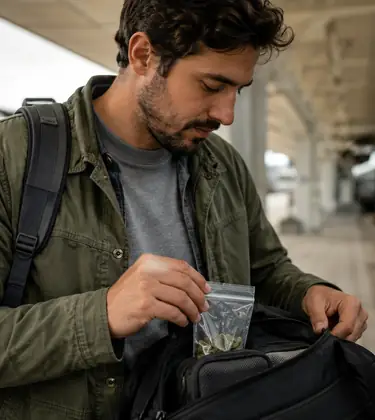
You bought legal flower in a legal state. Now you want to ride the rails or catch a cross-country bus with it in your bag. Simple question: can you bring weed on Amtrak or a Greyhound? The short answer is no. Not legally, anyway. The longer answer is where it gets interesting, because the rules on a train or a bus have almost nothing to do with your state's dispensary laws and everything to do with which government is technically in charge once you start moving.
Here is the part most people miss. The second you board a train or bus that crosses state lines, you step out of your state's rulebook and onto federal turf. And federally, cannabis is still a problem. Let's break down exactly what Amtrak and Greyhound say, what actually happens on the ground, and the smarter way to travel green.
Can you bring weed on Amtrak?
No. Amtrak's own rules are blunt about it. The company's official policy prohibits the use or transportation of marijuana in any form, for any purpose, even in states where recreational use is legal or where it is permitted medically. That covers flower, vapes, edibles, tinctures, all of it. Medical card included.
Why so strict? Amtrak is a federally chartered corporation that runs on federal funding and crosses state lines constantly. That puts every train, every station, and every platform under federal jurisdiction. State legalization does not reach onto a federal carrier, so a legal ounce in Denver becomes a federal headache the moment it boards the California Zephyr.
Amtrak does allow smoking outdoors on some platforms during longer stops, but that exception is for tobacco only. Marijuana and vaping stay banned everywhere, every time. And while there is no TSA line at most Amtrak stations, which fuels a lot of loose talk online about how nobody checks, that is not the same as permission. Major hubs run K-9 units, conductors can smell a fresh bag from a few rows away, and getting flagged means removal from the train, a possible law enforcement handoff, and no refund on your ticket. The lack of a metal detector is not a green light.
What about weed on a Greyhound bus?
Same answer, same logic. Greyhound bans illegal substances on its coaches, and intercity buses are the definition of interstate travel. Cross a state line with cannabis on board and you have moved the question from state court to federal jurisdiction, where the plant still carries weight.
Greyhound terminals vary wildly in how much they screen. Some small-town stops check nothing but your ticket. Larger terminals bring in dogs and security, and routes running through the southern border states pick up Border Patrol checkpoints on top of that. Staff can search bags when they have reason to, and a refused search usually means you are not getting back on the bus. Riding a Greyhound with weed is a gamble, and the house edge climbs every time you pull into a major terminal.
Stashing it in checked luggage under the bus does not help either. That bag is still on a coach crossing state lines, still yours, and still fair game if a dog hits on it at a stop. Historically Greyhound has run a zero-tolerance approach, meaning a find gets handed to police instead of quietly ignored. Distance from the driver's seat does not equal distance from the consequences.
Why is weed still banned on transit when my state legalized it?
This is the split that trips people up. Cannabis is now legal for adults in 24 states plus Washington D.C., and legal for medical use in 41 states. But none of that state-level progress rewrites federal law, and interstate carriers answer to Washington, not to your statehouse.
Under the federal Controlled Substances Act, most cannabis is still a Schedule I drug, the government's harshest classification. State legalization created a patchwork where the plant is fine on one side of a county line and a crime on the other. Trains and buses that thread through multiple states sit squarely on the federal side of that line for the entire trip. That is why your dispensary receipt means nothing to a conductor.
Feeling lost on how to start? Try taking our quiz!
Start a QuizDid the 2026 rescheduling change any of this?
Here is the freshest wrinkle, and it is where a lot of travelers are getting the wrong idea. In April 2026 the Justice Department moved FDA-approved cannabis medicines and state-licensed medical marijuana from Schedule I down to Schedule III. It was the biggest shift in federal cannabis policy in decades, and a broader hearing on rescheduling the rest of the plant ran through the summer of 2026.
But read the fine print before you pack a bowl for the train. Recreational cannabis stayed exactly where it was, in Schedule I. And even Schedule III is a controlled substance with strict transport rules. Neither Amtrak nor Greyhound changed a word of policy after the announcement. So the honest answer for anyone hauling recreational weed onto public transit in 2026 is that nothing changed. The train and bus rules are the same as they always were.
The unexamined day is a wasted opportunity. Reflect on what you did, what you learned, and how you can improve.
John Dewey
What about edibles, vapes, or CBD?
Amtrak and Greyhound draw no line between flower and everything else. Gummies, chocolates, THC vape carts, and concentrates all fall under the same marijuana ban, and in some prohibition states edibles and concentrates are charged harder than bud, because the entire product weight counts toward the penalty, THC content aside. A single cartridge can carry more legal risk than a bag of flower.
Hemp-derived CBD under 0.3% THC sits in a grayer zone. It is federally legal, but a roadside field test cannot tell CBD apart from THC, and no conductor is going to run a lab on your carry-on. If it looks and smells like weed, expect to be treated like you are carrying weed until proven otherwise. The clean move is to leave anything ambiguous at home and skip the roadside chemistry lesson.
What happens if you get caught?
It depends almost entirely on where you are standing when it happens. In a legal state, personal amounts often end with confiscation, a warning, or a very awkward exit from the train. In a prohibition state, the same baggie can turn into real charges, and crossing a state line can push a simple possession issue into federal territory.
The pattern mirrors what happens at airports, which we broke down in our guide on flying with weed. The staff are not hunting for your stash, but once it surfaces they are often required to loop in law enforcement, and from there the outcome rides on local rules. The safest assumption is the strictest one, because you rarely control which jurisdiction you are in when a bag gets opened.
A few ground rules keep the trip smooth:
Assume federal rules apply the whole way. The moment your route touches a second state, you are on federal turf.
A medical card does not travel. It is issued by your state and carries no weight on a federal carrier.
Smell is the tell. Odor-proof storage does not make it legal, and it will not beat a trained dog.
Buy at the destination instead. If your endpoint is a legal state, sourcing there removes the entire risk.
What is the smarter way to travel green?
After nearly four decades of putting seeds in the ground on both sides of the Atlantic, we will tell you what actually works. Do not smuggle. The math is bad and the reward is a stressful ride with a felony hanging over it. Two better plays exist.
Play one: arrive empty and buy legal at your destination if it is a legal state. Simple, clean, done.
Play two, the one we like best: grow your own so you are never the person sweating a bag on a Greyhound. A personal stash you cultivated at home never has to ride across a state line in your luggage. If you are new to it, start with genetics that are forgiving and fast. Gorilla Z is an indica-leaning powerhouse that finishes in eight to nine weeks and rewards a first-timer with dense, relaxing flower, the kind of thing you actually want waiting at home after a long haul. For something more balanced and daytime-friendly, Runtz brings a candy-sweet, even hybrid buzz and grows vigorously without a lot of hand-holding.
Home cultivation rules are their own patchwork, so check what your state allows before you plant. We mapped the whole thing out in our rundown of home grow laws by state. Grow within your limits, keep it at home, and the entire train-and-bus dilemma disappears.
The rails and the highways will always call. Just do not answer with contraband in your bag. Federal law owns the space between states, and no dispensary receipt changes that on an Amtrak platform or a Greyhound curb. Keep your travel clean, keep your grow legal, and let the genetics do the work while you enjoy the ride.
Barney's Farm has been developing premium cannabis genetics since the 1980s, with over 40 Cannabis Cup wins. Explore our full cannabis seed catalog and find more Amsterdam classics, USA-bred hybrids, and award-winning strains.