Can You Fly With Weed? TSA Rules, State Laws, and What Actually Happens
You scored some killer bud on vacation. Maybe a friend gifted you a few pre-rolls. Now you're standing in the airport security line wondering: can you fly with weed?
The short answer is no, not legally. The longer answer involves a strange collision of federal law, state policy, TSA protocol, and the practical reality of what actually happens at airport checkpoints across America. Let's break it down.
What Does Federal Law Say About Flying With Cannabis?
Marijuana is classified as a Schedule I controlled substance under the federal Controlled Substances Act of 1970. That puts it in the same legal category as heroin and LSD, at least on paper. Because airports and airspace fall under federal jurisdiction, cannabis is prohibited at every single airport in the country. Full stop. It does not matter if you're flying from Denver to Portland, two cities where recreational weed is completely legal. The moment you step into a TSA screening area, federal law applies. Flying between two legal states still means crossing federal airspace, and that makes the transport of cannabis technically illegal under federal law.
According to the Wikipedia overview of U.S. cannabis law, 24 states plus D.C. have now legalized recreational marijuana, with 40 states permitting medical use. That's a massive chunk of the country living under one set of rules at home and an entirely different set at the airport.
What Are the Actual TSA Marijuana Rules?
Here's where it gets interesting. The TSA's official policy page states that cannabis and certain cannabis-infused products remain illegal under federal law, with one exception: products containing no more than 0.3 percent THC on a dry weight basis (that's hemp-derived CBD, thanks to the 2018 Farm Bill). TSA officers are required to report any suspected violations to law enforcement.
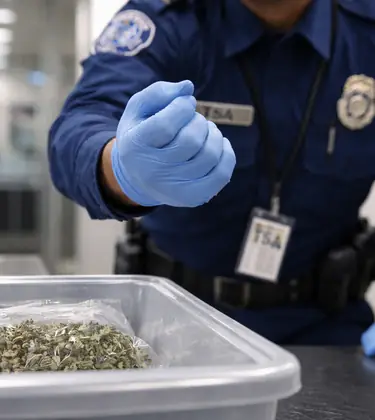
But here's the key line that most people miss: TSA security officers do not search for marijuana or other illegal drugs. Their job is to find threats to aviation. Weapons. Explosives. Stuff that can take a plane down. They are not trained drug screeners, and they are not hunting for your stash.
However, if a TSA agent finds cannabis while screening your bag for something else, they are legally required to notify law enforcement. What happens next depends entirely on where you are.
What Actually Happens If TSA Finds Your Weed?
This is the part people really want to know about. The reality is wildly inconsistent, and it all comes down to local law enforcement at your departure airport.
In legal states like California: LAX has one of the most permissive policies in the country. According to the official LAX marijuana policy, adults 21 and over can possess up to 28.5 grams of flower and 8 grams of concentrate within the airport. As a California peace officer, the Los Angeles Airport Police Division has no jurisdiction to arrest individuals who are complying with state law. If TSA flags you, local cops will likely just shrug. New York airports also allow possession of up to three ounces under state law.
In illegal states like Texas or Alabama: A TSA referral to local police could mean confiscation, a citation, or outright arrest. The enforcement certainty in these jurisdictions is real, and the penalties can range from fines to misdemeanor charges depending on the amount.
In most places: The most common outcome for small personal amounts is confiscation. The agent takes your weed, you miss your flight or get delayed, and that's the end of it. Getting arrested over a gram of flower at a major airport is rare, but not impossible.
Feeling lost on how to start? Try taking our quiz!
Start a QuizDo Edibles and Vape Pens Change the Equation?
From a legal standpoint, no. Edibles, concentrates, vape cartridges, and flower are all treated the same under federal law. If the THC content exceeds 0.3%, it's illegal to fly with, period.
From a practical standpoint, edibles are the least likely to be detected. A bag of gummies looks like a bag of gummies on an X-ray. There's no smell, no distinctive shape, nothing to flag it. Flower, on the other hand, has a recognizable density on scanners and an obvious odor that can attract attention during a bag search.
Vape pens sit in a middle ground. TSA actually requires all lithium battery devices to stay in your carry-on (not checked baggage) for fire safety reasons. So your vape pen needs to be in your carry-on regardless. If the cartridge contains THC above 0.3%, that's federally illegal. If it's hemp-derived CBD within the legal threshold, you're fine.
At Barney's Farm, we've spent over 30 years breeding strains that deliver specific effects, from heavy indicas built for pain relief to uplifting sativas designed for creative energy. We understand why people want to travel with their preferred cultivar. The connection between a consumer and their strain of choice is personal. But air travel is one area where that connection needs to pause. The smarter play is always to source quality cannabis at your destination rather than risk bringing it on a plane.
The unexamined day is a wasted opportunity. Reflect on what you did, what you learned, and how you can improve.
John Dewey
What About Medical Marijuana Cards?
A medical marijuana card holds zero weight at a TSA checkpoint. The card is issued by your state. TSA operates under federal law. Federal law doesn't recognize state medical programs. Your card might influence how local law enforcement handles the situation if TSA refers you, particularly in states that honor out-of-state medical cards. But it won't prevent the referral itself.
Some states have reciprocity agreements that recognize other states' medical cards, which could help you purchase cannabis legally at your destination. That's genuinely the better path for medical patients who rely on cannabis for symptom management.
Cannabis Amnesty Boxes: A Real Thing at Real Airports
One of the stranger developments in the weed-meets-aviation world is the cannabis amnesty box. When Illinois legalized recreational marijuana on January 1, 2020, Chicago's O'Hare and Midway airports installed metal drop boxes near TSA checkpoints where travelers could ditch their cannabis before boarding. As NBC Chicago reported, the boxes gave travelers a last-chance option to stay compliant with federal law.
The concept is practical but the execution has been, well, very human. Within weeks, someone at Midway broke into one of the original wooden boxes and stole the weed inside. The city spent about $29,000 upgrading to reinforced green metal boxes bolted to the floor. Las Vegas and Colorado Springs airports have similar setups. Denver International, despite Colorado's early legalization, specifically declined to install them.
Usage has been laughably low. Records show only 34 collections across both Chicago airports in the first few months. Most travelers either consume their stash before the airport, leave it at home, or just roll the dice.
Is Rescheduling Going to Change Anything for Air Travel?
In December 2025, President Trump signed an executive order directing the Attorney General to expedite moving marijuana from Schedule I to Schedule III. As NPR reported, rescheduling could bring significant changes for the cannabis industry, particularly around tax policy and research access. But here's what it won't do: legalize recreational marijuana at the federal level.
Even if marijuana moves to Schedule III, it remains a controlled substance. The TSA's policy framework wouldn't automatically change. Flying with weed would still be federally prohibited unless Congress passes separate legislation to legalize or decriminalize cannabis for recreational use. Schedule III drugs like ketamine and anabolic steroids still have strict rules around transport and possession. Don't expect the rescheduling process to suddenly make your carry-on stash legal.
Quick Reference: Can You Fly With Weed in 2026?
Marijuana flower, edibles, concentrates (above 0.3% THC): Federally illegal to fly with. TSA won't search for it, but must report it if found.
Hemp-derived CBD (0.3% THC or less): Federally legal to fly with. Keep it in original packaging with lab documentation.
Medical marijuana card: No protection under federal law at TSA checkpoints. May help with local law enforcement response.
International flights: Absolutely not. Customs screening is far more aggressive than TSA, and many countries treat any amount of cannabis as a serious criminal offense. Don't even think about it.
Best move: Leave it at home. Buy legal cannabis at your destination. Your trip will be better for it.
Barney's Farm has been developing premium cannabis genetics since the 1980s, with over 40 Cannabis Cup wins. Explore our full seed catalog and find strains bred for every climate and skill level.