Can Lawyers Smoke Weed? Bar Admission and Attorney Ethics

Lawyers spend their days explaining what the law allows, and in nearly half the states, the law now lets adults buy weed. That leaves plenty of attorneys and law students wondering whether the same freedom reaches people who carry a law license.
The answer runs through three places at once: state ethics rules, the bar application and a federal law that still treats recreational marijuana as a crime.
Key takeaways
- The ABA's model ethics rule treats a crime as misconduct when it reflects adversely on a lawyer's honesty, trustworthiness or fitness.
- New York's state bar said in 2021 that lawyers may use marijuana recreationally and grow it at home under state law.
- A Seattle-area bar group asked Washington's top court in 2013 to confirm that smoking legal pot alone does not break the ethics rules.
- Bar applications ask about arrests and job losses, and a lack of candor often weighs heavily against applicants.
- An Ohio bar applicant had his applications disapproved in 2020 after hiding a firing over a positive marijuana test.
Two sets of laws, one law license
So can lawyers smoke weed in a state where it is legal? Most states base their ethics codes on the American Bar Association's Model Rules of Professional Conduct, and the key provision is Rule 8.4(b). Each state's highest court adopts and enforces its own version, so the answer can change at the state line. It makes it professional misconduct to commit a criminal act that reflects adversely on the lawyer's honesty, trustworthiness or fitness as a lawyer in other respects. The next line of the same rule, 8.4(c), bars conduct involving dishonesty, fraud, deceit or misrepresentation.
The trouble sits in the word "criminal." Recreational marijuana remains illegal under federal law, even after an April 2026 federal rule moved state-licensed medical marijuana into Schedule III, so a lawyer who uses recreational weed legally under state law still breaks federal law on paper. Whether a joint at home says anything about a lawyer's honesty or fitness is exactly the question state bars have been asked to answer, and the rules on attorney cannabis use have grown up opinion by opinion.
Ethics opinions from Seattle to Albany
Two moments show how the thinking moved, first in Washington and then in New York, and one limit applies everywhere.
Washington asks its top court
A year after Washington voters legalized recreational marijuana in 2012, would-be pot-smoking lawyers in the state were facing an ethical dilemma, the ABA Journal reported. The King County Bar Association, the Seattle-area bar group, asked the Washington State Supreme Court to clarify that lawyers were not violating the ethics rules simply by smoking pot. Its proposed rule said lawyers do not break the rules "solely because" they do something Washington allows and federal law bans. The same article noted that marijuana use could still run into other ethics rules, such as the requirement for competence and diligence.
New York says yes
New York went further after legalizing adult use in 2021. In Ethics Opinion 1225, issued in July 2021, the New York State Bar Association concluded that a lawyer may also use marijuana for recreational purposes and may grow an authorized amount at home once the law takes full effect. The opinion also lets lawyers help cannabis businesses comply with state law and accept an ownership stake in a client's company in exchange for legal work, subject to the rules on conflicts of interest and business deals with clients. It leans on federal forbearance, calling the activities technically illegal under federal law and tying its conclusion to federal enforcement policy that could change.
High at work is another matter
No ethics opinion blesses practicing law while impaired. Competence and diligence rules apply every working hour, so a lawyer who shows up high to a deposition, a hearing or a client call invites discipline under those rules, whatever state law says about the weed itself.
Feeling lost on how to start? Try taking our quiz!
Start a QuizCharacter and fitness on the bar application
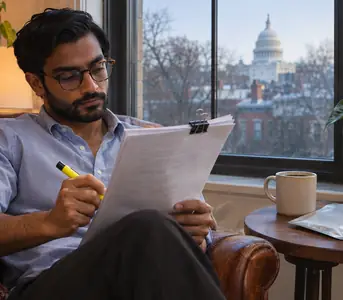
For most applicants, the link between the bar exam and marijuana is the paperwork, not the test itself. Applicants are asked to disclose any arrests, academic misconduct charges, job losses, traffic tickets, bankruptcies and in some cases mental health histories, the ABA Journal reported, and the National Conference of Bar Examiners lists evidence of drug or alcohol dependency among the kinds of conduct that can raise concerns. A law professor quoted in the same piece said a lack of candor is frequently a factor that significantly contributes to a refusal to admit someone. The article also noted that many states offer conditional admission, often reserved for applicants with past alcohol or drug problems, so a history of heavy use does not automatically close the door.
So the real character and fitness marijuana question usually comes down to honesty about the arrests, charges and jobs connected to past use. A few steps keep the answers clean:
- Read each question closely, including its time frame, and answer exactly what it asks.
- List every arrest, charge or citation the question covers, even a dismissed case if the wording includes it.
- Pull out your law school application and make sure the two sets of answers match.
- Add a short, factual explanation of what happened and what has changed since.
- Call the bar admissions office before filing if any question is unclear.
The unexamined day is a wasted opportunity. Reflect on what you did, what you learned, and how you can improve.
John Dewey
A failed drug test, then a false answer
An Ohio case shows how a cannabis problem turns into a candor problem. The applicant in In re Application of Phares had been fired in 2016 after a urine test came back positive for marijuana, then answered "no" on his bar registration application when asked whether he had ever been terminated from a job. In 2020, the Supreme Court of Ohio voted to disapprove Phares's pending applications, pointing to a pattern of dishonesty that began with that omission and continued with false testimony at his admissions hearings. The court based its ruling on the dishonesty, with the positive test only as the starting point, and it allowed him to reapply for the July 2022 bar exam or a later one.
Testing becomes a workplace question after admission. Private firms set their own policies, and a lawyer's drug test results can still cost a job in states that offer no protection for off-duty use. Some states protect workers who use legally on their own time, and whether you can get fired for smoking weed in a legal state depends on where you live and who signs your paycheck.
Growing at home with a law license
New York's opinion covers home growing, too, and in states that allow it, a few plants at home keep cannabis away from the office and the dispensary line. Two strains from our catalog fit very different ends of a long workday:
- Amnesia Lemon, created with the legendary breeder Soma and a Cannabis Cup winner in 2004, crosses Amnesia Haze with Lemon Skunk at 26% THC, finishes in 60 to 65 days and brings an uplifting, cerebral high with lemon, spice and sweet flavors.
- Bubba Kush, an Afghan Kush landrace and OG Kush cross at 29% THC, flowers in 56 to 63 days and tastes of dank earth, mocha and sweet hashish, with a deeply relaxing effect suited to evenings with no court date the next morning.
Keep the harvest locked away from the office, the car and anyone underage, and check your state's plant limit before the first seed goes in.
Habits that protect a law license
A few habits keep personal use from turning into a professional problem:
- Keep cannabis out of the office, the courthouse and every client meeting.
- Never draft, argue or advise while high.
- Skip driving after a session, since impaired driving is a crime in every state.
- Leave cannabis at home when you travel, and never carry it across a state line.
- Read your employer's drug policy before you accept an offer.
- Answer every bar and employment question about drugs and arrests truthfully.
Counsel, cannabis and candor
Lawyers in legal states can often use cannabis without breaking their ethics rules, as New York's 2021 opinion shows, but federal law still makes recreational use a crime, and the bar application rewards honesty above everything else. Keep it off the clock, out of the office and truthful on every form, and a law license and a legal joint can live in the same house.
Barney's Farm has been developing premium cannabis genetics since the 1980s, with over 40 Cannabis Cup wins. Explore our full seed catalog and find strains bred for every climate and skill level.