Where Is Weed Legal? Every US State at a Glance
Crossing a state line can turn a legal gram into a crime. The cannabis map of the United States shifts almost every year, and 2026 brought a new federal rule, a retail law in Virginia and two votes that kept the map from moving backward.
So where is weed legal in the US in late 2026? Recreational use is legal in nearly half the states, medical programs of some kind cover most of the rest, and two states still allow neither. A few rules also apply everywhere, whatever the local law says.
Key takeaways
- Twenty-four states and Washington, D.C., allow both recreational and medical marijuana.
- Another 24 states run some type of medical marijuana program, while Idaho and Kansas allow neither.
- More than half of Americans live in a place where recreational marijuana is legal.
- A federal rule moved state-licensed medical marijuana into Schedule III in April 2026, while other marijuana stays in Schedule I.
- Virginia approved retail shops that can open from July 1, 2027, and voters in Massachusetts and Idaho rejected measures to roll back or block legal weed.
Counting the legal states
Pinning down how many states have legalized weed depends on what counts as legal. Twenty-four states and D.C. allow small amounts of marijuana for both medical and recreational use, Pew Research Center reported in May 2026, citing the National Conference of State Legislatures. Another 24 states do not permit recreational use but have some type of medical marijuana access program, and Idaho and Kansas allow neither.
Population tells a bigger story than the state count. More than half of Americans, 53%, live where recreational marijuana use is legal, according to Pew's analysis of 2025 Census figures, and public opinion runs ahead of the law. In Pew's January 2026 survey of more than 8,500 adults, Americans split this way:
- 55% say marijuana should be legal for medical and recreational use.
- 33% say it should be legal for medical use only.
- 11% say it should not be legal at all.
Gallup measured support for legalization at 64% of adults in 2025, down from 70% in 2023, Pew noted.
All 50 states by legal status
In what states is weed legal, and how far does the law go? Pew's totals, as of May 2026, break down into four groups once the medical states are split by how much THC they allow:
| Legal status | Number of states | States in the group |
|---|---|---|
| Recreational and medical | 24 plus D.C. | Alaska, Arizona, California, Colorado, Connecticut, Delaware, Illinois, Maine, Maryland, Massachusetts, Michigan, Minnesota, Missouri, Montana, Nevada, New Jersey, New Mexico, New York, Ohio, Oregon, Rhode Island, Vermont, Virginia, Washington |
| Full medical program only | 15 | Alabama, Arkansas, Florida, Hawaii, Kentucky, Louisiana, Mississippi, Nebraska, New Hampshire, North Dakota, Oklahoma, Pennsylvania, South Dakota, Utah, West Virginia |
| Low-THC or CBD oil only | 9 | Georgia, Indiana, Iowa, North Carolina, South Carolina, Tennessee, Texas, Wisconsin, Wyoming |
| No legal access | 2 | Idaho, Kansas |
| Legal status | Recreational and medical | Full medical program only | Low-THC or CBD oil only | No legal access |
|---|---|---|---|---|
| Number of states | 24 plus D.C. | 15 | 9 | 2 |
| States in the group | Alaska, Arizona, California, Colorado, Connecticut, Delaware, Illinois, Maine, Maryland, Massachusetts, Michigan, Minnesota, Missouri, Montana, Nevada, New Jersey, New Mexico, New York, Ohio, Oregon, Rhode Island, Vermont, Virginia, Washington | Alabama, Arkansas, Florida, Hawaii, Kentucky, Louisiana, Mississippi, Nebraska, New Hampshire, North Dakota, Oklahoma, Pennsylvania, South Dakota, Utah, West Virginia | Georgia, Indiana, Iowa, North Carolina, South Carolina, Tennessee, Texas, Wisconsin, Wyoming | Idaho, Kansas |
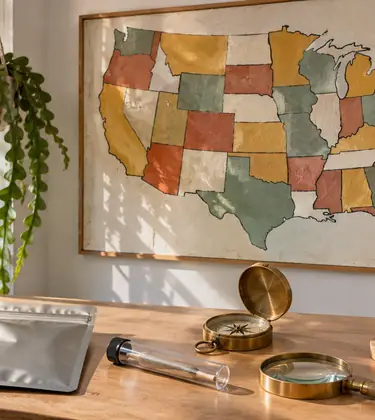
What states have recreational weed, and where do they sit? Laid out on a weed-legal states map, the 24 recreational states cover the Pacific Coast, most of the Mountain West, much of the Northeast and five Midwestern states from Minnesota to Ohio, while Virginia stands alone in the Southeast. Adults 21 and older can buy from licensed stores in nearly all of them, and most also allow a few plants at home. Medical-only states fill much of the South and the Plains, from Florida to Oklahoma and both Dakotas.
The West Coast also gave the world some of its best-known strains. Blue Dream, a sativa-dominant hybrid that originated in California, crosses Blueberry with Super Silver Haze, reaches 28% THC and finishes flowering in 65 to 70 days, with sweet berry flavors and a creative, uplifting effect.
Feeling lost on how to start? Try taking our quiz!
Start a QuizFederal and state changes in 2026
The federal government moved first. A Drug Enforcement Administration final rule, effective April 28, 2026, places marijuana drug products approved by the Food and Drug Administration in Schedule III, along with marijuana subject to a state medical marijuana license, the Federal Register shows. Schedule III is the same federal category as ketamine and anabolic steroids, drugs with accepted medical uses. Marijuana outside those programs, including everything sold in recreational stores, remains in Schedule I, so adult-use weed is still illegal under federal law even where a state allows it. At the counter, little changes for now, since medical patients keep buying from the same state-licensed dispensaries and recreational shoppers face the same federal law as before.
States kept moving, too. In Virginia, the first Southern state to legalize possession, back in 2021, budget legislation enacted on June 29 will allow up to 350 cannabis shops to open starting July 1, 2027, the Associated Press reported, after lawmakers accepted all of Gov. Abigail Spanberger's amendments. In Massachusetts, the effort to ban recreational cannabis sales was defeated with a resounding "no" vote on November 3, WBUR reported, so the state did not become the first to reverse course on legal weed. The main changes of the year line up as follows:
| Date in 2026 | Place or agency | What changed |
|---|---|---|
| April 28 | Federal government | FDA-approved marijuana drugs and state-licensed medical marijuana moved to Schedule III |
| June 29 | Virginia | A budget law allowed up to 350 retail shops starting July 1, 2027 |
| November 3 | Massachusetts | Voters defeated Question 8, which would have banned recreational sales |
| November 3 | Idaho | Voters rejected HJR 4, which would have let only the Legislature legalize marijuana |
| Date in 2026 | April 28 | June 29 | November 3 | November 3 |
|---|---|---|---|---|
| Place or agency | Federal government | Virginia | Massachusetts | Idaho |
| What changed | FDA-approved marijuana drugs and state-licensed medical marijuana moved to Schedule III | A budget law allowed up to 350 retail shops starting July 1, 2027 | Voters defeated Question 8, which would have banned recreational sales | Voters rejected HJR 4, which would have let only the Legislature legalize marijuana |
The unexamined day is a wasted opportunity. Reflect on what you did, what you learned, and how you can improve.
John Dewey
Medical-only states and the holdouts
In the 15 states with full medical programs, only registered patients can buy or carry cannabis, usually with a doctor's recommendation and a state card, and adults without one can still be charged. Each state writes its own list of qualifying conditions, fees and renewal rules, and a medical card from one state is not always honored in another. Hawaii is one of these medical-only states, and its landrace sativa is half the family tree of Pineapple Express, a 28% THC cross with Trainwreck that brings a fast cerebral rush, fresh-cut pineapple, tropical fruit and mango flavors and a flowering time of 60 to 65 days.
The nine low-THC states allow only oils with small amounts of THC for a short list of medical conditions, and smokable flower stays illegal there. Some states without recreational sales have decriminalized small amounts, which swaps an arrest for a fine, though possession stays illegal. Home growing is banned in most medical-only and low-THC states, and how many plants you can legally grow varies even among the recreational ones, from a total ban for most adults in a few states to 12 plants per household in Michigan.
Idaho and Kansas are the holdouts. In Idaho, all forms of marijuana and cannabis are illegal, East Idaho News reported, and on November 3, voters rejected HJR 4 by about 66% to 34% in the unofficial count. The amendment would have made the Legislature the only body able to legalize any drug, medical or recreational marijuana included, and ended voters' power to legalize it through a ballot initiative. With HJR 4 defeated, Idaho voters keep the option of a marijuana initiative in a future election.
Rules that apply in every state
A state's law covers only what happens inside its borders, and federal law sits on top of all of them. A few rules hold across the country:
- Adults must be 21 or older to buy or carry recreational weed in every recreational state.
- Driving while high is illegal everywhere, including states with dispensaries.
- Carrying weed across a state line breaks federal law, even between two recreational states.
- National parks, military bases and other federal land follow federal law.
- Smoking in public is banned almost everywhere, apart from licensed lounges in a few states.
- Possession limits differ by state, so a legal amount in one place can be over the cap in the next.
- Airport security checkpoints follow federal rules, even in states where weed is legal.
- Home grows usually have to stay out of public view and out of reach of minors.
- Employers and landlords can still set their own rules.
Reading the map before you travel
Twenty-four states and D.C. allow recreational weed, another 24 run medical programs of some kind, and Idaho and Kansas allow neither. This year added a federal Schedule III rule for medical marijuana, a 2027 start date for Virginia's shops and two votes that kept the map from moving backward. Check each state's rules before you go, and leave your weed behind at the border.
Barney's Farm has been developing premium cannabis genetics since the 1980s, with over 40 Cannabis Cup wins. Explore our full seed catalog and find strains bred for every climate and skill level.