Can You Get Fired for Smoking Weed in a Legal State?

You live in a legal state. You bought your flower from a licensed dispensary. You smoked on your own couch, on your own time, on a Saturday night. Monday morning, you get hit with a random drug test. Two days later, you're fired.
Sound unfair? It is. And it happens constantly.
Cannabis legalization has swept across the U.S. at a speed nobody predicted. But employment law? That's been dragging its feet like it's still 1986. The gap between what's legal at the dispensary and what's allowed at your job is one of the most frustrating contradictions in modern American life. Let's break down exactly where you stand.
Can Your Employer Fire You for Smoking Weed Off the Clock?
Short answer: in most states, yes. Even if you live somewhere that legalized recreational cannabis years ago, your employer can still show you the door for a positive THC test. The reason sits at the federal level. Under the Controlled Substances Act, marijuana is classified as a Schedule I substance alongside heroin and LSD. No accepted medical use, high potential for abuse. That's the federal government's official position, and it hasn't changed since 1970.
This federal classification gives employers a legal fallback. Even in states where recreational use is fully legal, many company drug policies reference federal law. Zero-tolerance workplace cannabis policies remain widespread and, in most jurisdictions, perfectly legal to enforce.
Which States Actually Protect Cannabis Users at Work?
Here's where it gets complicated. A growing number of states have started passing laws that specifically protect employees who use cannabis off-duty. States like California, New York, New Jersey, Connecticut, Montana, and Rhode Island now prohibit employers from firing or refusing to hire someone based solely on off-duty cannabis use or a positive THC test for non-psychoactive metabolites.
California's Assembly Bill 2188, which took effect in 2024, bars employers from penalizing workers for off-duty recreational use. New York's cannabis employment protections go further, preventing employers from even testing for recreational marijuana in most cases.
But exceptions exist everywhere. Safety-sensitive positions, federal contractors, Department of Transportation-regulated jobs, and roles requiring federal security clearance are almost always exempt. If you drive trucks, fly planes, or work in construction, workplace cannabis protections likely don't apply to you regardless of your state.
And here's the kicker: more than half of the 24 states that have legalized recreational cannabis still allow employers to enforce zero-tolerance drug policies with no employment protections whatsoever.
The Case That Changed Everything (and Nothing)
The landmark case that exposed this whole mess is Coats v. Dish Network, decided by the Colorado Supreme Court in 2015. Brandon Coats, a quadriplegic who used medical marijuana at home to manage painful muscle spasms, was fired by Dish Network after failing a random drug test. He never used cannabis at work. He was reportedly ranked in the top 5% of his department's customer service representatives.
Coats sued under Colorado's "lawful activities" statute, which prohibits employers from firing workers for legal off-duty conduct. The Colorado Supreme Court ruled unanimously against him. Their reasoning? Because marijuana remains illegal under federal law, it cannot be considered a "lawful activity" under state employment protections.
The decision sent a clear signal across the country. State legalization does not automatically translate to job protection. For cannabis consumers, the lesson was brutal: your state may say it's legal, but your employer still holds the power.
Feeling lost on how to start? Try taking our quiz!
Start a QuizWhy Does a Drug Test at Work Detect Last Week's Joint?
This is one of the biggest problems with workplace cannabis policy, and one that rarely gets enough attention.
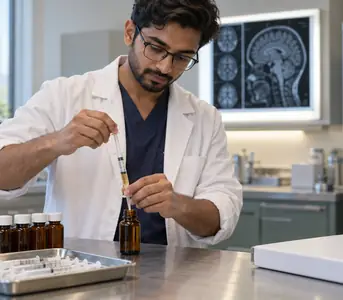
Standard urine drug tests don't measure impairment. They detect THC-COOH, a non-psychoactive metabolite that can linger in your system for weeks after your last session. A peer-reviewed study published in the Journal of Analytical Toxicology noted that cannabis is the most commonly detected substance in U.S. workplace drug tests, and that current testing protocols are unable to determine whether someone was actually impaired at work.
Compare that to alcohol. An employee can get hammered on a Friday night and blow clean by Monday morning. A cannabis user who took one puff on Saturday could test positive the following Thursday.
There's no breathalyzer equivalent for THC. Saliva tests offer a shorter detection window of roughly 24 to 48 hours, and some states like California are pushing employers toward these newer methods. But the technology for real-time cannabis impairment testing simply doesn't exist yet.
The unexamined day is a wasted opportunity. Reflect on what you did, what you learned, and how you can improve.
John Dewey
Are Employers Finally Dropping Weed From Drug Tests?
The tide is turning, slowly. Amazon announced in 2021 that it would stop screening most job applicants for marijuana, excluding only positions regulated by the Department of Transportation. As the second-largest private employer in the United States, that move sent shockwaves through the corporate world. Amazon even reinstated eligibility for former employees who had been fired or deferred because of prior cannabis screenings.
The broader trend backs this up. According to CBS News reporting on Quest Diagnostics data, the share of private-sector employers who drug test their workers dropped from 30% in 1996 to around 16% in 2021. At the same time, cannabis positivity rates hit record highs among workers who were still being tested.
The math is simple. In a competitive labor market, testing for a substance that's legal in half the country shrinks your talent pool. Employers are starting to figure that out. But "starting to" is doing a lot of heavy lifting in that sentence. Plenty of industries, especially healthcare, manufacturing, and anything touching federal money, haven't budged.
What Does the Trump Rescheduling Order Mean for Your Job?
On December 18, 2025, President Trump signed an executive order directing the Attorney General to expedite the rescheduling of marijuana from Schedule I to Schedule III under the Controlled Substances Act. If completed, this would place cannabis in the same category as ketamine and Tylenol with codeine.
But rescheduling is not legalization. Moving cannabis to Schedule III means the federal government acknowledges it has accepted medical uses and a lower potential for abuse. That's a significant shift after 55 years of Schedule I classification. But it wouldn't make recreational use federally legal, and it wouldn't automatically override existing employer drug policies in most states.
Where it could shake things up: employees with medical conditions may gain stronger ground to request cannabis use as a reasonable accommodation under the Americans with Disabilities Act. Until now, courts have rejected ADA claims related to cannabis because it was classified alongside heroin. Schedule III status could change that equation.
The rulemaking process takes months, and legal challenges are expected. For now, marijuana remains Schedule I under federal law, and employers can operate accordingly.
How to Protect Yourself as a Cannabis Consumer
This is the section no legal blog wants to write plainly, so here it is.
Know your state's specific protections. Don't assume that "legal state" means "protected employee." Look up whether your state has employment protections for off-duty cannabis use, and check for carve-outs that might apply to your industry or role.
Read your employee handbook. Your company's drug policy is a binding part of your employment agreement. If it says zero tolerance, that's what they'll enforce. If it references federal law, they have cover to test and terminate regardless of state legality.
Understand your testing window. If you know your employer tests, understand how long THC metabolites stay detectable based on your consumption frequency. Occasional users may clear a urine test in a few days. Regular consumers could take 30 days or more. This isn't about gaming the system. It's about understanding what you're dealing with.
Consider what you're consuming. Not all cannabis products carry the same detection risk. High-CBD, low-THC strains produce fewer metabolites that trigger standard drug screens. At Barney's Farm, our breeders have spent decades developing strains across the full spectrum, from powerhouse THC genetics to CBD-dominant cultivars. Knowing the cannabinoid profile of what you consume is part of being an informed user.
Document everything. If you're terminated and believe your state's protections were violated, keep records of your employment, the test, and the termination. Employment lawyers specializing in cannabis law are increasingly common, and some cases are being won.
The Bottom Line
Cannabis employment law in the United States is a mess. Full stop. You can buy weed legally, pay taxes on it, and still lose your livelihood because federal law hasn't caught up and your employer's policy handbook was written in 2004.
Progress is happening. More states are adding employment protections. Major employers are dropping cannabis from their screening panels. Federal rescheduling may fundamentally shift the legal landscape in the coming years. But none of that helps the person who just got fired today.
At Barney's Farm, we believe the cannabis community deserves better than a system where legality depends on which door you walk through, your dispensary or your office. Until the law fully catches up, the best defense is knowledge: know your rights, know your state, and know exactly what you're consuming. That's how you stay ahead.
Barney's Farm has been developing premium cannabis genetics since the 1980s, with over 40 Cannabis Cup wins. Explore our full seed catalog and find strains bred for every climate and skill level.