Brownie Mary: The Grandmother Who Changed Cannabis Law
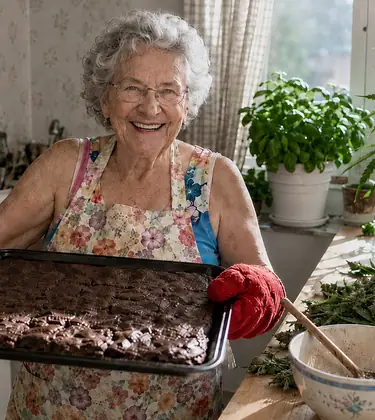
On the night of January 14, 1981, a San Francisco police detective knocked on an apartment door while working undercover as a customer. A woman in her late fifties opened it wearing a flowered apron.
Inside were more than eighteen pounds of cannabis and fifty-four dozen brownies. That is 648 of them, baked in a subsidized apartment by a retired waitress.
She pleaded guilty, got three years of probation and 500 hours of community service, and went on to become one of the most consequential figures in American cannabis history. This guide covers who she was, what she actually did, and how a grandmother with a cake tin helped drag medical cannabis into law.
Who she was
Mary Jane Rathbun was born in Chicago on December 22, 1922, grew up in Minneapolis, campaigned for unions in Wisconsin, and eventually landed in San Francisco. She worked as a waitress at the International House of Pancakes, where she is said to have served coffee to the police who later arrested her.
In the 1970s she sold cannabis brownies on the street for two to four dollars apiece, advertising them out loud as magically delicious. That was a side hustle, not a cause.
The cause arrived with the epidemic.
The ward
In January 1983, doctors at San Francisco General opened Ward 86, the first outpatient AIDS clinic in the country. At that point a diagnosis carried a life expectancy of roughly eighteen months.
Rathbun became a hospital volunteer. Reporting on her life records that every Thursday for sixteen years she went to the AIDS ward, visiting patients and carrying specimens to the lab. That detail matters more than the brownies do. She was a registered volunteer doing ordinary ward work, week after week, through the worst years of the epidemic.
She called the patients her kids. Most of them were men in their twenties and thirties, many abandoned by their families, and a great many of them died.
The ward named her its Volunteer of the Year.
The brownies
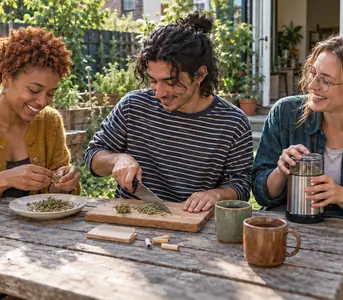
She kept baking, and she stopped charging. The same reporting quotes Dennis Peron, the activist who worked alongside her, estimating the scale after her death: 134 dozen a month during the heyday, from 1984 to 1990, all in her little old kitchen in her subsidized apartment. That works out to more than 1,600 brownies a month. Treat it as an advocate's estimate and not an audited figure, because it is one, but even a fraction of that number is remarkable.
The economics are the part that stops people. The cannabis was donated anonymously and left on her doorstep. Everything else, the flour, the butter, the chocolate, the gas for the oven, she paid for herself out of her Social Security check.
She and Peron published a cookbook in the early 1990s, titled Brownie Mary's Marijuana Cookbook and Dennis Peron's Recipe for Social Change. It contained every ingredient except the recipe that mattered. She kept that in a safe deposit box, saying that when it was finally legal she would sell it to Betty Crocker or Duncan Hines and buy a Victorian house for her kids with AIDS.
Feeling lost on how to start? Try taking our quiz!
Start a QuizThe arrest that broke it open
She was arrested again on December 7, 1982, carrying four dozen brownies down Market Street. The district attorney dropped it.
The one that changed everything came on July 19, 1992, in Cazadero, in Sonoma County, where she was caught mid-bake at a friend's house with two and a half pounds of cannabis and twenty dozen brownies. She was 69 years old and facing two felony counts.
She refused to deal. She planned to argue medical necessity in open court, and she made it very clear that she intended to keep baking whatever a judge decided. The line she is most remembered for was delivered at a San Francisco City Hall rally that summer, and it told the narcotics officers, in language a seed catalog will paraphrase, that they could go and do something anatomically ambitious in a department store window if they thought she was going to stop.
That trial never happened. In December 1992 the Sonoma County District Attorney dropped the charges, saying prosecuting her would be too costly and time consuming. He also told reporters that the trial of the grandmother who bakes pot brownies would be a media circus. The San Francisco Chronicle ran an editorial suggesting he might eventually get his priorities straight.
She is often described as having been acquitted. She was not. Nobody dared try her.
The unexamined day is a wasted opportunity. Reflect on what you did, what you learned, and how you can improve.
John Dewey
Brownie Mary Day, and the vote that followed
The timing was everything. 1992 was the year new AIDS cases in San Francisco peaked at 2,332, and the year the CDC reported AIDS as the leading cause of death for American men aged 25 to 44.
Three weeks after her arrest she testified at City Hall to a packed and cheering room. The Board of Supervisors declared August 25, 1992 Brownie Mary Day.
The vote had already happened. On November 5, 1991, San Francisco voters had passed Proposition P, officially titled Hemp Medication. It asked whether it should be city policy to recommend that California and the California Medical Association restore cannabis preparations to the list of available medicines, and 79 percent of San Francisco voters approved it as a non-binding measure expressing support for the medical use of cannabis. The city's own ballot records put it at 136,492 votes in favor against 35,732.
San Francisco classifies Prop P as a Policy Declaration. It changed no law and protected nobody. It was a city of three-quarters of a million people telling Sacramento what it thought, and it turned out to be the opening move.
What she lived to see
Five years later, California voters passed Proposition 215, the Compassionate Use Act. Its official ballot summary promised to exempt patients and defined caregivers who possess or cultivate marijuana for medical treatment recommended by a physician from criminal laws which otherwise prohibit possession or cultivation. It passed on November 5, 1996 with just under 56 percent of the vote, and it was the first medical cannabis law in the United States.
She campaigned for it. Her arrests were part of what built the sympathy that carried it, because it turned out to be very hard to argue that a woman in her sixties baking for dying men was the face of the drug problem.
Mary Jane Rathbun died on April 10, 1999, following a long convalescence after a fall at home. Roughly 500 people held a candlelight vigil in the Castro. A San Francisco Democratic club founded in 2014 still carries her name.
What a seed company owes her
We should be honest about our position here. Everything that lets a company like ours ship genetics to American customers legally traces back through people who took the risk when there was no upside in it, and she is near the front of that queue.
The other honest thing we can offer is the chemistry she was working with blind.
Raw cannabis contains THCA rather than THC, and it takes sustained heat to convert one to the other. A brownie batter baking at conventional oven temperatures does that conversion incidentally, which is why baking works and why cold infusions mostly do not. THC is also fat-soluble, so butter is the carrier that makes the whole thing function.
None of that was measurable in her kitchen. She had no lab, no potency testing and no way to know the strength of what was left on her doorstep. She standardized by experience, and she got good enough at it that patients kept coming back. Modern home bakers have the same problem in a smaller form, which is why the only sound rule with a homemade edible is to treat the first dose as the whole decision.
If you are baking, what you need is the volume of plant material and genetics you can rely on. OG Kush is the West Coast line with the right heritage for this story, Chemdawg crossed with Lemon Thai and Hindu Kush at 26% THC, flowering in 55 to 65 days and producing up to 2,000 grams from a single outdoor plant, citrus and pine over deep skunk. Amnesia Lemon has documented provenance of its own, made with the breeder Soma from his best Amnesia Haze phenotype crossed into Lemon Skunk, 26% across 60 to 65 days, and it won the Cannabis Cup in 2004.
Four decades of breeding has taught us that the plants worth keeping are the ones with a paper trail. So are the people.
What one volunteer set in motion
Mary Jane Rathbun baked cannabis brownies for AIDS patients in San Francisco through the worst years of the epidemic, volunteering on the country's first outpatient AIDS ward every Thursday for sixteen years and paying for the ingredients out of her Social Security check.
She was arrested three times. The 1981 raid found 648 brownies. The 1992 case in Sonoma County was dropped instead of tried, because prosecuting a 69-year-old grandmother was a fight the district attorney did not want.
San Francisco declared a day in her name in 1992, having already voted 79 percent for a non-binding medical cannabis measure in 1991. California passed the first medical cannabis law in the country in 1996, and she lived to see it.
Barney's Farm has been developing premium cannabis genetics since the 1980s, with over 40 Cannabis Cup wins. Explore our full seed catalog and find strains bred for every climate and skill level.