Reclaim And Resin: Should You Ever Smoke What's Left?
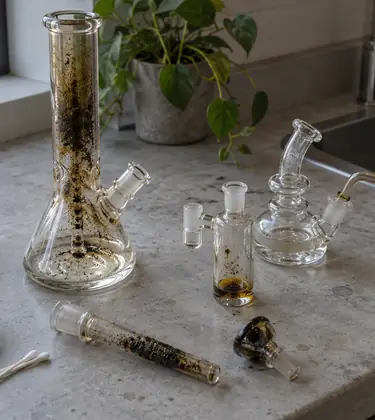
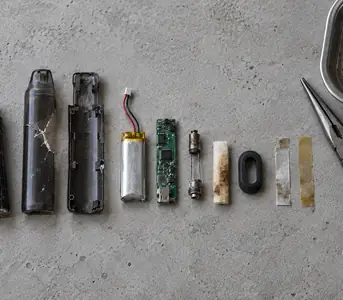
Two sticky substances turn up in smoking equipment, they get talked about as if they were the same thing, and they are not. One is the black tar inside a bong. The other is the amber film in a dab rig. They look related, they are both residue, and chemically they have almost nothing in common.
The answer to whether you should smoke either of them is different in each case, and one of the two answers is much less satisfying than the internet suggests.
One is burnt, one never was
The distinction is simple enough to state in a sentence and it does all the work. Bong resin is a combustion by-product. It is what condenses out of smoke: burnt plant material, ash and tar, deposited on cold glass. Every molecule in it has already been through a flame at several hundred degrees.
Dab reclaim is a vaporization by-product. It is cannabis concentrate that was heated until it turned to vapor, failed to reach your lungs, and condensed on the way. Some people fit a reclaim catcher, a small glass attachment below the banger, specifically to trap it. A 2024 US patent for a reclaim removal device defines it plainly: a cannabis consumption utensil may have buildup formed in the utensil as part of the consumption process, and this buildup may be known as reclaim. Nothing in that description involves combustion.
That single difference, burnt versus vaporized, is why the two deserve separate answers.
What resin is
Cannabis smoke is not a clean substance, and resin is what is left when you let it cool on glass. A 2020 study in Scientific Reports compared tobacco and cannabis smoke particle by particle and found that of the compounds identified in each, 173 and 110 different compounds are known to cause negative health effects through carcinogenic, mutagenic, teratogenic or other toxic mechanisms. The same paper found cannabis smoke particles average 29 percent larger than tobacco smoke particles and carry 3.4 times more total mass.
That extra particulate mass is the raw material for resin. The black film in a bong neck is the heaviest fraction of that smoke, the part too large and too tarry to stay airborne.
Burning it again does not undo any of it. Re-combusting deposited tar is a documented behavior of pipes and always has been: a 1980 water pipe patent notes in its background that as tar and other products of combustion deposit upon the unburned material, they are subsequently ignited and burned. Smoking resin is running that loop deliberately.
The THC in it is largely gone
There is a second reason resin disappoints, and it is about what heat does to cannabinoids. THC degrades to CBN under heat and oxidation, and it does so faster than most people assume. A 2022 study in Frontiers in Chemistry measuring cannabinoid degradation found that 17.2% of Δ9-THC was degraded, producing CBN as a by-product during nothing more than a brief residence in a gas chromatography inlet. Seconds of heat, a sixth of the THC gone.
Resin has been through a flame, then sat exposed to air and light for days or weeks, then gets heated again. The psychoactive fraction that survives that sequence is small, and what replaces it is CBN, which is a fraction as psychoactive as the THC it came from. So, is smoking resin bad? Yes, and for three reasons that stack:
- It is the concentrated heavy end of combustion products, the fraction too tarry to stay airborne.
- Most of the THC that was in it has already degraded.
- Burning it means running the same tar through a flame a second time.
There is no version of that which is a good idea.
Feeling lost on how to start? Try taking our quiz!
Start a QuizReclaim is a genuinely different case
The science parts company with the folk wisdom here, and it does so in reclaim's favor. Vaporized material carries a measurably lighter chemical load than combusted material. A 2019 study in ACS Omega measuring aerosol gas-phase components found that gas-phase aerosol products had significantly lower values in dabbing and vaporizing compared to cannabis smoking. The same work found that users may still be exposed to degradants such as methacrolein and benzene when dabbing, so this is not a clean bill of health. It is a different starting point.
Reclaim also still contains cannabinoids, which is why it is amber instead of black and why people collect it at all. What it has lost is terpenes, which boil off first, which is why reclaim tastes and smells the way it does. Two things make the material worth choosing carefully if you are going to end up with reclaim at all:
- Super Boof is listed at 32 percent THC with comprehensive trichome coverage indicating exceptional secondary metabolite production, which is the polite way of saying there is a great deal of resin on it to begin with.
- Black Cherry Gushers sits at the same 32 percent with a generous dusting of crystalline trichomes, and behaves similarly once it is extracted.
The better the input, the more of what condenses in the rig is cannabinoid and the less of it is everything else.
The unexamined day is a wasted opportunity. Reflect on what you did, what you learned, and how you can improve.
John Dewey
Nobody has actually analyzed it
This is the part the confident answers online leave out, and it is the most useful thing in this article. There is no published chemical analysis of dab reclaim. Not a paywalled one, not an obscure one. Searching the peer-reviewed literature for a compositional study of the residue that condenses in a dab rig returns nothing. A licensed cannabis testing laboratory has published a proposal to investigate exactly this question, which tells you clearly that it has not been investigated.
Everything anyone tells you about reclaim's potency or safety is extrapolation from adjacent chemistry. That includes this article.
What the adjacent chemistry does say is worth knowing, and it is about temperature. A 2017 study in ACS Omega simulating dabbing found that methacrolein, benzene, and several other products of concern to human health were formed under conditions that mimicked real-world use. In the same work, methacrolein was undetectable at the low end of the temperature range and rose sharply at the top of it. Temperature was the variable, not the material.
This also settles the question of how to collect reclaim without making it worse. Reclaim has already been through that temperature band once. Smoking it sends it through a second time, and the usual method for extracting it from the rig, an oven, is a third heating. Every pass is another chance to make degradation products instead of cannabinoids.
Cleaning it out is the other option
The reason most people encounter resin at all is that glass gets cleaned rarely. Isopropyl alcohol is the standard solvent for a reason that is not folklore. Alcohols including isopropyl are used industrially to extract cannabinoids from plant material, which is exactly why a bottle of it lifts the resin film off glass. The coarse salt everyone adds is doing mechanical work, scouring the loosened film instead of dissolving anything, and there is no scientific literature on that at all. It is a household method that happens to work.
One real caution applies if you collect reclaim with alcohol and intend to use it. Residual solvent is a measured problem in cannabis products, and a 2022 analysis of 279 South African cannabis samples found a 37 percent failure rate against the pharmacopoeia specification for solvent residues. Alcohol that has not been fully evaporated does not stop being alcohol because it is in something you made yourself.
Res no, reclaim maybe
Bong resin and dab reclaim are two different substances that happen to appear in the same room.
Resin is combustion residue, carrying the heavy end of smoke that already contains over a hundred compounds known to be harmful, with most of its THC already degraded to CBN by the flame that made it. Smoking it is worse than the smoke it came from, in exchange for very little.
Reclaim was vaporized and not burnt, starts from a measurably lighter chemical load, and still holds cannabinoids. It is also terpene-stripped, has been through the temperature band where degradation products form, and has never been chemically analyzed by anyone. Nobody can tell you what is in it, and everyone who says otherwise is guessing. That is the whole answer, and a clean rig is still the better habit. Barney's Farm has been developing premium cannabis genetics since the 1980s, with over 40 Cannabis Cup wins. Explore our full seed catalog and find strains bred for every climate and skill level.