Bisabolol: The Chamomile Terpene in Cannabis
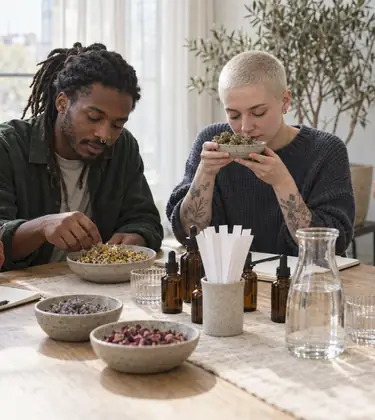
Open a box of chamomile tea and breathe in. That soft, sweet, faintly floral smell comes mostly from one molecule, bisabolol, and the same molecule turns up in cannabis.
In weed it has never been the headline act; myrcene and limonene get the attention. The cosmetics industry, meanwhile, has put it in lipstick and deodorant for decades, and the cannabis world mostly knows it as a word on a terpene chart with a list of health claims attached. Those claims deserve a closer look.
Chamomile made the molecule famous
The full name is alpha-bisabolol, often printed as α-bisabolol, and drug references also call it levomenol. Chemists file it as a sesquiterpene alcohol. In plain terms, it is a terpene built from 15 carbon atoms, half again as big as light terpenes like limonene, with an alcohol group attached. That makes it heavier, oilier and slower to evaporate than the bright citrus and pine molecules.
Pure, it is a colorless, thick oil, and it is the primary constituent of the essential oil from German chamomile, the daisy-like flower that ends up in tea bags. Researchers describe its smell as delicate and floral, with fruity, nutty hints.
Much of the commercial supply never saw a tea flower, though. A 2015 reference book on medicinal plants notes that it is currently obtained from the candeia tree, a Brazilian member of the daisy family, and warns that continuous overharvesting of candeia has created an urgent need for other sources. Factory-made bisabolol is usually a 50-50 mix of the natural molecule and its mirror-image twin.
Cannabis carries it, mostly in CBD-leaning plants
The bisabolol terpene is one of dozens of aroma molecules a cannabis flower can make, and the clearest data on where it concentrates comes from a 2021 Canadian study. Researchers grew 21 cannabis strains in a commercial greenhouse under a Health Canada research license and sorted them into three chemical types: THC-dominant, CBD-dominant, and intermediate plants with roughly equal amounts of both.
The pattern was clear. CBD dominant strains had higher amounts of alpha-bisabolol, along with myrcene, guaiol and two related terpenes called eudesmols, while the THC-dominant plants led on limonene, linalool, beta-caryophyllene and terpinolene. The intermediate plants looked much more like the CBD types, and the authors ended up treating bisabolol as a chemical marker of both. Two cautions before anyone builds a shopping list on that:
- The study identified its strains by number codes, so nobody can use it to say which named strain on a dispensary menu is loaded with bisabolol.
- We have not found a peer-reviewed survey that gives a typical bisabolol level for cannabis flower, so any menu that quotes a percentage is quoting one lab test of one batch.
Growing for the floral end of the jar
No seed company can reliably promise you a bisabolol number, and we won't pretend to. Terpene levels shift with genetics, growing conditions, harvest timing, drying and storage, and even a lab can only tell you what one harvest made. What a grower can do is protect the aroma a plant makes on its way into the jar.
Terpenes leave in order of weight. The light, bright ones evaporate first, so a fast, warm dry strips the citrus and pine top notes and leaves a flatter, heavier smell behind. A slow dry at cool room temperature, with many growers aiming for around 60°F and 60 percent humidity, followed by a cure in sealed glass opened briefly each day, keeps far more of the profile, top notes and heavy floral base together.
If you want to grow toward the floral side of the aroma wheel, where chamomile lives, two of ours list floral among their aroma notes. Blue Dream, a Blueberry and Super Silver Haze cross, pairs sweet berry, pine and earth with a delicate floral undertone, tests at 28 percent THC and flowers in 65 to 70 days, while Zoap crosses Pink Guava #16 with Rainbow Sherbet for a fruit and sweet citrus nose with floral elements underneath, at 29 percent THC in 63 to 70 days. Neither page promises bisabolol, and neither do we: floral smells come from a blend of terpenes, and a lab report is the only way to see what a particular harvest made.
Feeling lost on how to start? Try taking our quiz!
Start a QuizSkin care is the job it already has
Cosmetics chemists figured bisabolol out long before cannabis menus did. The Cosmetic Ingredient Review, the US panel that assesses the safety of cosmetic ingredients, published its bisabolol assessment in 1999. It found alpha-bisabolol used across a wide range of products as a skin conditioning agent, at concentrations from 0.001 percent in lipstick to 1 percent in underarm deodorant. The panel concluded it was safe as used and found no evidence that it triggered skin allergies or reactions to sunlight.
The same report flagged the property that makes bisabolol on skin interesting for topicals. It is well absorbed, and the panel warned formulators that it may increase the penetration of other components of a product. In a 1991 experiment, human skin samples pretreated with a half-and-half mix of bisabolol and propylene glycol, a common cosmetic solvent, became 17-fold more permeable to 5-fluorouracil, a cancer drug, and 73-fold more permeable to a steroid cream ingredient. Those were skin samples tested in a lab, but the effect was large.
For a cannabis balm, that cuts both ways. In principle it could help cannabinoids through the outer layer of skin, and it could do the same for everything else in the product, fragrance and preservatives included. Read the whole ingredient list.
Allergy is the other caution. The US National Center for Complementary and Integrative Health warns that people allergic to ragweed, chrysanthemums, marigolds or daisies are more likely to react to chamomile. That warning is about the flower, and the data on the purified molecule is mixed: the 1999 cosmetics panel found no sensitization, while a 2020 safety assessment from the Research Institute for Fragrance Materials rated alpha-bisabolol a weak skin sensitizer, meaning that at high enough exposure it can make skin allergic to it.
The unexamined day is a wasted opportunity. Reflect on what you did, what you learned, and how you can improve.
John Dewey
Most of the evidence comes from dishes and mice
Look up bisabolol and its effects and you will find a long list: anti-inflammatory, pain-relieving, antimicrobial, protective of nerves and heart, even anticancer. The list comes from real research. A 2022 review in the journal Nutrients gathered it and was clear about the limits: the findings rest on studies mostly performed on cell lines or animal models, and the authors wrote that further studies are needed before clinical or nutritional use in humans. The headline studies tested something far from a joint:
- Cells in a dish. A 2004 study found bisabolol cut the survival of human and rat glioma cells, a type of brain tumor, while normal rat brain cells at the same concentrations were unaffected.
- Rodents, dosed hard. A 2011 study that showed anti-inflammatory and pain-relieving effects gave rodents 25 to 200 milligrams per kilogram of body weight straight into the stomach, far more bisabolol than a person could get from smoking a bowl.
- Creams with company. The human skin studies in the 2022 review, for problems like eczema and leg ulcers, tested creams and sprays containing bisabolol, some alongside other active ingredients such as heparin.
None of that means bisabolol does nothing. It means that when a strain menu says bisabolol calms inflammation, the claim is borrowed from mouse studies and cosmetic chemistry. No study we know of has measured it in people who smoked it.
Entourage claims run ahead of the evidence
The bisabolol-in-weed story usually leans on the entourage effect, the idea that terpenes and minor compounds change how THC and CBD act. Testing that idea at the receptor level has been humbling. A 2020 study tested five of the most common cannabis terpenes, alone and mixed with THC, CBD and one of the body's own cannabinoids, at CB1 and CB2, the body's two main cannabinoid receptors. Apart from a possible weak interaction between beta-caryophyllene and CB2, the terpenes did nothing measurable, and the authors concluded the entourage effect cannot be explained by direct effects at CB1 or CB2.
Bisabolol was not one of the five, and we have not seen a study that makes a stronger case for it. The entourage idea survives in other forms. Smell and taste change how people experience a strain, and terpenes could act on other targets in the body.
Reading a label that lists bisabolol
The molecule appears under slightly different names, and the numbers mean different things depending on where you see them:
- On a cannabis certificate of analysis, look for alpha-bisabolol or α-bisabolol in the terpene panel, usually given as a percentage or milligrams per gram for that batch only.
- On a cosmetic ingredient list it appears simply as bisabolol, usually at 1 percent or less.
- If a product claims bisabolol heals, treats or cures something, the evidence behind that claim is mostly cells and rodents.
- If ragweed season wrecks you or chamomile tea makes you itch, patch-test a bisabolol product on the inside of your arm first.
A quiet terpene with a loud reputation
Bisabolol is real, measurable and worth knowing. It gives chamomile its smell, it turns up in cannabis, most reliably in CBD-leaning plants, and skin care makers have used it for decades at levels a safety panel called safe. What it does inside your body when you smoke or vape a flower that contains it is still an open question, and the confident claims on menus run well past the studies behind them.
Grow for the aroma you love, ask for the lab report when the number matters, and treat bisabolol as one soft note in a much bigger chord. Barney's Farm has been developing premium cannabis genetics since the 1980s, with over 40 Cannabis Cup wins. Explore our full seed catalog and find strains bred for every climate and skill level.