Why Doesn't Weed Work on Me? The Non-Responder Phenomenon
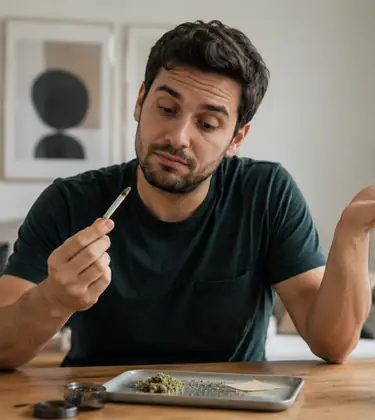
Everyone else on the couch is somewhere else entirely. One is laughing at a lamp. Another has gone quiet and philosophical. You passed the joint the same number of times, took the same hits, and you feel exactly like you did an hour ago. Sober, mildly bored, and starting to wonder if there is something wrong with you.
The search history that follows is always the same. Why doesn't weed work on me. Can you be immune to weed. Weed doesn't affect me. It is one of the most common questions in cannabis and one of the least honestly answered, because most of the answers online stop at "everyone is different" and leave it there. Here is what the research actually says, what we have learned from four decades of breeding, and what you can change.
Can you actually be immune to weed?
There is no documented case of a person whose cannabinoid receptors simply refuse to accept THC. Immunity in the medical sense does not exist here. What does exist is a set of brakes, and some people are running more of them than others.
The most interesting one was found in 2014. Researchers discovered that THC itself triggers the brain to produce more pregnenolone, and that pregnenolone then acts as a signaling-specific inhibitor of the CB1 receptor, reducing several of THC's effects. The work was done in rodents, so nobody should oversell it, but the principle is worth sitting with. Your brain may have a built-in dimmer switch on the high, and there is no reason to assume that switch is calibrated identically in every skull.
Add to that the natural variation in receptor density, baseline endocannabinoid levels, and enzyme activity, and you get a spectrum. Most people sit in the middle. Some sit at the quiet end. We covered that spread in more detail in our piece on why weed affects everyone differently, and it is worth a read if biology is the part you want to chase.
Why do some people feel nothing the first time they smoke?
This is the single most common version of the complaint, and it has a surprisingly old answer. Sociologist Howard Becker argued back in the 1950s that getting high is partly a learned skill. Researchers still build on his framework today, describing how becoming a cannabis user involves learning to smoke properly, learning to recognize what being high feels like, and learning to define that feeling as pleasurable.
Strip away the academic language and it is very practical. First-timers often pull smoke into their mouth and never get it into their lungs. They take one hit, cough, decide they are done, and sit down expecting a lightning strike. Meanwhile the actual signal is subtle. Slightly brighter colors. Music sitting a little differently. Time stretching by a beat. If you are waiting for a switch to flip, you will scroll straight past all of it.
Most people who report nothing on attempt one report plenty on attempt three. The receptors did not change. The technique and the attention did.
Is your weed actually as strong as the label says?
This is the part nobody in the dispensary wants to talk about. A 2025 audit published in Scientific Reports bought 277 cannabis products from 52 Colorado dispensaries and lab-tested them against the numbers on the package. The finding was blunt: only 56.7% of flower products landed within 15% of their labeled THC content, compared with 96% of concentrates.
Read that again. Roughly four in ten jars of flower on a legal shelf were not telling the truth about what was inside, and the errors mostly ran in one direction. If you bought something advertised at 28% and it is really sitting around 16%, your body is behaving perfectly normally. The label lied.
Degradation piles on top of that. THC breaks down into CBN with exposure to heat, light and oxygen. Flower that has been sitting in a clear jar under a shop light, or rattling around in a plastic baggie in a hot car, has quietly lost potency since the day it was tested.
Feeling lost on how to start? Try taking our quiz!
Start a QuizWhy don't edibles work on me?
Some people smoke fine and get absolutely nothing from a gummy. That gap has a mechanism. Eaten cannabis has to pass through the liver, where THC is converted into 11-hydroxy-THC, a compound that crosses into the brain more readily than what you inhale. CYP2C9 has been identified as the main clearance pathway for THC, handling an estimated 70% of that metabolism.
Enzyme activity is not uniform across people. Two adults can eat the same 10mg gummy and end up with very different amounts of the active metabolite in circulation. Nobody has a clean clinical test for this yet, which is why the phenomenon lives mostly in forum threads and comment sections, but the plumbing is real.
If edibles are your dead end, the workarounds are simple. Take them with fat, because cannabinoids are fat-soluble. Wait a full two hours before you even consider a second dose. Try a sublingual tincture, which skips the liver route entirely. And if inhaling works for you and eating does not, stop fighting it.
The unexamined day is a wasted opportunity. Reflect on what you did, what you learned, and how you can improve.
John Dewey
Could the problem be the product, not you?
Here is the angle almost nobody covers, and it matters a lot in the US right now. A huge share of what Americans buy and casually call weed never came from a dispensary. It came from a smoke shop, a gas station or an online store selling hemp-derived cannabinoids under the 2018 Farm Bill loophole.
That is about to end. In November 2025 Congress rewrote the federal definition of hemp, moving from a delta-9-only measure to total THC and excluding final hemp-derived products that contain more than 0.4 milligrams of THC per container, with the new definition taking effect on November 12, 2026. Legal challenges and amendment attempts are still in motion, so the picture may shift again before the deadline.
The reason this belongs in an article about non-responders is simple. That market has been largely untested and wildly inconsistent for years. Plenty of people who believe they are immune to cannabis have only ever tried a 10mg delta-8 gummy from behind a counter, and there is a decent chance it contained a fraction of what the wrapper claimed. Before you diagnose your endocannabinoid system, check the source.
What we have learned about weed that doesn't hit
Barney's Farm has been breeding cannabis since Derry started hauling landrace genetics back from Afghanistan and the Himalayas in the early 1980s. Forty-plus Cannabis Cups later, one thing we can say with confidence is that identical seeds do not guarantee identical smoke. What happens between harvest and jar decides more than most consumers realize.
Harvest window. Cut a plant too early and the cannabinoid profile has not finished building. The buds look ready, the trichomes are still cloudy and clear rather than showing amber, and the resulting flower feels thin and short. Growers chasing a fast turnaround do this constantly.
The cure. A rushed dry blasts off the volatile terpenes that give a strain its character. Bud that tastes like hay usually smokes like hay. Terpenes shape how a high is perceived, and losing them flattens the whole experience even when the THC number on paper stays the same.
Storage. Glass, cool, dark, sealed. Anything else is a slow leak of potency and aroma.
This is the honest case for growing your own. Not romance about the plant, though we have plenty of that. Simple control. You know the genetics, you know the harvest date, you know how it was dried, and you know how long it has been in the jar. Every one of the variables above stops being a mystery. When people finally do feel it after years of thinking they could not, homegrown flower is very often what did it.
How do I get weed to actually work?
Fix the inhale. Smoke into your lungs, not your mouth. A short, easy pull beats a heroic rip that ends in a coughing fit. There is no benefit to holding it for fifteen seconds.
Give it three sessions. If session one is a blank, that is normal. Change one variable at a time and stay patient.
Reset your tolerance. If it used to work and now it doesn't, this is almost certainly you. Even a few days off starts pulling CB1 receptors back online. We wrote a full breakdown of how tolerance breaks work and how long they take.
Change the format. A dry-herb vaporizer at a decent temperature delivers cannabinoids more efficiently than a joint that burns half of them off into the air.
Control the input. If you want a real test of whether cannabis works on you, use something with genetics you can trust and potency you can verify. Runtz runs to 29% THC with a sweet candy and diesel profile that comes through clean. Mimosa EVO pushes to 30% and lands with a bright, uplifting citrus character rather than a heavy fade. Neither one leaves much room for the excuse that the weed was weak.
Watch the setting. Anxious, distracted and clock-watching is the worst possible environment for noticing a subtle effect. Put the phone down.
So are you a non-responder?
Probably not. The odds are overwhelming that you are a person who inhaled badly, bought mislabeled flower, ate an underdosed gummy, built a tolerance without noticing, or expected fireworks and missed the actual signal. Those are all fixable.
A small number of people really do sit at the quiet end of the spectrum, and if you have worked through every variable above and still feel nothing, that is worth accepting without drama. Cannabis is not a personality test and there is no prize for getting high. But before you write yourself off, control the inputs. Most non-responders turn out to have been running bad data.
Barney’s Farm has been developing premium cannabis genetics since 1986, with more than 40 Cannabis Cup wins. Explore our full cannabis seed catalog and find the genetics that fit how you actually medicate.