Weed and Accutane: What Dermatologists Want You to Know
Isotretinoin, still best known by its old brand name Accutane, is one of the strongest acne medicines dermatologists prescribe, and a course of it lasts months, with a checkup every month along the way. Plenty of patients who smoke are not planning a break that long, so weed and Accutane often end up on the same calendar.
No well-known interaction ties the two together, but the drug's warnings on dryness, mood and blood tests all touch on things cannabis does. Knowing where they meet makes the monthly visits easier and the talk with your dermatologist shorter, too.
Key takeaways
- Isotretinoin is prescribed for severe, stubborn nodular acne, and its MedlinePlus guide never mentions marijuana.
- Dry skin, chapped lips, irritated eyes and nosebleeds are common on the drug, and hot smoke makes cracked lips worse.
- A 2023 review of 25 studies with more than 1.6 million people found no added risk of suicide or psychiatric disorders in isotretinoin users.
- The CDC links cannabis use with depression and anxiety, so heavy use can blur the mood changes dermatologists watch for.
- Dermatologists check liver function and blood fats before and during treatment, and high-dose CBD raised liver enzymes in 5.6% of healthy adults in a 2025 trial.
- Blood donation, waxing and vitamin A supplements are off-limits during the course, whatever you decide about weed.
Isotretinoin in brief
Isotretinoin is used to treat severe recalcitrant nodular acne, a stubborn, deep form of acne, MedlinePlus explains. Accutane is the name most people still use, though pharmacies today usually fill the prescription with generic isotretinoin or with brands such as Absorica. Because the drug can harm an unborn baby, a program called iPLEDGE makes sure that pregnant women do not take it, and patients who can get pregnant take the required pregnancy tests along the way. The American Academy of Dermatology, or AAD, tells patients to see their dermatologist every 30 days, in person or by telemedicine, and to report any possible side effect right away.
The MedlinePlus guide never mentions marijuana, cannabis or THC. Together with the AAD, it does spell out a handful of rules that apply to every patient:
- Blood donation is off-limits during treatment and for 1 month after the last pill.
- Waxing, laser skin treatments and dermabrasion are out during the course and for 6 months after.
- Vitamin A supplements should be skipped, since they raise the risk of side effects.
- St. John's wort, an herbal product, may interact with the drug.
- Tanning beds and sun lamps are a no, and strong sun is best kept to a minimum.
Beyond those rules, isotretinoin and cannabis meet in three places: the skin, lips and eyes the drug dries out, the mood changes doctors screen for, and the blood tests that track the liver and blood fats.
Dry lips, dry eyes and smoke
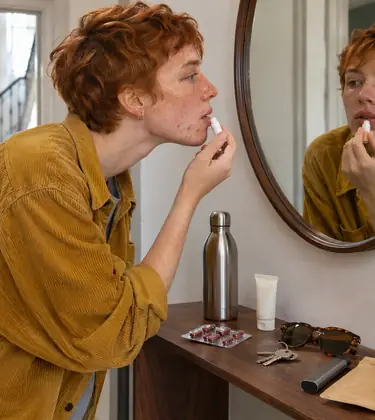
Dryness is the side effect almost everyone notices. The AAD lists dry skin, chapped lips, dry and irritated eyes and even nosebleeds as common while taking isotretinoin, and its lip advice includes a balm with SPF 30 or higher whenever you head outdoors. MedlinePlus adds that the drug can make contact lenses uncomfortable and may limit your ability to see in the dark.
Smoking weed on Accutane puts hot, dry smoke straight onto lips that are already cracking, and cannabis often brings its own dry mouth and red eyes. A few habits make the dryness easier to live with:
- Swap joints and blunts for a dry-herb vaporizer on a low setting.
- Keep a lip balm with SPF 30 or higher on you when you go outside.
- Sip water through the session to ease dry mouth.
- Ask your dermatologist which eye drops to use if your eyes feel scratchy.
- Skip night driving after a session, since the drug can already make it harder to see in the dark.
Edibles and tinctures skip the smoke altogether, though an edible takes longer to kick in and can be easy to overdo. If you keep using cannabis during the course, a familiar strain at a small dose is easier to judge than a big hit of something new. Two new strains in our catalog suit a slow night at home. Thin Mint Frosting F1, a Thin Mint and Banana Frosting cross at 30% THC and 70% indica, flowers in 56 to 63 days and brings cool mint, sweet cream and vanilla notes with euphoric, happy, relaxing effects, while RS11 F1, a Pink Guava and OZK cross at 27% THC, finishes in 55 to 65 days with berry, cherry and pine flavors and a balanced, happy, relaxing effect.
Feeling lost on how to start? Try taking our quiz!
Start a QuizMood checks at every visit
Mood is one of the warnings dermatologists take most seriously. The drug's label lists depression, psychosis and suicidal thoughts among its warnings, and the AAD says dermatologists screen patients for signs of depression and thoughts of suicide before prescribing, then ask patients and families to report any mood change at once.
The research has grown more reassuring. A 2023 JAMA Dermatology review of 25 studies with 1,625,891 participants found that isotretinoin users do not have an increased risk for suicide or psychiatric disorders, Medical Xpress reported, and the one-year risk of depression across 11 of those studies was 3.83%. The AAD adds that some studies have even linked isotretinoin with a lower risk of mood changes, though a link of that kind does not prove the cause.
Cannabis complicates the picture from the other side. The CDC notes that cannabis use is associated with depression, social anxiety and thoughts of suicide. No clinical trial has tested Accutane and THC together, so the practical risk is confusion: a heavy habit can hide a mood shift or create one, and either way your dermatologist needs to hear about it.
The unexamined day is a wasted opportunity. Reflect on what you did, what you learned, and how you can improve.
John Dewey
Liver tests and blood fats
Your dermatologist will check your cholesterol and how your liver is working before you start and during treatment, according to the AAD, and the Absorica label tells prescribers to monitor liver function tests prior to and during treatment. The same label warns about high triglycerides, low HDL, the so-called good cholesterol, and raised cholesterol, and calls for a fasting lipid profile before treatment. MedlinePlus also asks patients to tell their doctor if they drink, or have ever drunk, large amounts of alcohol.
Both the effect of Accutane on the liver and weed's own record matter here. Smoked cannabis has no documented pattern of liver injury, but high doses of oral CBD are another story. In a 2025 trial, healthy adults took 5 mg of CBD per kilogram of body weight a day for 28 days, about 350 mg a day for a 154-pound adult. Eight of them, or 5.6%, experienced liver enzyme level elevations, EurekAlert reported, and their levels returned to normal within 1 to 2 weeks after stopping. A daily CBD oil habit can make a liver result harder to read, so mention it before the blood draw. The main overlaps line up like this:
| Isotretinoin check | What the dermatologist does | Where cannabis comes in |
|---|---|---|
| Dry lips, eyes and skin | Suggests lip balm, gentle skin care and eye care | Smoke dries the lips further, and THC can cause dry mouth and red eyes |
| Mood | Screens before treatment and asks about mood at visits | Heavy use is linked with depression and anxiety |
| Liver function | Orders blood tests before and during treatment | High-dose oral CBD can raise liver enzymes |
| Blood fats | Orders a fasting lipid profile with triglycerides | Drinking on top of cannabis is something doctors ask about, too |
| Night vision | Warns that seeing in the dark may get harder | Driving high is unsafe at any hour |
| Isotretinoin check | Dry lips, eyes and skin | Mood | Liver function | Blood fats | Night vision |
|---|---|---|---|---|---|
| What the dermatologist does | Suggests lip balm, gentle skin care and eye care | Screens before treatment and asks about mood at visits | Orders blood tests before and during treatment | Orders a fasting lipid profile with triglycerides | Warns that seeing in the dark may get harder |
| Where cannabis comes in | Smoke dries the lips further, and THC can cause dry mouth and red eyes | Heavy use is linked with depression and anxiety | High-dose oral CBD can raise liver enzymes | Drinking on top of cannabis is something doctors ask about, too | Driving high is unsafe at any hour |
Talking to your dermatologist about weed
Plenty of patients skip the cannabis question at the first visit, but the answer changes how a dermatologist reads mood and blood results. Dermatologists are not there to police anyone's habits, and an honest answer helps them tell a side effect of the drug from the foggy morning after a heavy session. A short talk covers it:
- Say how often you use cannabis and in what form, from joints to edibles.
- Mention any CBD oil, gummies or balms, along with the dose.
- Ask whether your dermatologist wants you to cut back during the course.
- Report any change in mood, sleep or temper right away, even if you think weed explains it.
- Bring up drinking as well, since heavy alcohol use is on the list of things doctors need to know.
Clear skin without guesswork
Weed and Accutane have no tested interaction, but isotretinoin dries the lips and eyes that smoke irritates, carries mood warnings that heavy use can blur and comes with liver tests that a CBD habit can muddy. Tell the dermatologist what you use, keep the dose small and show up for every monthly visit.
Barney's Farm has been developing premium cannabis genetics since the 1980s, with over 40 Cannabis Cup wins. Explore our full seed catalog and find strains bred for every climate and skill level.