THC Inhalers and Nasal Sprays: Cannabis in a Metered Dose
Light a joint and nobody can say exactly how much THC you just took. Puff length, lung depth and the bud itself all change the answer, which is a problem for doctors who think in milligrams.
Metered devices try to solve it. An inhaler or spray releases a set amount of THC with each use, and a handful of products, from an Israeli inhaler to a nasal spray sold in Georgia, already work this way.
Key takeaways
- A metered-dose cannabis inhaler releases the same small amount of THC with every breath, unlike a joint or a vape.
- In a 2020 trial, single puffs of 0.5 mg and 1 mg of THC reduced chronic pain, though only 1 mg beat the placebo.
- The Syqe Inhaler is approved in Israel and sold there and in Australia, but it has no FDA approval.
- Sativex, a mouth spray with 2.7 mg of THC per spray, is approved in 29 countries but not the US.
- Georgia patients on the low-THC registry can buy a nasal spray that delivers 5 mg of THC per spray.
- The FDA has not approved any cannabis product for any condition, and the cannabinoid drugs it has approved are taken by mouth.
Joints, vapes and guesswork
Inhaled THC acts fast, but the dose is hard to measure. In a 2018 crossover trial of 17 adults who rarely used cannabis, the same doses had different effects depending on the device, and vaporized cannabis produced greater pharmacodynamic effects and higher concentrations of THC in blood than smoked cannabis did. Even 10 mg of inhaled THC caused modest impairment in thinking skills, and 25 mg brought pronounced impairment and more side effects.
Flower adds its own uncertainty. A half-gram joint of Lemon Cherry Gelato, a Sunset Sherbet and Girl Scout Cookies cross listed at 32% THC, holds about 160 mg of THC, and one rolled from Skunk #1, the Afghan, Acapulco Gold and Colombian Gold classic at 26%, holds about 130 mg. How much of that reaches the blood is another matter. A 2007 review of human cannabinoid pharmacokinetics put the bioavailability of smoked THC anywhere from 2% to 56%, so the Lemon Cherry Gelato joint could deliver roughly 3 mg or close to 90 mg, depending on how it is smoked.
That uncertainty is the case for metered-dose cannabis. A THC inhaler or metered spray replaces the guesswork with a number, releasing a set dose with each breath or spray, which is what doctors need before they can prescribe cannabis the way they prescribe other medicines.
Syqe and the measured puff
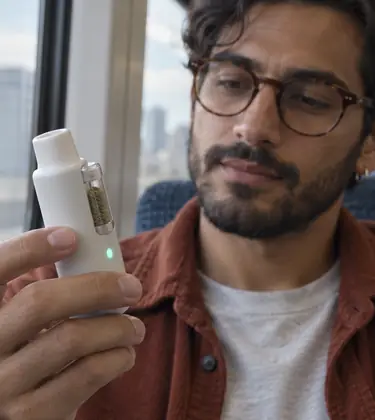
The best-known cannabis inhaler comes from Israel. Syqe Medical's device holds granulated raw cannabis flower in single-use dose chips. When the patient breathes in, it heats the chip for two seconds, turning about 90% of the THC acid into active THC, and releases a programmed dose between 0.5 mg and 1.5 mg. In 2019, Globes reported that Israel's Ministry of Health had approved it as a medical device combined with cannabis, with Teva Israel handling marketing and distribution.
Its key trial, published in the European Journal of Pain in 2020, gave 27 people with chronic pain a single puff of 0.5 mg of THC, 1 mg of THC or a placebo, from dose chips filled with Dutch pharmaceutical flower at 22% THC. Both doses, but not the placebo, demonstrated a significant reduction in pain intensity compared with baseline. Other findings from the trial:
- Blood THC peaked in about 4 minutes after either dose.
- Pain relief held for the full 150 minutes of observation.
- Only the 1 mg dose did significantly better than the placebo.
- Side effects were mostly mild and passed on their own.
- Tests found no consistent harm to cognitive performance.
The authors wrote that the difficulty of precise dosing has made physicians reluctant to prescribe medical cannabis.
A 2022 follow-up of 143 patients who used the inhaler in daily life found they settled on about 1,500 micrograms of THC a day, or 1.5 mg, after roughly four weeks of adjusting. Pain dropped by 22.8% to 28.4%, and side effects, reported by 34% of patients during that adjustment, fell to 4% or less after three months. The data came from Syqe's own patient support program.
Tobacco money backs the device. Philip Morris International invested $20 million in Syqe in 2016, and in July 2023 Calcalist reported a deal worth up to $650 million, starting with $120 million to fund the push for FDA approval. The full purchase depends on that approval. In July 2025, Syqe laid off 50 of its 154 employees during the second phase of its clinical trial, and as of that report the inhaler was sold only in Israel and Australia.
Feeling lost on how to start? Try taking our quiz!
Start a QuizSativex, a spray with a fixed dose
Metered sprays reached pharmacies before metered inhalers did. Nabiximols, sold as Sativex, was approved in the UK in 2010 as a botanical drug, a cannabis extract sprayed into the mouth to ease spasticity, nerve pain and other symptoms of multiple sclerosis. Each spray delivers a dose of 2.7 mg THC and 2.5 mg CBD.
It is now approved in 29 countries, including Canada and most of Europe, according to Multiple Sclerosis News Today, and the UK label caps use at 12 sprays a day. The United States never approved it, and development for new markets, the US included, was discontinued in 2022.
Not all of the mouth spray stays in the mouth. Researchers proposed in 2019 that the spray is washed off the lining of the mouth by saliva and swallowed, with absorption continuing through the gut, much like an edible.
The unexamined day is a wasted opportunity. Reflect on what you did, what you learned, and how you can improve.
John Dewey
Nasal sprays reach US dispensaries
A THC nasal spray aims the dose at the lining of the nose. Atlanta News First described the launch in May 2023: one month after Georgia's first medical cannabis dispensaries opened, the company that owns the stores is now offering a new type of product. A store manager said each spray carries 5 mg of THC from a 1,500 mg bottle, and only patients with a Georgia low-THC oil registry card can buy it, at $120 a bottle. Some seizure patients reach for it when they feel an attack coming on, she said.
The science trails the shelf. Nasal cannabinoid research is still at an early stage, and a 2026 rat study in Pharmaceuticals noted that the pharmacokinetics of nasal CBD had not been established. Its own nanoparticle formula reached 47.9% bioavailability in rats, with brain levels peaking in 10 minutes.
Set side by side, the metered formats and a plain joint look like this:
| Product | THC per dose | Route | Where it is sold |
|---|---|---|---|
| Syqe Inhaler | 0.5 mg or 1 mg in the 2020 trial | Lungs | Israel and Australia |
| Sativex | 2.7 mg, plus 2.5 mg of CBD | Lining of the mouth | 29 countries, not the US |
| Georgia nasal spray | 5 mg | Lining of the nose | Georgia low-THC registry patients |
| Half-gram joint at 32% THC | About 160 mg in the joint, 2% to 56% absorbed | Lungs | Legal state markets |
| Product | Syqe Inhaler | Sativex | Georgia nasal spray | Half-gram joint at 32% THC |
|---|---|---|---|---|
| THC per dose | 0.5 mg or 1 mg in the 2020 trial | 2.7 mg, plus 2.5 mg of CBD | 5 mg | About 160 mg in the joint, 2% to 56% absorbed |
| Route | Lungs | Lining of the mouth | Lining of the nose | Lungs |
| Where it is sold | Israel and Australia | 29 countries, not the US | Georgia low-THC registry patients | Legal state markets |
Medical status in the United States
No medical THC inhaler has FDA approval. The agency says it has never approved a marketing application for cannabis for any disease or condition, and the cannabinoid drugs it has approved are all taken by mouth:
- Epidiolex, a CBD medicine for seizures linked to Lennox-Gastaut and Dravet syndromes
- Marinol and Syndros, two forms of synthetic THC called dronabinol, for chemotherapy nausea and weight loss in AIDS
- Cesamet, or nabilone, a synthetic cannabinoid for chemotherapy nausea
Federal rules did shift this year. In April 2026, the Justice Department moved medical marijuana from Schedule I to Schedule III. NPR explained that the change covers FDA-approved products and those regulated under a state medical marijuana license, while recreational marijuana was not immediately affected. Researchers studying medical marijuana also no longer need a Schedule I license.
States are setting their own inhaler rules. In May 2025, KERA reported that the Texas House had passed House Bill 46, which provides for prescribed inhalers in the state's low-THC program. The state health department's list of approved inhalation devices, with approvals dated from January 2026, is made up of vape cartridges, tanks and a vaporizer, and it says nothing about metered doses.
For Syqe, the American route runs through the FDA. Its Philip Morris deal closes only if the inhaler is approved, which would make it a prescription drug in the US.
Milligrams instead of guesswork
A joint can deliver a few milligrams of THC or dozens, while a metered inhaler or spray releases the same small dose each time. Trials of the Syqe Inhaler found pain relief from 0.5 mg and 1 mg puffs, Sativex delivers a fixed dose of THC and CBD in 29 countries, and Georgia patients can buy a 5 mg nasal spray. In the US, no inhaled cannabis medicine has FDA approval yet, so metered dosing stays rare outside a few state programs.
Until that changes, careful dosing starts with knowing your flower. Barney's Farm has been developing premium cannabis genetics since the 1980s, with over 40 Cannabis Cup wins. Explore our full seed catalog and find strains bred for every climate and skill level.