The Tag on Every Plant: How Seed-to-Sale Tracking Works
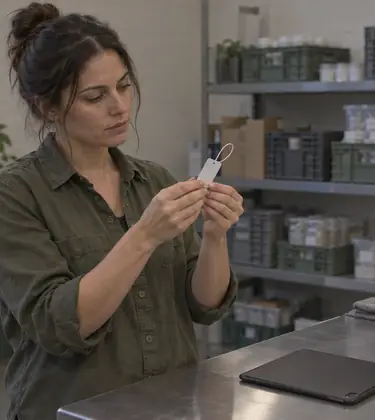
In Missouri, a cannabis plant stops being a seedling and becomes a tracked object at a specific size. The rule states it plainly: all immature plants at least eight inches tall or eight inches wide shall be tagged with traceability information.
Eight inches. Below that, a plant is inventory in bulk. Above it, a plant is an individually numbered item that a state database follows until somebody smokes it.
What seed to sale tracking is
Every legal cannabis market in America runs on a state-mandated inventory database, and licensees are required to report into it rather than keep their own books.
The dominant vendor is Metrc, built by a Florida company called Franwell and first developed for Colorado in 2011. In testimony to the Maine legislature in May 2025 the company put its own reach at 29 regulatory contracts, including two tribal nations, and said its competitors held ten between them.
The economics are worth noticing before anything else. Colorado, the state that started all this, has paid the vendor a few hundred thousand dollars across a decade. The industry pays the rest, per tag, forever.
The cannabis plant tag, in detail
The tag is a physical object with a radio chip in it, zip-tied to the stem. California's agriculture department describes what it carries: a UID is a unique 24-character alphanumeric code used to identify cannabis on a licensed premises, and the embedded information includes the facility name, the business license number, the date the tag was ordered, that 24-digit number and a barcode matching the chip. It must be affixed at the base of each flowering plant, and it cannot come off until the plant is harvested, destroyed or disposed of.
The prices are set per jurisdiction and a state regulator has helpfully published the comparison. Oklahoma's medical marijuana authority compiled Metrc's tag costs across 21 jurisdictions in July 2025:
- Most states: 45 cents per plant tag, 25 cents per package tag
- Montana is the most expensive at 55 cents and 32 cents
- Ohio is the cheapest at 39 cents and 19 cents
- California, Illinois and Missouri fold the cost into licensing fees instead
Add a monthly system access fee on top. For a cultivator, one Colorado operator put the annual tag bill in the low six figures.
The eight-inch trigger is not a Metrc rule, incidentally. It is a state definition, and the largest market in the country does not use it. California switches a plant from lot tracking to individual tagging when it moves into the canopy area or begins flowering, whatever its height.
What gets reported, and how fast
The reporting obligations are heavier than most consumers imagine. Oregon requires licensees to reconcile all inventories and weights by 8am the following calendar day, and to record the wet weight of every harvested plant immediately after harvest. The rule then does something quietly remarkable: it grants a 45-day window during which the weight of moisture lost to evaporation does not have to be reconciled daily. The regulation accounts for water leaving a plant.
California gives licensees 24 hours to record receipts, rejections, manufacturing, destruction, packaging, lab results and sales, and three days for cultivation events like planting a lot or moving it into flower. Transfers move under a manifest naming both licensees, every UID in the load, the driver's license number and the vehicle plate.
And there is a tolerance, though only one state I could find puts a number on it. California defines a significant discrepancy as a five percent difference between the physical count and what the system says. Cross that and the department has to be told within 24 hours.
Feeling lost on how to start? Try taking our quiz!
Start a QuizThe state cannabis tracking system map is moving
This is not a settled market, and 2026 has been a bad year for the incumbent's competitors and an unsettled one for the incumbent. Washington abandoned commercial vendors altogether after its previous system was breached in 2018, and now runs a reporting platform it built and maintains in-house.
New Mexico switched off BioTrack on 4 September 2026 and moved every licensee onto a state-built system that costs them nothing, a transition the state made mandatory. New York went the other way in December 2025, moving its licensees off BioTrack and onto Metrc tracking, and told retailers they could not sell newly acquired inventory until it was entered.
Meanwhile Colorado, where the whole thing started, let its founding contract run to expiry in October 2026 and rewrote its rules to remove the words radio frequency identification, specifically so vendors that do not use RFID tags could bid.
The unexamined day is a wasted opportunity. Reflect on what you did, what you learned, and how you can improve.
John Dewey
What the tag catches, and what it does not
Here is where an honest article has to stop describing the system and start describing its results. Oregon's Secretary of State audited the program in 2019, in report 2019-04, and found among other things that a marijuana testing lab had reported destroying 81,273 pounds of marijuana samples. A sample is generally a few grams. Nothing in the system stopped the entry, and the auditors' summary of the design problem is the sentence worth remembering: it provides the rules of the road but puts up no barriers to prevent licensees from breaking them.
Colorado's State Auditor reached the same conclusion from the other direction, evaluating whether the data was of any use for enforcement. Its report gives a worked example of what the numbers look like when something is wrong: a cultivator with three separate harvests and no associated packages, leaving roughly 7,000 grams of unreported marijuana. The gap is visible in the data. Somebody has to go looking.
A Michigan enforcement complaint from January 2026 makes the same point physically. Inspectors walked into a facility and found 3,500 plants between four and six feet tall, every one of them tagged. Fifteen hundred of those tags had been recorded in the system days earlier as a transfer of immature plants.
Every plant was tagged. The tags were wrong.
Whether your own plants are in it
For almost everyone growing at home, no. The Oregon audit is unusually direct about this: of 13,959 registered grow sites in October 2018, about 6,230 were smaller home or personal medical grows legally exempt from any tracking. Colorado's home grow rules set plant limits and say nothing about registration or tags at all.
There is one real exception. Rhode Island requires by statute that every marijuana plant grown by a registered patient or caregiver carries a physical state-issued tag, mature or immature, and provides those tags without charge since December 2022. Grow without them and there is an administrative penalty.
Missouri sits between the two. A personal cultivation card costs $100 and the plants must be labeled with the grower's name, but that is a paper label rather than a chip in a database.
What a breeder makes of a 24-character number
Forty years of this work leaves you with a particular reaction to a plant with a serial number on it: about time, and also, that is not the identity that matters. A Metrc tag proves custody. It says this object was legally produced, moved from A to B, and weighed at each step. That is worth having, and it is what most consumers assume a label means.
What it does not prove is what the plant is. The tag number is assigned at eight inches. Whatever was written on the label at that moment travels with the plant forever, and no part of the system verifies it against the genetics. This is exactly why DNA studies keep finding the same famous names attached to unrelated plants in different states. Two of ours illustrate the difference between custody and lineage:
- Girl Scout Cookies is among the most mislabeled names in America, an OG Kush and Durban Poison cross whose reputation travels far beyond the plants entitled to it.
- Master Kush is the opposite case, a stabilized Hindu Kush line whose parents are documented back through every generation that produced it.
A state database can tell you where a plant has been since it was eight inches tall. A breeding record tells you what it is. Those are different claims, and only one of them is printed on the tag.
The system, fairly stated
Seed-to-sale tracking does the job it was designed for. It makes diversion traceable, gives regulators a data set, and it is why a legal purchase can be followed back to a specific harvest.
It also costs the industry more than it costs the states that require it, it records what licensees type, not what is in the room, and its most famous audit findings are cases where somebody typed something absurd and nothing happened. Read the tag as a chain of custody, which is what it is, and not as a guarantee about the plant.
Barney's Farm has been developing premium cannabis genetics since the 1980s, with over 40 Cannabis Cup wins. Explore our full seed catalog and find strains bred for every climate and skill level.