Reefer Songs: How 1930s Jazz Wrote the First Weed Anthems
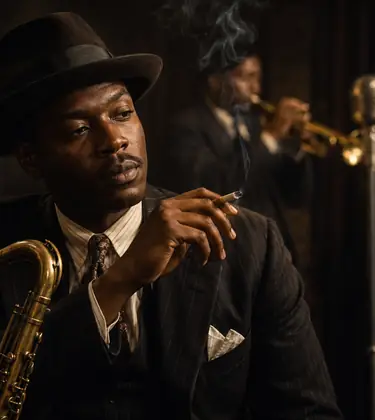
Long before Cypress Hill, before Willie Nelson, before anybody said the word "edible" out loud, there was a room full of horn players in Harlem calling themselves vipers and cutting records about getting high. They put it on wax. They pressed it. They sold it in record stores. And for about a decade, nobody in power seemed to notice.
Then somebody did notice, and the whole thing got buried for fifty years.
This is the story of reefer songs, the jazz era's weed anthems, and the growers and players who built a subculture out of a plant that was still legal when the first records dropped.
The vipers had their own dictionary
Ask a musician in 1935 if he smoked marijuana and you would probably get a blank stare. Ask him if he was a viper and you would get a grin.
"Viper" was the word. It came from the hissing sound of a deep pull on a joint, and it described anyone in the scene who partook. The weed itself went by gage, muggles, tea, jive, and greta. A joint was a stick or a mezz. Nobody said marijuana, partly because the slang was fun and partly because vague language kept the cops out of your business.
That last term, mezz, is worth pausing on. It came from a person.
Mezz Mezzrow, Harlem's most famous connect
Milton "Mezz" Mezzrow was a clarinet player from Chicago who moved to New York and became something more useful than a sideman. He imported strong Mexican cannabis into Harlem and sold it around the clubs, and his product was good enough that his own name became the street term for quality weed. When Stuff Smith wrote "You'se a Viper" in 1936, later retitled "If You're a Viper," the lyrics name-checked Mezz directly, as documented in the song's history.
Think about what that means. A dealer got shouted out by name in a commercially released jazz record, and the record sold. Mezzrow later wrote a memoir about all of it called Really the Blues, published in 1946, which is still one of the strangest and most honest accounts of the era anybody put on paper.
Smith's tune got covered by Rosetta Howard in 1937 at a slower tempo, then by Fats Waller in 1943 on a V-Disc pressing meant for American troops overseas. The government literally shipped a weed song to soldiers.
Louis Armstrong smoked every day and never pretended otherwise
Armstrong is the center of gravity here. He recorded "Muggles" with his Hot Five in 1928, an instrumental named after the slang for weed, on OKeh Records. No lyrics, no plausible deniability needed, just a title that everyone in the know understood immediately.
Two years later he got caught. On November 14, 1930, Armstrong and drummer Vic Berton were smoking in the parking lot of the Cotton Club in Culver City, California, when two detectives walked up. Armstrong's own account of the bust is perfect: "While Vic and I were blasting this joint, having lots of laughs and feelin' good, two big, healthy dicks come from behind a car and say to us, 'We'll take the roach, boys.'" LA Weekly reported that the arresting officer stuck around to catch Armstrong's last set of the night before hauling him in.
He got a suspended sentence structured so it would not interfere with his gigs. He kept smoking for the rest of his life. He called it a thousand times better than whiskey and wrote about it openly in letters, including one from England in 1932 asking Mezzrow how to arrange a resupply.
Feeling lost on how to start? Try taking our quiz!
Start a QuizThe actual songs, and there were dozens
The catalog is deeper than most people expect. Cab Calloway cut "Have You Ever Met That Funny Reefer Man" in 1932, written by J. Russel Robinson with lyrics by Andy Razaf, and performed it on screen in the 1933 W.C. Fields film International House. Sidney Bechet and Noble Sissle did "Viper Mad." Barney Bigard recorded "Sweet Marijuana Brown." The Harlem Hamfats, Benny Goodman, Ella Fitzgerald with Chick Webb, Lil Johnson, Blue Lu Barker, Trixie Smith, Buster Bailey. Songs like "Texas Tea Party," "Light Up," "Smokin' Reefers," "The Man from Harlem," "Here Comes the Man with the Jive," and "Jack, I'm Mellow."
A 1989 compilation called Reefer Songs gathered a couple dozen of these tracks in one place and finally put a genre name on something that had circulated for decades without one.
These were not protest songs. They were jokes, brags, dance numbers, and inside references sold to a general audience that mostly did not get the joke. That is what makes them work. The vipers were hiding in plain sight on the Billboard shelves.
The unexamined day is a wasted opportunity. Reflect on what you did, what you learned, and how you can improve.
John Dewey
Then a bureaucrat with a budget problem showed up
Harry Anslinger ran the Federal Bureau of Narcotics, and he needed a mission. Alcohol prohibition had ended and his agency was looking at cuts. Cannabis became the target.
Anslinger's campaign leaned on race from the start. He pushed the Spanish-derived spelling "marihuana" specifically to link the plant to Mexican immigrants, and he told the public that jazz musicians were producing Satanic music under its influence. CBS News covered his record in detail, including the fact that early in his career Anslinger had called the idea of marijuana causing violence an absurd fallacy, before reversing himself completely when it became professionally convenient.
He drafted the legislation himself. Franklin Roosevelt signed the Marihuana Tax Act on August 2, 1937, and it took effect on October 1 that year. Within days, Samuel Caldwell and Moses Baca became the first men convicted under federal marijuana law. Caldwell got four years in Leavenworth over a dollar-per-ounce tax stamp.
The reefer songs did not survive that. Labels stopped pressing them, radio stopped playing them, and a genre that had been in open circulation for fifteen years went quiet almost overnight.
What the vipers were actually smoking, and how it compares to now
Here is the part most articles skip, and it is the part we find most interesting at Barney's Farm.
The weed moving through Harlem in the 1930s was imported, not domestic. It came up through Mexico and in from the Caribbean, which means it was almost entirely tropical landrace sativa. That genetic background explains a lot about the music. Long-flowering equatorial sativas produce a bright, talkative, forward-leaning high, which is exactly the energy in the recordings. Nobody was falling asleep on a Cab Calloway session.
It also explains why nobody in 1935 was talking about potency the way people do today. Landrace sativa material from that period, poorly cured and shipped a long way, was weak by any modern measure. Vipers smoked constantly in part because they had to.
Those tropical genetics never went away, and modern breeding has concentrated them rather than replaced them. Laughing Buddha is the closest thing in our catalog to a viper's plant, a Thai crossed with Jamaican that runs 80% sativa and hits 24% THC, with an uplifting and social effect that sits right in the pocket of that era. It stretches to about 100 to 110 cm indoors, finishes in 70 to 75 days, and gives 500 to 600 g/m². Every parent in that cross traces back to the same equatorial belt the 1930s imports came from.
If you want the same lineage pushed further, Amnesia Haze blends Jamaican, Thai, South Asian, and Cambodian genetics into a Cannabis Cup winner at 28% THC, 80% sativa, 70 to 85 days of flowering and up to 650 g/m² indoors or a kilo per plant outside. The cerebral, energizing, time-bending character of it is the modern expression of what the reefer songs were laughing about ninety years ago.
Grow either one and you are running the same broad genetic family that soundtracked Harlem, with roughly a century of selection work stacked on top.
The records outlasted the ban
Ninety years later, the story keeps turning. Armstrong would have turned 125 in August 2026, and orchestras and museums across the country have spent this year celebrating it. Meanwhile, on April 23, 2026, the Justice Department moved FDA-approved and state-licensed medical marijuana products to Schedule III and opened an expedited hearing process, which began June 29, 2026, to consider rescheduling marijuana more broadly.
Anslinger's law took roughly one October to shut the reefer songs down. Undoing it has taken most of a century.
The songs are all still there. Go find "If You're a Viper" and listen to what a weed anthem sounded like before anybody was allowed to make one.
Barney’s Farm has been developing premium cannabis genetics since 1986, with more than 40 Cannabis Cup wins. Explore our full cannabis seed catalog and find the genetics that fit how you actually medicate.