Can You Use Medical Cannabis in a Hospital?
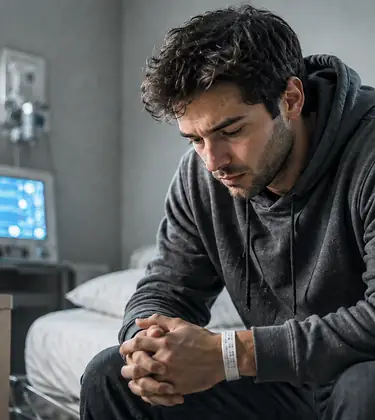
You are a registered medical cannabis patient. You manage your pain with it every day at home. Then you get admitted, and the thing that works gets taken off you at the door.
For most Americans that is still what happens. A handful of states have passed laws to change it, and even in those states the picture is narrower than the headlines suggest.
This guide covers what the laws actually require, why hospitals refuse, what the data says happens to patients, and the safety conversation you should have before surgery regardless.
Your state may allow it, your hospital still won't
Almost nowhere, and rarely by right. A small number of states now require hospitals to permit it, usually only for terminally ill patients and never by smoking. Everywhere else the hospital decides, and most decide no.
Ryan's Law, and what it really covers
California's SB 311 took effect in 2022 and is the template every other state has copied. It is named for Ryan Bartell, a man in his early forties with stage four pancreatic cancer whose father described him as asleep most of the time on morphine and fentanyl, and alert and talking after switching to cannabis.
The law is narrower than its reputation. It applies to terminally ill patients, defined as a prognosis of a year or less. It excludes emergency departments, state hospitals and chemical dependency recovery hospitals. It bans smoking and vaping outright. And it makes the patient or their caregiver responsible for acquiring, storing, administering and removing the product, because staff are forbidden from touching it.
There was an expansion in 2023 covering people over 65 with chronic disease, then a correction in 2024 that pulled hospitals back out of it. Inside a California hospital, it is still terminal patients only.
The most useful provision is the one nobody quotes. The statute lets a facility suspend compliance if a federal agency actually moves against it, then adds that this does not permit a health care facility to prohibit patient use of medicinal cannabis due solely to the fact that cannabis is a Schedule I drug under federal law.
In other words, the standard hospital excuse is specifically ruled out. The hospital needs a real federal action, not a general fear of one.
Which states, and the difference between may and shall
The split that matters is whether a law says a hospital shall permit cannabis or merely may.
Washington passed its own Ryan's Law in March 2026, requiring hospitals, nursing homes and hospice centers to permit use by patients with a terminal condition, with the same smoking ban and emergency department carve-out. It becomes operative in January 2027.
Colorado went the other way. Its 2026 law permits facilities to allow it and requires nothing, after an amendment let hospitals opt out. The governor signed it while publicly criticizing that amendment and saying he expected many hospitals simply would not use the option.
Connecticut and Maine took a third approach back in 2016, shielding hospital staff from liability rather than compelling access.
Minnesota is the outlier worth knowing about, because it is the only state that does not tie this to dying. Since March 1, 2025 Minnesota health care facilities are not generally permitted to prohibit the use of medical cannabis by enrolled patients. Facilities may set reasonable restrictions but may not unreasonably limit access, and staff are protected while carrying out their duties.
Illinois is the counterexample. Its medical cannabis statute defines health care facilities as places where use is prohibited. Any article telling you Illinois protects hospital patients has it backwards.
Feeling lost on how to start? Try taking our quiz!
Start a QuizWhy hospitals refuse
The reason given is federal funding, and that is roughly right but usually cited to the wrong rule.
Medicare's conditions of participation require a hospital to comply with applicable federal laws. The pharmacy rule is more specific and more fatal: drugs must be handled consistent with State and Federal laws, and controlled substances in Schedules II through V must be kept locked in a secure area.
Read that list again. Schedule I is not on it. There is no compliant storage category for a Schedule I drug, because federal regulation does not contemplate a hospital holding one.
Underneath that sits a simpler problem. Federal law provides no prescribing mechanism for Schedule I substances at all. Prescription authority under the Controlled Substances Act covers Schedules II through V. A doctor cannot write for it, a pharmacy cannot dispense it, and a nurse cannot administer it.
That is why every one of these state laws makes the patient responsible for their own supply. It is not squeamishness. It is the only structure that is legally possible.
The unexamined day is a wasted opportunity. Reflect on what you did, what you learned, and how you can improve.
John Dewey
What actually happens to patients
The best data on this comes from a national survey of nurse leaders published in 2023, covering 291 respondents working in acute inpatient settings in states with legal medical cannabis.
Only 5.8 percent reported that the drug was kept in the pharmacy and dispensed like other prescriptions, and another 3.4 percent that patients kept it in their rooms. Most, at 55.6 percent, reported that patients were switched to an alternative medication during their inpatient stays, and among those, 49.4 percent said opioids were substituted.
Fewer than one patient in ten gets access. More than half get switched, and about half of those switches are to opioids, in a country that has spent fifteen years trying to reduce opioid prescribing.
A companion study documented what the substitution looks like in practice: product confiscated and sent to security, family asked to remove it, or police contacted. In one documented Kansas case, hospital staff called police on a 69-year-old terminal cancer patient who vaped in his room. Officers confiscated his device and issued a citation, later dismissed.
The conversation to have before surgery
This part applies to everyone, including recreational users, and it is the most useful thing in this article.
American anesthesiologists issued their first perioperative cannabis guidelines in 2023, and the headline recommendation is universal screening before surgery, covering product type, route, amount, frequency and time of last use. They also recommend delaying elective surgery for at least two hours after smoking, because of raised short-term cardiac risk.
The reason is measurable. A study of 318 patients undergoing endoscopy found cannabis users required 0.33 milligrams per kilogram per minute of propofol against 0.18 in controls, a difference that held up after adjusting for other factors. Daily users needed the most.
That is nearly double the sedative. An anesthetist who does not know you use cannabis is dosing you on the wrong assumption.
There is also a documented interaction with warfarin, where cannabinoids inhibit the enzyme that clears it and INR can climb dangerously. If you take blood thinners, this is not optional information.
Disclosure is safer than it feels. The guidelines exist precisely so clinicians ask the question routinely, and doctors are not required to report cannabis use to anyone.
What a grower can control
Here is the part that follows from the law rather than from marketing. Every one of these statutes puts the patient in charge of their own supply. Nobody at the hospital will source it, verify it or vouch for it. That makes consistency the whole game, because a patient who needs the same thing every day cannot be at the mercy of whatever a shop has in stock this month.
That is an argument for growing a small number of cultivars you know well and running them the same way every cycle, so that what you have in October behaves like what you had in June. Predictability beats novelty when something is doing a job.
Black Cherry Gushers is a 60% indica from Acai crossed with Black Cherry Funk at 32% THC, flowering in 70 to 75 days at 100 to 120 cm indoors, cherry and apricot over a soothing body effect that settles into calm. Lemon Cherry Gelato is faster at 60 to 65 days, also 60% indica and 32%, Sunset Sherbet crossed with Girl Scout Cookies, sweet lemon and cherry with a lift before the physical settle.
Neither is a treatment, and nothing here is medical advice. Four decades of breeding has taught us that stability is the underrated virtue in a plant, and it matters most to the people who are not growing for fun.
Ask before you're admitted
A handful of states require hospitals to permit medical cannabis, nearly always only for terminally ill patients and never by smoking. California excludes emergency departments, Washington's law starts in 2027, Colorado lets hospitals opt out, and Minnesota alone extends access beyond terminal illness. Illinois prohibits it outright.
The federal obstacle is structural. There is no lawful way for a hospital pharmacy to stock, dispense or administer a Schedule I drug, which is why every state law makes the patient responsible.
Fewer than one in ten hospitalized patients get access, over half are switched to something else, and roughly half of those switches are to opioids. Tell your anesthetist before surgery, because cannabis users need close to double the propofol.
Barney's Farm has been developing premium cannabis genetics since the 1980s, with over 40 Cannabis Cup wins. Explore our full seed catalog and find strains bred for every climate and skill level.