Do Power Companies Report Home Growers? The Utility Bill Myth
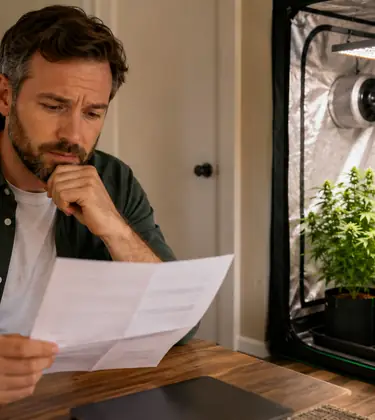
Every grow forum has the same ghost story. A friend of a friend got raided because the power company noticed his bill jump and called the cops. The story never comes with a name, a date, or a case number. It just gets repeated until people picture some guy at the utility staring at a screen, waiting for your tent to fire up.
So let's take the fear apart properly. Here is who can actually see your electricity data, what it takes for anyone to care, and what a legal home grow really does to your meter.
Do power companies report grow rooms to police?
Not proactively. Not in the United States.
The cleanest proof comes from a utility that wanted to and got told no. In 2024, Versant Power in Maine went to the state's Public Utilities Commission and asked for permission to report unusually high residential electricity use to law enforcement. Illegal grow houses were pulling more current than residential wiring could carry, the company said, and meter readers had found meters running dangerously hot. Regulators rejected the proposal unanimously, saying it is not a utility's role to monitor customer behavior and report suspicious activity, and that people with big bills for perfectly ordinary reasons would get caught in the net.
Sit with that for a second. A power company had to ask permission to talk to police, and was refused. Versant's own spokesperson said the utility had never handed customer information to anyone, law enforcement included, without a subpoena or a warrant.
If utilities were already quietly snitching on growers, that hearing would never have needed to happen.
How do police actually get your electricity records?
They go through a judge, then they serve the utility with a subpoena.
That is the whole mechanism. Investigators build suspicion some other way, then request billing records for an address, often alongside a few neighboring homes for comparison. The utility complies because the law requires it to. Refusing is not an option once the paperwork is valid.
The sequence is the part worth understanding. Power records almost never start an investigation. They corroborate one that already exists. Something else put the address on a list first: a complaint about odor, an anonymous tip, an informant, a landlord, an intercepted package, a neighbor with a grudge. The bill then gets pulled to help build a warrant that is already half written.
And the consumption that draws that kind of attention is not subtle. When Versant described the sort of property it would have flagged, it meant homes where a single day of electricity use came close to an average customer's entire month. That is a gutted house wired for dozens of thousand watt lights, with the service panel upgraded to feed them. It looks nothing like a tent in a spare bedroom.
Can a smart meter flag a grow room?
Smart meters do capture more than the old spinning dials. Most log consumption in fifteen minute intervals, which reveals the shape of a household's day: when lights come on, when they go off, when the air conditioning kicks in.
That level of detail has already been through the courts. In Naperville Smart Meter Awareness v. City of Naperville, the Seventh Circuit found that collecting smart meter data counts as a search under the Fourth Amendment, then ruled it reasonable, partly because the data was gathered by utility employees rather than police and was not accessible to law enforcement without a warrant. The judges added a warning: shorter intervals, or data handed easily to police, could change the outcome.
So yes, the meter is recording. No, nobody at the utility is sitting in front of a dashboard ranking households by grow probability. That data exists for billing, outage detection and load management. Moving it into a police file still takes paper, and paper takes probable cause.
Feeling lost on how to start? Try taking our quiz!
Start a QuizHow much electricity does a legal home grow actually use?
This is where the myth falls apart on simple arithmetic.
The average American home used about 865 kilowatt hours a month in 2024, according to federal energy data. That is the baseline everything else gets measured against.
Now price out a legal six plant grow. A 2x4 tent running a modern LED board draws somewhere between 200 and 300 watts. At 300 watts on an 18/6 veg schedule, that is 5.4 kWh a day, or roughly 160 kWh a month. Flip to 12/12 for flower and it falls to about 110. Add an inline fan, a small dehumidifier and a timer, and you land somewhere around 150 to 200 kWh a month on top of your normal usage.
That is a bump of under 25 percent. A hot tub beats it. So does a second fridge in the garage, a daily electric dryer, an EV charging overnight, or a pair of space heaters in a cold February. Nobody has ever been raided for owning a chest freezer.
The fear made sense in 2005. Back then a closet grow meant two 1000 watt HPS lamps plus a window AC unit fighting the heat they threw off, and the bill genuinely doubled. LED efficiency killed that math years ago. A modern tent pulls less power than a gaming PC left running.
The unexamined day is a wasted opportunity. Reflect on what you did, what you learned, and how you can improve.
John Dewey
What actually gets home growers caught?
Four decades of putting genetics into growers' hands, from Amsterdam coffeeshops to legal states across the US, has taught us something useful here. The power bill is nowhere near the top of the list. What actually causes trouble is deeply unglamorous.
Smell. This is number one and it is not close. A tent in week six without a carbon filter announces itself down the hallway, out the window and into the neighbor's yard. Odor complaints outnumber every other trigger by a mile.
Your own mouth. Telling people is the oldest failure mode in cannabis. It was true in 1985 and it is true now.
Plant count. Going one plant over your state's limit converts a legal garden into a criminal one instantly. Most states cap adults at six, with a household ceiling regardless of how many adults live there.
Your lease. Landlords in most legal states can ban cultivation on their property. That is a contract problem rather than a police problem, but it ends grows just the same.
Visibility. Plants seen from the sidewalk or through an uncovered window. Nearly every state requires a home grow to be secured, locked and out of public view.
Dangerous wiring. Bypassing a meter or overloading a circuit is what turns a grow into a fire, and a fire brings the one visitor you cannot argue with. The criminal operations in the news get discovered this way constantly. Run your gear on proper circuits and this risk disappears.
Genetics quietly solve more of this than people expect. Shorter, faster plants mean smaller lights, less heat, less noise, less odor and fewer weeks of exposure. Our Wedding Cake Auto finishes at 80 to 100cm indoors and goes seed to harvest in 70 to 75 days, which means a small tent, a modest LED and a grow that is done before most photoperiod plants have finished stretching. For growers who want real weight without a monster light, Pineapple Chunk stays compact at 90 to 110cm and still delivers 550 to 650 g/m² in eight to nine weeks. Yield per watt is a genuine metric, and it is one we have bred toward for years.
Does federal rescheduling change any of this?
Not for home growers, and this is the part most coverage is currently fumbling.
On April 23, 2026, the Justice Department moved FDA approved cannabis drug products and state licensed medical marijuana from Schedule I to Schedule III. Everything else stayed exactly where it was. Adult use cannabis, and anything you grow yourself in your own house, is still Schedule I under federal law.
The bigger question is being argued right now. The DEA opened an expedited hearing on June 29, 2026 to consider moving marijuana as a whole to Schedule III, and that hearing is set to conclude no later than July 15.
Even a full move to Schedule III would not legalize personal cultivation federally. Schedule III is still a controlled substance, and home growing is still not a federally sanctioned activity anywhere. What protects a home grower today is state law plus the Fourth Amendment, and that will remain true the day after the hearing wraps.
So should you worry about your electric bill?
No. Worry about the things that actually end grows.
Stay inside your state's plant limit, and check it properly before you germinate anything, because the rules shift constantly and vary by county. Our state by state home grow guide breaks down where you stand. Run a carbon filter. Use efficient lights, which you want regardless. Keep the grow locked, out of sight, and out of conversation.
The people getting doors kicked in are running hundreds of lights in gutted houses on illegally upgraded service, drawing a month of normal household power every single day. A grower with six plants and a 300 watt LED is a rounding error on a utility spreadsheet, and always has been.
Now go grow something worth the electricity.
Barney’s Farm has been developing premium cannabis genetics since 1986, with more than 40 Cannabis Cup wins. Explore our full cannabis seed catalog and find the genetics that fit how you actually medicate.