Can a Cracked Bong Be Saved? Glass Repair and When to Give Up
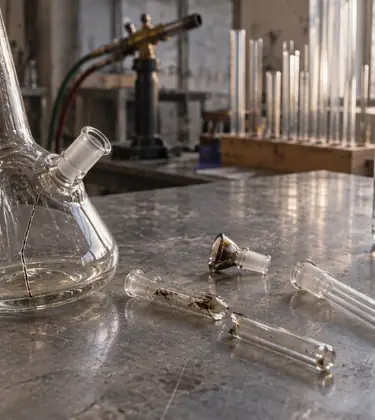
There is a particular sound a bong makes when it meets a tile floor, and most people who have owned one know it. Sometimes the piece survives with a chip. Sometimes it shows a crack you can barely see. Sometimes the downstem is in two pieces and the rest looks fine.
Whether you can fix a cracked bong depends on three things: what the glass is made of, where the damage is, and whether you are prepared to hand it to someone with a torch and a kiln. Glue is the fourth option, and it is the one that needs the most caution.
Borosilicate is why it survived this long
Almost every decent bong is borosilicate glass, the same family as laboratory beakers and ovenproof dishes, and that choice of material is the reason a crack is sometimes survivable. Borosilicate has an unusually low coefficient of thermal expansion, which is the rate at which a material grows as it heats. Wikipedia's entry puts it at about 3 × 10⁻⁶ per kelvin at room temperature, making it more resistant to thermal shock than any other common glass. Ordinary soda-lime glass, the stuff of windows and drinking glasses, expands roughly three times as much when it heats.
That matters because a bong lives through constant temperature swings: hot smoke, cold water, ice in the neck, hot water during cleaning. Soda-lime glass would crack from that routine alone. Borosilicate tolerates it, which also means that when a piece like this does crack, the usual cause is a knock, not wear.
Cracks grow from the tip
A crack in glass is not a stable thing. It is a stress concentrator, and it will keep growing if you give it a reason. Any sharp flaw in a material gathers stress at its tip, and brittle materials will typically fail at the stress concentration, which in plain terms means that glass breaks where it is already damaged. Nicks and scratches count, too. A crack is just the most extreme version. For a cracked bong, that has practical consequences:
- Every temperature swing puts fresh stress on the crack tip. Ice, hot water and a lighter held near the damage are the three fastest ways to make a hairline crack longer.
- Water helps a crack grow. Materials research on glass has identified ambient water as a key accelerant of slow crack propagation, and a bong is a vessel built to hold water.
- A knock that a sound piece would shrug off can finish a cracked one.
A crack that runs through the base or the joint, where the glass takes load and heat, is far more dangerous than a chip on a decorative lip. Where it is matters more than how long it is.
A glassblower can fix what glue cannot
The only bong repair that actually restores the glass is heat, applied by someone who knows what they are doing, followed by a slow cool. A skilled lampworker can soften borosilicate in a flame, work a crack closed or replace a damaged section, and rebuild a joint. The part people skip is what comes next. The Corning Museum of Glass defines annealing as slowly cooling a finished object, and explains why it cannot be skipped: if a hot glass object is allowed to cool too quickly, it will be highly strained by the time it reaches room temperature, and it may break, either as it cools or at some later date.
That is the whole case against a home torch job. Heating a crack with a lighter or a kitchen blowtorch, without a kiln to anneal the piece afterward, leaves stress locked into the glass. It may look repaired and then fail the next time it meets cold water.
Glassblowers also want the piece clean before they touch it, and with good reason. Anything left inside burns off when the glass is heated, and a glass repair guide from a lampworking educator warns that outgassing goes straight into the worker's breathing space. What you smoke through a piece decides how much there is to scrub off first:
- Zillions is listed at 32 percent THC with a sparkling frost of trichomes and a resin-rich harvest, which is to say the neck of a bong it goes through will need real work.
- Banana Runtz at 30 percent is described as chunky and resin-drenched, and leaves the same kind of film behind.
A glassblower who has to spend an hour cleaning before they can start is a glassblower who charges for that hour.
Feeling lost on how to start? Try taking our quiz!
Start a QuizGlue on a bong is a strength problem first
People glue cracked bongs all the time, with epoxy, silicone or superglue, and it is worth being clear about what that actually buys you. The first problem is not fumes. It is strength under heat. Most adhesives lose their grip well before they burn. A 2019 study in the International Journal of Adhesion and Adhesives testing a structural epoxy found that at 70 °C the shear and tensile strengths are both reduced to around 15% of the corresponding ambient temperature strengths. Hot water from cleaning, or smoke passing close to the joint, can take a glued bond into that range.
The second problem is what the glue does if it gets genuinely hot. Cured epoxy begins to break down into phenols, bisphenol A and other compounds from about 300 °C, according to thermal degradation research on the resin. Nobody has measured what a glued bong actually releases in use, and it would be dishonest to pretend otherwise. The reasonable reading is that glue near the bowl or the slide is the worst case, and glue on the base or the outside of the neck is mostly a leak and strength issue.
If you glue a piece, treat it as a temporary fix on a part that never gets hot, and stop using it the moment the joint starts to weep.
The unexamined day is a wasted opportunity. Reflect on what you did, what you learned, and how you can improve.
John Dewey
Downstems are cheap to replace
The most commonly broken part of a bong is also the easiest to deal with, and it rarely needs repair at all.
Bong joints borrow their design from laboratory glassware. Ground glass joints are used in laboratories to quickly and easily fit leak-tight apparatus together from interchangeable commonly available parts, and that interchangeability is the point. We have written about how the 14mm and 18mm joint sizes work and why a bowl sometimes refuses to fit, but for a broken downstem the relevant fact is that it is a standard part.
So the broken downstem fix is almost always a replacement: measure the joint and the length, buy a new one, and slide it in. Paying a glassblower to rebuild a downstem usually costs more than a new one.
Deciding whether it is worth saving
There is no reliable published figure for bong repair cost. Glassblowers set their own prices, the damage varies enormously, and the only numbers available come from shops advertising their own services. The honest advice is to ask a local lampworker for a quote, and to accept that not every repair succeeds. A good one will tell you when it is not worth trying. What you can judge yourself:
- A chip on a lip or a foot that does not run into the body is cosmetic. Sand the sharp edge and keep using it gently.
- A hairline crack in the body of a cheap piece is usually the end. Replacement costs less than repair.
- A crack in a piece you care about, heady glass or anything irreplaceable, is worth a glassblower's opinion before you do anything to it, including cleaning it with boiling water.
- Any crack through the joint or the base is a retirement, unless a professional rebuilds it.
Glass pipe repair follows the same logic. Small and cheap, replace it. Rare or loved, get a quote. Glued and hot, stop.
Glass has a memory
A cracked bong can sometimes be saved, and the material is the reason why. Borosilicate survives the temperature swings that would destroy ordinary glass, so a crack usually comes from impact, and a skilled lampworker can heat it, rework it and anneal it back into service.
What cannot fix it is a lighter or a tube of glue. Heat without a slow cool leaves stress in the glass that fails later, glue loses most of its strength well below boiling, and a crack keeps growing every time the piece meets heat or water. A snapped downstem is a replacement part, not a repair. Everything else is a judgment about what the piece is worth and where the damage sits. Barney's Farm has been developing premium cannabis genetics since the 1980s, with over 40 Cannabis Cup wins. Explore our full seed catalog and find strains bred for every climate and skill level.