
 Autoflower Seeds
 Feminized Seeds
 New Releases
 USA Cannabis Seeds
 High THC Strains
 High Yield Cannabis Strains
 Precision F1 Hybrids
 Washing Strains
 Cup Winning Cannabis Seeds
 Chill Out Cannabis Strains
 Amsterdam Cannabis Seeds Classics
 Best Taste & Aroma Cannabis Seeds
 Regular Seeds
 Merchandise
 Merchandise
 Blog
Blog Contact Us
 Wholesale Login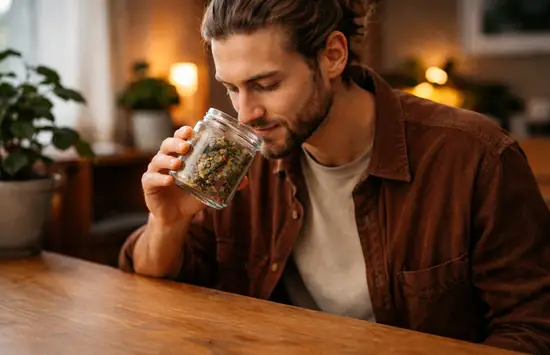
Why Does Weed Taste Different From Strain to Strain?
Open a jar of Zkittlez next to a jar of Sour Diesel and your nose tells the whole story before you even roll one. One hits like a handful of tropical candy. The other punches you in the face with fuel and funk. Both are cannabis. Both are flower. The question is where the gap comes from.
The short answer is chemistry. The long answer is a lot more interesting, and scientists have been rewriting parts of it over the last few years.
What gives cannabis its flavor in the first place?
Flavor in any strain comes from a crowd of aromatic molecules locked inside the trichomes, those tiny resin glands coating your buds. For decades the conversation focused almost entirely on terpenes. Recent research has widened the lens. A scientific review published in the journal Molecules argues that cannabis aroma and flavor come from a much bigger cast, including terpenes, flavonoids, phenols, aldehydes, ketones, esters, and sulfur-containing compounds, with terpenes alone no longer considered the full story.
Every strain runs a different recipe on these molecules. Some dial up the fruity esters. Some blast the sulfur compounds. Some play it herbal and earthy. That chemical recipe is what your tongue actually reads when you exhale.
Which terpenes give weed its classic flavors?
A handful of terpenes do most of the heavy lifting on the palate. Learn these five and you will start spotting them in the wild.
Myrcene. The most common cannabis terpene. Earthy, musky, with a touch of ripe mango. Shows up heavily in classic indica-leaning strains.
Limonene. That sharp citrus snap you get off anything with “lemon” in the name. Same compound that makes orange peel smell like orange peel.
Pinene. Woody and fresh. If a strain reminds you of a Christmas tree or a hike through a pine forest, pinene is why.
Caryophyllene. Peppery, spicy, warm. The same molecule you taste in black pepper and cloves.
Linalool. Floral and soft, like lavender. Often the dominant note in nighttime strains.
Humulene. Earthy, woody, slightly hoppy. Same terpene that shows up in beer hops, which makes sense considering cannabis and hops are botanical cousins.
Combinations are where it gets wild. A strain pushing myrcene and limonene together lands in a sweet-tropical zone. Swap limonene for caryophyllene and the same base jumps into earthy-spicy territory. The ratio between the top three or four terpenes is most of what separates a Blueberry from a Chemdawg.
Why do two strains with similar terpenes still taste totally different?
This is where the classic terpenes-only explanation fell apart.
A 2023 paper published in ACS Omega found that cannabis varieties with wildly divergent aromas often show nearly identical terpene profiles, and varieties with very different terpene chemistry sometimes smell almost the same. Something else had to be doing the work.
That something is a group of minor compounds researchers now call flavorants. Esters bring the fruity candy notes. A class of tropical volatile sulfur compounds drives the citrus-punch aromas behind strains like Tangie and Papaya. Skatole, oddly, shows up in trace amounts in savory, chem-forward strains.
And the skunk. The classic funk. Scientists writing in Nature reported that cannabis produces sulfurous compounds structurally related to the molecules skunks actually spray, and these volatile sulfur compounds are responsible for the pungent musk most people immediately associate with weed. One thiol in particular, 3-methyl-2-butene-1-thiol, correlates tightly with how skunky a given cultivar smells.
These minor compounds often account for less than a fraction of a percent of a bud by weight. They still dominate what your nose picks up.
How does the grow environment shape flavor?
Genetics set the ceiling. The grow-room decides how close you get to it.
Light intensity, humidity, temperature swings, nutrient mix, soil composition, timing of the flip, all of it bends the terpene and flavorant output of the same seed. Two growers can take identical clones of the same mother, run them under different conditions, and hand you two jars that smell like cousins at best.
This is why serious cultivators obsess over microclimate. Hitting that sweet spot of heat, humidity, and light wavelength is what lets the genetics actually express. Cut corners and the flavor flattens out.
Post-harvest does the second half of the work. Drying too hot kills aromatic compounds. Rushing the cure traps chlorophyll and the grassy harshness that proper curing breaks down. A slow cure, done right, concentrates the good notes and softens everything else.
Outdoor versus indoor adds another twist. Sun-grown flower often carries more complex, grounded flavor, partly because the plant spent months reacting to real weather, real bugs, and real soil microbes. Indoor flower tends to taste cleaner and more focused, because the grower controlled every variable to push specific compounds forward. Neither one is better. They are just different philosophies, and both can produce top-shelf bud when done well.
Why does fresh-cured weed taste different from a jar that’s been sitting?
Timing is not marketing fluff. Research on the volatile sulfur compounds behind cannabis aroma showed that VSC concentrations spike at the end of the flowering stage, peak during curing, and drop off substantially after only 10 days of storage.
Translation: fresh-cured flower smells and tastes sharper, louder, and more skunk-forward than the same flower two weeks or two months later. Terpenes oxidize. Thiols volatilize. Esters fade. The whole bouquet softens and shifts.
If your flower tastes flat, storage is probably the culprit. Heat, light, and air are the three killers of flavor. Keep jars sealed, dark, and cool. Humidity packs help. Skip the freezer, skip the glove compartment, skip the sunny shelf.
Why does your buddy taste grape when you swear it’s bubblegum?
Everyone’s nose is wired differently. Humans carry hundreds of olfactory receptors, and the genes behind them vary wildly between individuals. Two people can inhale the same molecule and pick up two completely different signals.
Memory adds another layer. The same compound that reminds one person of their grandmother’s kitchen reminds another of a gas station. Language layers on top of biology, and you get the familiar pointless argument over whether a strain is more “berry” or more “diesel.”
This is also why a blind tasting is worth running with friends at least once. Strip the label, the expectations, the hype. Let your nose actually work. The flavor conversations get a lot sharper afterward.
How does Barney’s Farm approach strain flavor?
Flavor sits on the Barney’s Farm selection sheet alongside yield, resin density, and potency. It is a breeding target with the same weight as every other metric, and it has been for thirty plus years.
Amsterdam breeding has made one thing clear over that stretch. A flavor people remember is what turns a one-time buyer into a lifer. When selecting phenos from a new cross, the team sniffs every plant, runs taste tests on cured samples, and cuts the ones that come across as generic. The phenotype that hits the nose hardest and holds that profile across multiple generations is the one that makes it into the catalog.
That is the story behind strains like Strawberry Lemonade, where the citrus-berry punch stayed loud enough across generations to earn its name, and Pineapple Chunk, which fuses tropical sweetness up front with a skunk-forward base underneath. Both got selected because the flavor refused to fade, not because the label sounded good on a seed pack.
Good flavor breeding is patient work. It takes multiple generations to stabilize a profile so every seed in a pack lands in roughly the same zone. Anyone can cross two plants. Getting the kid to taste like the parents did, every single run, is the part that takes time.
It is also why chasing a specific flavor on your own grow starts with seed selection. If you want a citrus-heavy finish, begin with a strain already bred around limonene-forward expression. You will never turn a myrcene-dominant genetic into a lemon bomb by changing the nutrients. The ceiling is genetic. Everything downstream is about how much of that ceiling you actually reach.
So why does weed taste different from strain to strain?
Because every strain is a different chemistry set. Genetics write the blueprint. Terpenes sketch the foundation. Flavorants, sulfur compounds, esters, and flavonoids color everything in. The grower executes the vision, the curer refines it, and your own biology makes the final call on what actually lands in your head.
Next time you open a jar, slow down for a second. Take a real sniff. You are reading hundreds of compounds at once, and the reason it tastes nothing like the jar next to it comes down to all of them.
Barney's Farm has been developing premium cannabis genetics since the 1980s, with over 40 Cannabis Cup wins. Explore our full cannabis seed catalog and find strains bred for every climate and skill level.