What Happens If You Smoke Old Weed? Potency, Safety, and What to Watch For
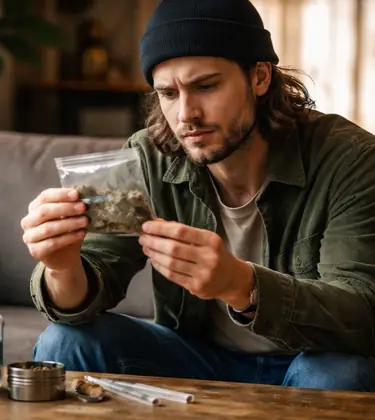
So you found an old bag. Maybe it was buried in a coat pocket since last winter, maybe it rolled under the couch cushions six months ago. You hold it up, squint at it, and ask the question every cannabis consumer eventually asks: can I still smoke this?
You can. The real question is what happens when you do. Because old cannabis doesn’t just sit there unchanged. The chemistry shifts, the experience changes, and in some cases, what grew on your flower while it was hiding in that drawer could actually cause problems. Here’s what to expect.
What Does Smoking Old Weed Actually Feel Like?
The first thing you’ll notice is the smoke itself. Dried-out flower burns fast and hot. It crackles, it chars unevenly, and it hits the back of your throat like sandpaper. Fresh cannabis burns slow and smooth because it still has moisture and intact terpenes moderating the combustion. Old weed has neither. Expect coughing, throat irritation, and a general harshness that makes the whole experience unpleasant before the high even kicks in.
Then there’s the taste, or lack of it. Terpenes are the aromatic compounds that give each strain its signature flavor and scent. They’re volatile by nature, meaning they evaporate at relatively low temperatures even inside a sealed container. Once they’re gone, your flower tastes like burnt cardboard. No citrus, no pine, no diesel, no funk. Just flat, acrid smoke.
And the high? It’ll be there, but different. Weaker, heavier, and sleepier than what you remember. People who smoke old cannabis consistently describe the effects as foggy, sluggish, and lacking the sharp onset or clean cerebral energy they expected. If the flower is old enough, you might barely feel anything at all.
Why Does Old Cannabis Produce a Different High?
The answer is cannabinol, or CBN. When THC is exposed to oxygen and light over time, it doesn’t vanish. It oxidizes into CBN, a related but far less potent cannabinoid. CBN was actually the first cannabinoid ever isolated from the cannabis plant, back in 1896, and for decades scientists assumed it was responsible for the plant’s psychoactive effects before THC was properly identified.
CBN binds to the same receptors in the brain as THC, but with significantly lower affinity. In practical terms, that means you need far more CBN to produce anything close to the same effect. And the effect itself is qualitatively different. Where THC tends to produce euphoria, mental stimulation, and a clear onset, CBN leans toward sedation, body heaviness, and a dull, drowsy feeling. That’s why old weed makes you feel tired rather than lifted.
But the shift isn’t just about THC and CBN. Terpenes play a critical role in shaping how a high feels. Limonene contributes to uplifting, energetic effects. Myrcene deepens relaxation. Pinene supports focus and alertness. When those terpenes evaporate from aging flower, the entourage effect collapses. You’re left with a stripped-down cannabinoid experience that lacks all the nuance the strain was bred to deliver.
This is exactly why genetics and post-harvest care matter so much. At Barney’s Farm, every strain we develop carries a specific terpene and cannabinoid blueprint. A cultivar like Mimosa EVO, bred for its bright citrus terpene profile, or Gorilla Z, loaded with resinous trichomes designed to lock in potency, will only deliver that intended experience while those compounds are intact. Time and poor handling strip those strains down to something generic. The genetics are still there. The magic isn’t.
What Happens If You Smoke Moldy Weed?
Old weed that’s just dry is one thing. Moldy weed is a completely different risk category.
If you’re a healthy person with a functioning immune system, a small exposure to moldy cannabis will probably cause coughing, nausea, maybe a headache. Unpleasant, sure, but unlikely to land you in a hospital. The bigger concern is for anyone with asthma, mold allergies, or a compromised immune system. For those people, inhaling fungal spores can trigger severe respiratory infections, chronic sinus inflammation, or allergic reactions that escalate fast.
The science on this is sobering. A 1983 study published in the Journal of Allergy and Clinical Immunology found fungi present in 13 out of 14 cannabis samples tested, including Aspergillus fumigatus, which passed directly through lit cannabis cigarettes and into the inhaled smoke. That means combustion doesn’t necessarily kill the threat. You can light moldy weed on fire and still inhale viable fungal material.
More recent research has widened the picture. A 2020 national study using U.S. insurance data from over 53,000 people found that cannabis users with susceptible health conditions were 3.5 times more likely to develop a fungal infection than non-users. The researchers specifically flagged Aspergillus as the most common fungal pathogen associated with cannabis-related infections.
Then there are mycotoxins. These are toxic chemical byproducts produced by mold, and they’re the part most people don’t think about. Mycotoxins are heat-resistant. Fire kills the mold itself, but those toxins transfer directly into the smoke and deposit in your respiratory tract. Certain Aspergillus species produce aflatoxins, which are classified as carcinogenic. Repeatedly inhaling them is a genuine long-term health risk, not just a bad afternoon.
Feeling lost on how to start? Try taking our quiz!
Start a QuizCan You Salvage Old Weed Instead of Smoking It?
If your old stash is mold-free but has lost its edge, don’t toss it. There are smarter ways to use it than grinding it into a harsh, flavorless joint.
Cook with it. Decarboxylating old flower and infusing it into butter or oil is one of the best ways to squeeze remaining value from degraded cannabis. When you eat cannabis, THC is metabolized by the liver into 11-hydroxy-THC, a compound that crosses the blood-brain barrier more efficiently than delta-9 THC. That means even weakened flower can still produce meaningful effects when eaten rather than smoked. The carrier fat also masks the stale flavor, which is a welcome bonus.
Sift it for kief. Run your old bud through a grinder with a kief catcher. The trichomes that remain will collect as a concentrated powder at the bottom. Sprinkle that kief on top of a bowl of fresh flower for a potency boost. The rest of the plant material can go in the bin.
Vaporize at lower temperatures. Vaping heats cannabis without combustion, which extracts cannabinoids more gently and avoids the brutal throat hit of burning dried-out flower. You won’t get a great flavor experience, but the delivery will be smoother and you’ll conserve more of whatever active compounds remain.
Make a topical. If the remaining cannabinoids aren’t potent enough to produce a high, they can still be useful in a cannabis-infused balm or salve. Infuse your old flower into coconut oil at low heat and use it as a topical. You won’t feel a psychoactive effect, but the cannabinoids may still offer localized benefits.
The unexamined day is a wasted opportunity. Reflect on what you did, what you learned, and how you can improve.
John Dewey
When Is Old Weed Actually Dangerous?
Dried-out cannabis that’s simply lost potency is not dangerous. Smoking it is a waste of good lung capacity, but it won’t make you sick. The danger shows up when mold enters the equation.
Mold can develop any time cannabis is exposed to excess moisture, warm temperatures, or trapped humidity. It grows inside the bud structure where it’s hard to spot, and by the time you see visible fuzz or discoloration on the surface, the contamination has already spread through the flower. You can’t cut off the bad parts and save the rest. Mold spores are microscopic. If it’s on one part of the bud, it’s everywhere.
The most important thing you can do is trust your nose. Moldy cannabis has a distinct musty, damp smell that’s nothing like the earthy, skunky, or floral aromas of fresh flower. If something smells off, it is off. Don’t rationalize it. Don’t try to salvage it. Throw it away and start fresh.
This is also why buying from reputable sources matters. Cannabis that’s been properly dried, cured, and stored from the start has a much longer window before any degradation becomes an issue. At Barney’s Farm, our 30+ years of breeding experience extends beyond genetics into understanding how flower behaves post-harvest. Dense, well-cured buds with intact trichome structures hold up longer than loosely packed, hastily dried flower. Quality at the source translates directly into quality in your jar weeks and months later.
The Bottom Line
Smoking old weed won’t kill you, but it’s a diminished experience across the board. The high is weaker, sleepier, and less defined. The smoke is harsher. The flavor is gone. If the cannabis is just old and dry, it’s safe to consume but underwhelming. Use it for edibles or kief instead of punishing your lungs with a harsh, low-reward session.
If mold is involved, walk away. The health risks, particularly for anyone with respiratory conditions or a weakened immune system, are real and well-documented. No stash is worth a lung infection.
Great cannabis is the product of great genetics, careful cultivation, and proper handling from seed to session. That’s been Barney’s Farm’s philosophy for over three decades and 40+ Cannabis Cup wins. Start with quality. Treat it right. And you’ll never have to wonder if what’s in your jar is still worth smoking.
Barney's Farm has been developing premium cannabis genetics since the 1980s, with over 40 Cannabis Cup wins. Explore our full cannabis seed catalog and find strains bred for every climate and skill level.