
How to Rehydrate Dry Weed Without Ruining It
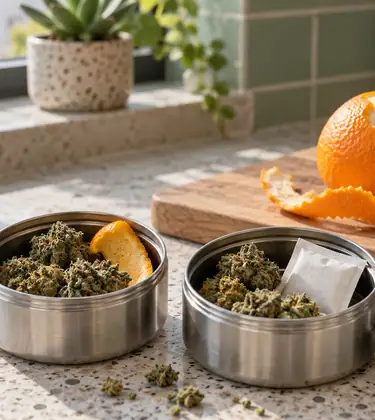
Buds that crumble to dust when you pinch them, a hit that scratches your throat, a stash that smells like hay: overdried weed is easy to spot.
You can put water back into a dry bud. You cannot put back the aroma that left with it, and the wrong trick can grow mold before it fixes anything.
Key takeaways
- California passes dried flower only if its water activity does not exceed 0.65, which matches 65% relative humidity.
- Overdried weed loses volatile terpenes, and rehydrating brings back water, not the aroma that evaporated.
- A two-way humidity pack in an airtight container is the safest way we know to rehydrate dry weed.
- Orange peel adds moisture and citrus oil, but citrus peels are prone to green and blue mold.
- Too much moisture invites mold, and Aspergillus infections strike mainly people with weak immune systems.
- In a one-year storage study, warmth at 25°C caused the largest changes, while whole buds at 4°C kept best.
Water activity and the 0.65 line
Whether your weed is too dry or too wet comes down to water activity, the measure labs use for moisture. Water activity is the equilibrium relative humidity expressed as a fraction, so a bud at 0.65 is in balance with air at 65% relative humidity.
California draws the line. A dried flower sample, pre-rolls included, passes only if the water activity does not exceed 0.65 Aw, and if a sample fails, its whole batch cannot be released for retail sale. Labs also report moisture content as a percentage.
Moisture and mold move together. In a 2023 study of high-THC cannabis, buds dried to a moisture content of 12% to 14%, or a water activity of 0.65 to 0.7, or lower, carried fewer yeast and mold colonies. Below that range, the problem flips, and weed too dry turns brittle and harsh.
Terpenes, trichomes and a harsh hit
Terpenes go first. They are volatile molecules whose levels can drop rapidly after harvest, and a 2024 storage study found sesquiterpenes less prone to degradation than monoterpenes, the lighter molecules behind many bright, fresh smells. In a 2020 study of fresh and air-dried buds, terpinolene was dramatically decreased upon drying in the high-THC type, which ended up with a higher share of sesquiterpenes, while the CBD-rich and intermediate types showed no detectable change.
Rehydrating puts water back into the bud, not the terpenes that evaporated, so the smell rarely returns to what it was. In our experience, bright, citrusy strains show the loss first. Amnesia Lemon, an Amnesia Haze and Lemon Skunk cross at 26% THC, is a good example, since its appeal is a lemony, spicy-sweet flavor.
Dry buds also shed resin. A 1976 storage study found that cannabinoid losses could be reduced by limiting damage to the resin glands, so handle dry buds gently. In our experience, overdried weed also burns fast and hot, much like a cigar kept too dry, which burns too quickly and hotly.
Feeling lost on how to start? Try taking our quiz!
Start a QuizRehydrating with a two-way humidity pack
The most reliable way to rehydrate dry weed is slow and sealed. A two-way humidity pack releases or absorbs moisture to hold the air in a closed container at a set relative humidity, the same idea as a cigar humidor. In our experience, this is how to rehydrate weed with the least risk:
- Put the buds in an airtight glass or metal container, filled no more than three-quarters full.
- Add a two-way humidity pack rated 58% or 62%, sized for the container.
- Seal it and keep it somewhere dark at room temperature.
- Open it once a day for a minute, smell the buds and check for fuzz or a musty note.
- Wait one to three days, or until small stems bend before they snap.
- Leave the pack in place to keep the moisture steady.
You can tell it worked by feel. In our experience, rehydrated buds are slightly springy, small stems bend before they snap, and the grind comes out fluffy instead of dusty. If the outside of the buds feels damp or sticky, open the container for an hour and let them breathe before you seal it again.
Skip heat and steam. In our experience, a steaming pot or a warm oven leaves buds damp on the outside and dry inside, and the heat drives off more of the aroma that is left.
The unexamined day is a wasted opportunity. Reflect on what you did, what you learned, and how you can improve.
John Dewey
Orange peel weed and other kitchen tricks
The orange peel weed trick is the classic quick fix: drop a strip of fresh peel in with the buds and take it out a few hours later. The peel also gives off citrus oil, since orange oil is produced by cells within the rind of an orange fruit and is more than 90% d-limonene.
The risk is mold. Green and blue mold are among the most economically impactful post-harvest diseases of citrus fruit, a 2022 review notes, and the spores of green mold are ubiquitous in the air. So how to moisten weed with kitchen scraps without growing mold? In our experience, the key is how long the scrap stays in:
| Method | Time in the container | Main risk | Our verdict |
|---|---|---|---|
| Two-way humidity pack | One to three days | Little, if the container seals well | Our first choice for any stash |
| Orange peel | A few hours, then remove it | Mold and a citrus taste | A quick fix for a gram or two |
| Lettuce leaf | A few hours, then remove it | Mold and a vegetable smell | A quick fix when there is no peel |
| Damp paper towel | A few hours, never touching the buds | Wet spots and mold | A last resort, checked every hour |
| Method | Two-way humidity pack | Orange peel | Lettuce leaf | Damp paper towel |
|---|---|---|---|---|
| Time in the container | One to three days | A few hours, then remove it | A few hours, then remove it | A few hours, never touching the buds |
| Main risk | Little, if the container seals well | Mold and a citrus taste | Mold and a vegetable smell | Wet spots and mold |
| Our verdict | Our first choice for any stash | A quick fix for a gram or two | A quick fix when there is no peel | A last resort, checked every hour |
Whatever you use, never leave fresh peel, leaves or paper in a sealed container overnight.
Storage that stops buds drying out
Prevention beats repair. In a 2020 one-year storage study, terpenoid levels fell rapidly under all storage conditions, a storage temperature of 25°C led to the largest changes, and freezing below minus 20°C and grinding were the worst for terpenoids. The authors concluded that storing whole buds at 4°C gave the optimal postharvest conditions for cannabis. At home, a fridge brings its own problem, condensation when a cold container meets warm air, so in our experience a cool, dark cupboard is the practical choice. The container matters too. A 2024 study found that storage in a glass bottle kept the aroma profile better than an open tray or a closed plastic box, though in glass some of the acid cannabinoids turned into their neutral forms.
Home growers set the moisture during the cure. In our experience, a slow dry and a few weeks of curing in sealed containers keep a strain like Blue Dream, a Blueberry and Super Silver Haze cross at 28% THC with sweet berry and pine notes, from crumbling months later. Check your state's home-grow rules first, since not every legal state allows it.
Mold and when to throw weed out
Rehydrating too far is worse than leaving buds dry, because moisture feeds mold. In the 2023 study, inadequate drying raised yeast and mold counts, and the main fungi included Penicillium and Aspergillus. Aspergillus is a common mold that people breathe in all the time, and it does not usually affect most people, but the infection it causes, aspergillosis, strikes those who are immunocompromised, such as transplant patients. California requires labs to confirm that four disease-causing Aspergillus species are not detected in 1 gram of inhalable cannabis products.
Throw buds out if you find:
- White, gray or green fuzz that does not glitter like trichomes
- Dark, soft or damp spots inside the bud
- A musty, mildewy smell
That smell is a strong sign that stored weed has gone bad, even when nothing is visible yet.
Dry weed, fixed slowly
Dry weed can be rescued, up to a point. Aim for a water activity at or below 0.65, use a two-way humidity pack in an airtight container and give it one to three days. Orange peel works as a quick fix if you remove it within hours, since citrus molds easily, and any fuzz or musty smell means the buds go in the trash. The water comes back, but the lost terpenes do not, so the best fix is storage that never lets buds dry out.
Barney's Farm has been developing premium cannabis genetics since the 1980s, with over 40 Cannabis Cup wins. Explore our full seed catalog and find strains bred for every climate and skill level.