Is Weed Legal in Oregon in 2026? Pioneer State Rules and Possession Limits
Oregon has been ahead of the curve on cannabis for over half a century. It was the first state in the country to decriminalize possession, back in 1973, when the rest of America was still busy locking people up over a joint. Four decades later, voters finished the job.
So yes, weed is legal in Oregon. But legal comes with a rulebook, and the rulebook has more edges than most people realize. Here is what actually applies in 2026, including a federal deadline landing this week that almost nobody is talking about.
Is weed legal in Oregon right now?
Yes. Adults 21 and over can legally buy, possess, use and grow cannabis in Oregon. Medical cannabis has been legal since 1998, making Oregon's program one of the oldest in the nation, and voters approved Measure 91 in November 2014 with 56.1 percent of the vote, legalizing adult use. Possession and home growing kicked in on July 1, 2015. Licensed retail sales started that October.
Measure 91 is now codified as ORS 475C, the Oregon Cannabis Code, and the Oregon Liquor and Cannabis Commission (OLCC) runs the commercial side. If you hear an Oregonian talk about "the OLCC," this is the agency that licenses every producer, processor and dispensary in the state.
One thing that trips people up: legalization is statewide, but retail is not. Cities and counties can vote to ban cannabis businesses inside their borders. Dozens have. Even in those places, personal possession and home growing stay legal. Only the storefronts disappear.
How much weed can you legally have in Oregon?
Oregon splits its possession limits between what you can carry in public and what you can keep at home, and the gap between the two is huge. According to the OLCC, adults 21 and over can possess two ounces of usable marijuana in a public place and eight ounces at home. That eight-ounce private stash is one of the most generous limits in any legal state.
The full personal possession picture:
Two ounces of usable flower in public.
Eight ounces of usable flower in your home.
Sixteen ounces of cannabinoid products in solid form, or cannabinoid concentrates.
Seventy-two ounces of cannabinoid products in liquid form.
One ounce of cannabinoid extract, and only if it came from a licensed retailer.
Four plants per household.
Purchase limits are a separate thing, and people mix the two up constantly. A retailer cannot sell you more than two ounces of flower, ten grams of concentrate, ten seeds or four immature plants in a single day. What you can buy in one visit and what you can legally hold are two different numbers.
Extracts deserve their own warning. That one-ounce cap only covers extract bought from a licensed shop. Anything you made yourself with butane or another solvent is not covered by personal possession law at all, and Oregon treats home extraction as manufacturing. This is the single easiest way for an otherwise law-abiding grower to end up in a courtroom.
What are the rules at a Portland dispensary?
Walk in with a valid government-issued photo ID showing you are 21 or over. That is the whole entry requirement. There is no residency test, so a visitor from Texas gets the same limits as someone who has lived in Sellwood their entire life.
Expect the price at the register to be higher than the price on the menu. Oregon has no general sales tax, but cannabis carries a 17 percent state excise tax, and the City of Portland stacks another 3 percent retail tax on top, so you are paying roughly 20 percent by the time you leave. Registered medical patients are exempt from the state tax, which is why a card still pays for itself if you buy in volume.
A few more things worth knowing before you go:
Bring cash. Federal banking rules keep plenty of shops card-averse, and the in-store ATM will charge you for the privilege.
Dispensaries cannot sit within 1,000 feet of a school, which is why some Portland neighborhoods have three on one block and others have none.
You cannot consume on site. Oregon has no consumption lounges. The parking lot is a public place, and so is the sidewalk.
Whatever you buy stays in Oregon. Crossing into Washington or California with it is a federal offense, and the Idaho border is a genuinely bad place to test that.
Feeling lost on how to start? Try taking our quiz!
Start a QuizCan you grow your own weed in Oregon?
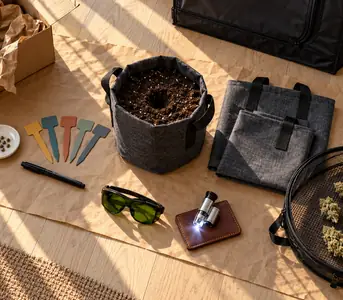
You can, and this is where Oregon quietly beats most legal states. Four plants per household, regardless of how many adults live there. Four adults under one roof does not get you sixteen plants. The limit belongs to the address, not the person.
The plants have to be out of public view. If your neighbor can see a cola from the sidewalk, you have a problem. Landlords can also ban growing outright, and plenty do, so read the lease before you germinate anything. Medical patients registered with the state get a bigger allowance and their own set of rules.
Now the part nobody in the legal guides will tell you, because they have never actually put a plant in the ground west of the Cascades.
Oregon's climate is a gift and a trap. Long summer days, real sun, cool nights that pull color into the leaves. Then October arrives, the rain sets in, and every fat indica cola still swelling in your backyard turns into a sponge. Botrytis does not care that your grow is legal. The Willamette Valley kills more outdoor harvests with humidity than law enforcement ever has.
Barney's Farm has been breeding since 1986, and Derry built the library by hauling landrace genetics back from Afghanistan and the Himalayas long before anyone was writing possession limits into statute. Four decades of that work, plus more than 40 Cannabis Cups, comes down to one thing that matters to an Oregon grower: a finish date you can actually trust. Stable genetics means the plant does what the packet says, every run, so you can plan a harvest around a weather window instead of praying.
Two that suit those four legal plants:
Gorilla Z is a GG4 crossed with the Original Z, 32 percent THC, indica-leaning, sweet fruit and chocolate on the nose. Outdoors she wraps up in the third or fourth week of September. That is the whole point. She is off the plant and drying before the autumn rain gets serious.
Purple Punch Auto runs on her own clock. Sixty-five to seventy days from seed to harvest, no light cycle to manage, 90 to 120 cm outdoors and 180 to 250 grams per plant. Small enough to stay behind a fence, fast enough to squeeze a run in and still be done early. Grape and berry, 22 percent THC, and the kind of end-of-day relaxation that made Purple Punch famous.
Four plants is not a farm. It is a season's supply if you pick genetics that match your latitude and your rainfall, and it is a wasted summer if you do not.
The unexamined day is a wasted opportunity. Reflect on what you did, what you learned, and how you can improve.
John Dewey
What is still illegal in Oregon?
Legalization is not a free pass. The rules people break most often:
Public consumption. Parks, sidewalks, streets, bus stops, hotel lobbies, apartment hallways. All public under Oregon law. Smoking in any of them is a violation with a fine attached.
Driving high. Cannabis DUII carries the same weight as alcohol. Nothing about Measure 91 changed that.
Sharing for money. Gifting up to your possession limit is legal. The moment cash, a cover charge, a donation or a raffle ticket enters the picture, the state calls it a sale, and unlicensed sales are a crime.
Federal land. National forests, BLM land, national parks. Oregon has an enormous amount of all three, and cannabis is prohibited on every acre.
Anyone under 21. No exceptions outside the medical program.
What changed in Oregon cannabis law in 2026?
The state's short legislative session wrapped in March and produced one law that actually matters to patients. House Bill 4142, known as Ryan's Law, expands the definition of a debilitating medical condition to cover hospice, palliative care and comprehensive symptom management. It also shields hospice programs and residential facilities from state criminal liability for handling medical cannabis on behalf of patients, and stops the Board of Nursing punishing nurses for discussing it. It was named after Ryan Bartell, a terminal cancer patient. It becomes operative in 2027.
The bigger story this month is federal. In April 2026, the Justice Department moved FDA-approved cannabis medicines and state-licensed medical cannabis into Schedule III of the Controlled Substances Act. Recreational cannabis was left behind in Schedule I, next to heroin. To settle that, the DEA opened a formal evidentiary hearing on 29 June, and the hearing is scheduled to conclude no later than 15 July 2026. Whatever comes out of that room feeds into the record an administrative law judge uses to make a recommendation.
None of this changes a single Oregon rule. Your two ounces are still two ounces. But it is the closest the federal government has come to admitting the obvious in fifty years, and Oregon, the state that started this whole argument in 1973, has been waiting a long time for the rest of the country to catch up.
The bottom line
Oregon is one of the easiest places in America to be a cannabis consumer. Two ounces on you, eight at home, four plants in the yard, dispensaries in every city that wants them and a tax bill that is mild by legal-state standards.
The trouble comes from the details: the extract rule, the public consumption line, the state border, the neighbor who can see over your fence. Learn those five things and you will never have a problem.
And if you are growing, remember that the law gives you four plants but the weather decides what you keep. Pick genetics that finish before the rain, and Oregon will do the rest.
Barney’s Farm has been developing premium cannabis genetics since 1986, with more than 40 Cannabis Cup wins. Explore our full cannabis seed catalog and find the genetics that fit how you actually medicate.