How to Store Cannabis Seeds Long-Term (And Why It Actually Matters)
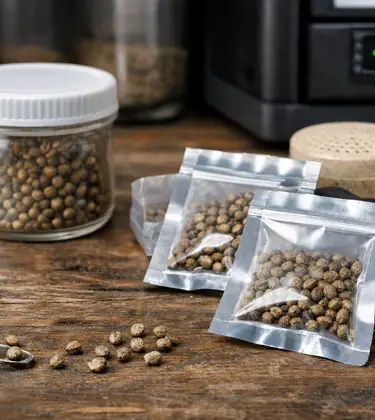
A single cannabis seed holds an entire genetic blueprint. A whole lineage of flavor, potency, and growth characteristics compressed into something smaller than a fingernail. Lose that seed to heat, moisture, or neglect, and that lineage is gone. Forever.
So whether you've got a handful of rare genetics stashed in a drawer or a full collection you've spent years building, knowing how to store cannabis seeds properly is the difference between preserving living potential and hoarding dead husks.
Do Cannabis Seeds Expire?
Technically, no. Seeds don't have a hard expiration date like milk or medication. What they have is a germination rate, and that rate drops over time depending on how you treat them.
Fresh seeds from a reputable breeder will typically germinate at 95% or higher. Leave those same seeds in a warm room for a couple of years and you might be looking at 50%. Store them in a sealed container in the fridge, though, and many growers report strong germination rates even after a decade.
At Barney's Farm, we've seen this firsthand across four decades of working with genetics collected from the Himalayas, Afghanistan, Southeast Asia, and beyond. Seeds that were carefully stored using controlled conditions have produced healthy, vigorous plants years after they were first harvested. The genetics don't degrade. The storage does.
Here's the real answer to "do cannabis seeds expire": they die when you let them. The embryo inside each seed is a living organism in a state of dormancy. It breathes. It metabolizes, slowly. And when the conditions around it shift too far from ideal, it burns through its nutrient reserves and dies before you ever put it in soil.
The Four Enemies of Seed Viability
Preserving marijuana seeds long-term comes down to controlling four variables. Get these right and your seeds can outlast you.
Moisture. This is the big one. Humidity above 30% can trigger germination processes even inside a sealed container. The seed starts to "wake up," consumes its stored energy, and then has nowhere to grow. That's a dead seed. For long-term seed storage, you want humidity between 11% and 18%. Go below 8% and you risk drying out the embryo completely, which also kills it.
Temperature. Cool and constant beats cold and fluctuating every time. A fridge set around 4°C (39°F) is the sweet spot for most home growers. The critical thing is stability. A seed stored consistently at 20°C will do better than one that bounces between 5°C and 25°C every time someone opens the fridge to grab a beer. If you're going to refrigerate your seeds, put them at the back of a shelf or in the crisper drawer where temperature stays steady.
Light. In nature, cannabis seeds drop to the ground and get covered by soil. They were never designed to sit under fluorescent lights or catch afternoon sun through a window. Light exposure can trick dormant seeds into attempting germination, and UV rays degrade the shell over time. Store them in the dark. Always.
Oxygen. Air accelerates cellular deterioration. Vacuum-sealed containers or nitrogen-flushed packaging dramatically slow this process. Every time you open a container to admire your collection, you're letting oxygen in. So plan ahead. If you have seeds you don't plan to use for a while, seal them up and leave them alone.
The Barney's Farm Approach to Seed Storage
Since the early 1980s, when our founder Derry first started collecting landrace genetics across Asia, seed preservation has been at the core of everything we do. Some of the parent genetics in our current breeding program trace back to seeds Derry gathered in remote mountain villages in Nepal and Afghanistan over 40 years ago. Those genetics survived because storage was never treated as an afterthought.
At our facility, seeds are stored in refrigerated, humidity-controlled conditions from the moment they're harvested. Every batch is tracked, tested, and monitored. When you buy a pack from Barney's Farm, those seeds have been kept in optimal conditions right up until they ship. That controlled chain matters, because even the best genetics are worthless if the seed arrives dead.
We've watched the industry long enough to know that storage is where a lot of growers lose their investment. Someone drops serious money on premium genetics, then leaves the pack in a desk drawer for two years. That drawer might be warm, might be damp, might be next to a window. By the time planting season rolls around, the germination rate has tanked.
Your seeds deserve better than that.
Feeling lost on how to start? Try taking our quiz!
Start a QuizHow to Store Cannabis Seeds at Home: A Step-by-Step Method
For seed storage long term at home, here's what works. No expensive equipment needed.
Start with a good container. Amber glass jars or opaque airtight containers are ideal. Clear plastic bags are a bad choice because they let light through and aren't truly airtight. If you're using ziplock bags, double-bag them, squeeze out all the air, and put them inside a second opaque container.
Add a desiccant. A small silica gel packet inside the container will help regulate humidity. Don't overdo it. One small packet per container is enough. Too much desiccant can pull moisture below safe levels and damage the seeds.
Put the container in the fridge. Not the freezer, not the counter, the fridge. Aim for 4-8°C. Wrap the container in a towel or bubble wrap if your fridge has frequent temperature swings from opening and closing.
Label everything. Strain name, breeder, date of purchase. You'll thank yourself later when you're staring at five identical containers wondering which one holds the Tangerine Dream and which has the Critical Kush.
Don't open them until you're ready to plant. Every time you crack the seal, you introduce fresh air and humidity. If you need to grab a few seeds from a larger batch, work quickly and reseal immediately.
Following this method, your seeds should remain viable for five years at minimum. Many growers report good results well beyond that.
The unexamined day is a wasted opportunity. Reflect on what you did, what you learned, and how you can improve.
John Dewey
The Science Behind Seed Longevity
The principles behind seed storage aren't unique to cannabis. They apply across the plant kingdom, and the research backing them up goes deep.
In 2005, Israeli researchers germinated a date palm seed that had been buried in rubble at King Herod's fortress at Masada for roughly 2,000 years. They named the plant Methuselah. The seed survived because the Dead Sea region provided exactly the conditions that preserve dormant seeds: extreme dryness, cool underground temperatures, and zero light. The team later germinated six more ancient seeds from the same region, and published their genomic findings in the journal PNAS, confirming that properly preserved seeds can retain genetic integrity across millennia.
The Svalbard Global Seed Vault in Norway operates on the same principles at industrial scale. Built 130 meters inside a mountain on a remote Arctic island, the vault stores over a million seed samples at -18°C. The permafrost keeps everything frozen even if the power goes out. And yes, cannabis is in there. Around 21,500 cannabis seeds from 17 countries are stored in the vault alongside wheat, rice, and thousands of other species.
A systematic review published in Frontiers in Plant Science examined decades of seed longevity research and found a consistent pattern: every reduction in temperature and moisture content extends seed life. The review highlighted historical experiments where properly stored seeds survived over 100 years. The fundamental biology is straightforward. Lower temperatures slow metabolic activity. Lower moisture prevents cellular damage. Remove light and oxygen, and you've essentially hit pause on the aging process.
What About Freezing?
The freezer question comes up constantly. Some growers swear by it. Others warn against it. The truth sits somewhere in the middle.
Freezing can work for very long-term storage (think 10+ years), but it carries risks. The embryonic tissue inside a seed is delicate. If there's too much moisture in the seed when it freezes, ice crystals form and shatter those tissues from the inside. That's why professional seed banks dry their seeds to precise moisture levels before freezing.
For most home growers, the fridge is the safer bet. You get 90% of the preservation benefit with almost none of the risk. If you do choose to freeze, make sure the seeds are fully dried, vacuum-sealed, and stored in a stable freezer that doesn't cycle through defrost modes.
Kenneth Morrow, a veteran cannabis breeder with over 40 years in the industry, wrote in Cannabis Business Times about his personal seed collection, some of which is 15 to 20 years old. His seeds were stored in sealed containers in a cool, dry location. Not frozen, not refrigerated with fancy equipment. Friends of his have germinated seeds that were 30+ years old using similar methods. No guarantees, but proper storage stacks the odds hard in your favor.
Reviving Old Seeds
Found a forgotten stash at the back of a closet? All is not necessarily lost. Old seeds can be stubborn, but there are ways to coax them back to life.
Soaking seeds in plain water for 12 to 24 hours can help rehydrate a dried-out shell. Some growers add a small amount of hydrogen peroxide to the soak water, which softens the shell and helps kill any surface mold. After soaking, the classic wet paper towel method works well. Place seeds between damp paper towels on a plate, cover them, and keep them warm and dark. Be patient. Old seeds can take a week or more to crack open, compared to 48 to 72 hours for fresh ones.
Gibberellic acid (GA3), a naturally occurring plant hormone, has shown promise for improving germination rates in aged seeds. Morrow notes that GA3 exposure has been documented to boost germination by 14% to 27% in certain studies, though cannabis-specific dosing is still being refined.
The main thing to remember: if a seed sinks in water, there's a good chance the embryo is still intact. Floaters are often hollow or dead. But the only real test is to plant it and see what happens.
Protecting Your Investment
Building a seed collection is an investment of time, money, and genuine passion. Some of those genetics might not be available again. Strains get discontinued, breeders retire, mother plants die. The seeds you have might be the last link to a specific lineage.
Store them like they matter, because they do.
Keep your storage environment consistent. Check your desiccants every six months. Rotate your stock by planting older seeds first. And when you find a strain you love, buy extras and store them properly so you can grow it again five or ten years from now.
Barney's Farm has been developing premium cannabis genetics since the 1980s, with over 40 Cannabis Cup wins. Explore our full seed catalog and find strains bred for every climate and skill level.